
Crypto Portfolio Allocation Basics
Spread crypto investments across blue-chip coins, altcoins and stablecoins with conservative, balanced or growth models, plus rebalancing and risk tips.
Crypto portfolio allocation is about spreading your investments across different digital assets like Bitcoin, Ethereum, altcoins, and stablecoins to balance risk and improve potential returns. Here's what you need to know:
- Why It Matters: The crypto market is highly volatile, with prices often swinging by 30% or more in a single day. Proper allocation helps manage risks and prevents emotional decision-making.
- Core Principles:
- Diversify by Market Cap: Allocate funds across large-cap (e.g., Bitcoin, Ethereum), mid-cap (e.g., Solana, Cardano), and small-cap coins for a mix of stability and growth.
- Diversify by Function: Spread investments across categories like store-of-value assets (e.g., Bitcoin), smart contract platforms (e.g., Ethereum), stablecoins, and DeFi tokens.
- Limit Exposure: Keep individual positions to 5-10% of your total portfolio to minimize losses from any single asset.
- Portfolio Models:
- Conservative: 2-5% of your total investments in crypto, focusing on Bitcoin, Ethereum, and stablecoins.
- Balanced: 7-15%, combining Bitcoin, Ethereum, and a small share of large-cap altcoins.
- Growth: 15-25%, adding emerging altcoins and DeFi tokens for higher risk and potential rewards.
Key Tips:
- Regularly rebalance your portfolio to maintain target allocations.
- Use stablecoins as a buffer during market downturns.
- Platforms like Kryptonim simplify fiat-to-crypto transactions and help manage your portfolio securely.
Crypto investing requires discipline and risk management. Start small, diversify wisely, and align your strategy with your financial goals and risk tolerance.
Core Principles of Crypto Portfolio Allocation
Diversifying by Market Capitalization
Market capitalization is a key way to sort cryptocurrencies by size and stability. Large-cap assets like Bitcoin and Ethereum provide a solid foundation for your portfolio, offering both stability and liquidity. For example, Bitcoin's market cap once reached a staggering $1.3 trillion, showcasing the scale of well-established cryptocurrencies.
Mid-cap cryptocurrencies - valued between $1 billion and $20 billion - strike a balance between growth potential and reliability. Projects such as Cardano, Solana, and Chainlink fall into this range. They offer more room for growth compared to large-caps but come with less risk than newer, untested tokens. On the other hand, small-cap assets present opportunities for high returns but come with significant risks. These smaller projects can deliver impressive gains but are more vulnerable to issues like low liquidity, protocol failures, or even scams.
A common strategy is the 80/20 rule: allocate 80% of your portfolio to large-cap assets for stability and 20% to smaller-cap tokens for growth. This approach balances risk and reward, ensuring a single asset's failure won't derail your entire portfolio. Alternatively, the core-satellite strategy offers another structured method: invest 60–80% in "core" blue-chip cryptocurrencies and 20–40% in "satellite" speculative assets.
Beyond market cap, categorizing assets by their function can further refine your investment strategy.
Allocating by Cryptocurrency Categories
Once you've diversified by market cap, the next step is to allocate your portfolio across different functional categories. Each category plays a unique role in the crypto ecosystem, helping you spread risk while capturing growth opportunities.
Store of value assets like Bitcoin are often compared to digital gold due to their capped supply of 21 million coins. These assets are ideal for preserving wealth over the long term. As Gemini explains:
"Bitcoin, often called 'digital gold,' remains the most widely recognized cryptocurrency."
Smart contract platforms such as Ethereum, Solana, and Cardano serve as the backbone for decentralized applications (dApps), forming the infrastructure for Web3. Stablecoins like USDC, USDT, and DAI act as a buffer during volatile periods, pegged to the U.S. dollar to provide stability and liquidity for new opportunities. DeFi tokens - like Uniswap, Aave, and Chainlink - offer governance and utility within decentralized finance ecosystems, while Layer-2 solutions like Polygon enhance network efficiency and reduce transaction costs.
To avoid overexposure, a good rule of thumb is to limit any single position to 5–10% of your total portfolio. With over 21,000 cryptocurrencies available, the choices can feel overwhelming. However, focusing on these core categories allows you to build a portfolio that balances growth potential with risk management.
sbb-itb-0796ce6
Portfolio Models for Beginners

Crypto Portfolio Allocation Models: Conservative, Balanced, and Growth Strategies
Once you’ve got a handle on diversification basics, the next step is to structure your crypto portfolio in a way that matches your risk tolerance and financial goals. Think of these portfolio models as blueprints, each catering to a different type of investor.
Conservative Portfolio Model
If your main priority is preserving your money rather than chasing high returns, a conservative portfolio is the way to go. This model leans heavily on Bitcoin and Ethereum, the two most established cryptocurrencies. As Collective Shift points out:
"Cryptocurrencies are among the riskiest assets you can invest in. Therefore, for most newcomers, it probably makes sense to start by owning the least riskiest member of this highly risky asset class, BTC."
For your entire investment portfolio, only allocate 2% to 5% to cryptocurrency. Within that small crypto slice, you might divide it like this: 60% in Bitcoin, 30% in Ethereum, and 10% in stablecoins (e.g., USDC or USDT). This setup gives you exposure to crypto’s potential growth while keeping risk in check. For example, the Bitwise 10 Crypto Index, as of September 16, 2024, allocated 73.1% to Bitcoin and 18.1% to Ethereum, showing that even institutional investors lean heavily on these two assets.
Balanced Portfolio Model
If you’re looking for a mix of stability and growth, the balanced model might suit you better. Here, you’d allocate 7% to 15% of your total portfolio to cryptocurrency. The breakdown could look like this: 60% Bitcoin, 30% Ethereum, and 10% in top-100 altcoins like Solana, Chainlink, or Uniswap.
This approach follows the 80/20 rule, where 80% of your crypto allocation is in stable, blue-chip assets (Bitcoin and Ethereum), while 20% is in altcoins with higher growth potential. Historical data backs this up - portfolios with a 4% to 7.5% crypto allocation achieved annualized returns between 16.2% and 20.3% from January 2017 to August 2025.
To keep your portfolio on track, quarterly rebalancing is key. If any asset’s weight shifts by more than 5% from your target, sell some of the overperformers and buy the underperformers. This disciplined approach ensures you’re systematically "buying low and selling high."
Growth Portfolio Model
If you’re willing to take on higher risk for the chance of greater rewards, the growth model might be your style. This model is often favored by younger investors who can allocate 15% to 25% of their total portfolio to crypto. Beyond Bitcoin and Ethereum, this model includes smaller, emerging tokens, DeFi projects, and assets outside the top 100.
Be prepared for extreme swings - Bitcoin itself has experienced 12-month drawdowns of up to 70%, and smaller altcoins can be even more volatile. To protect your investment, consider the "50% Sell Rule": when a position doubles in value, sell half to secure your original capital. Tess Nakaishi from Long Angle explains:
"The '50% Sell Rule': Taking profits on 50% of holdings when positions double, preserving initial capital."
To manage risk, limit any single altcoin to 2% of your total portfolio. Using dollar-cost averaging (DCA) - investing a fixed amount regularly - can also help reduce the impact of market fluctuations.
| Portfolio Model | Total Portfolio Allocation | Primary Assets | Risk Profile |
|---|---|---|---|
| Conservative | 2% - 5% | Bitcoin, Ethereum, Stablecoins | Low (within crypto context) |
| Balanced | 7% - 15% | 60% BTC, 30% ETH, 10% Large-cap Altcoins | Medium |
| Growth | 15% - 25% | BTC, ETH, Emerging Altcoins, DeFi Tokens | High |
Cryptocurrency is inherently volatile, with an annualized volatility of around 55% - about four times higher than the S&P 500 Index. Even adding a modest 6% crypto allocation to a growth-oriented portfolio can nearly double its overall volatility. Each model is designed for a specific type of investor, so choose the one that aligns with your risk tolerance and financial goals.
Managing and Optimizing Your Portfolio
Determining Risk Tolerance and Investment Goals
Before making adjustments to your portfolio, it's important to evaluate your risk tolerance. With crypto's infamous volatility, knowing how much risk you can handle is essential. Risk tolerance is about two things: how much you can afford to lose financially and how well you can emotionally manage significant losses without making impulsive decisions. As CoinShares puts it:
"Risk tolerance reflects both financial capacity and psychological composure required to endure portfolio fluctuations without resorting to short-term, reactive decisions."
Think about how much of a loss would push you to act and whether that money is earmarked for any immediate needs. A good exercise is to imagine your portfolio dropping by 50% overnight - would you hold steady or start selling? Since Bitcoin has seen dips as severe as 93%, if that kind of volatility feels overwhelming, you might want to cap your crypto allocation at 1% to 5% of your overall investments as a precaution.
Next, get clear on why you're investing in crypto. Are you using it as a hedge against inflation, aiming for capital growth, or looking to diversify away from traditional assets? Your goals and timeframe matter, too. Short-term plans (0–6 months) might focus on quick momentum plays, while mid-term goals (1–5 years) could align with broader market cycles like Bitcoin halvings. Long-term objectives (5+ years) might aim for building generational wealth or holding crypto as a store of value. For these long-term goals, you might measure success by the amount of crypto you accumulate - like "owning 0.1 BTC" - rather than its dollar value.
Once you've nailed down your risk tolerance and investment goals, the next step is keeping your portfolio balanced.
Rebalancing Your Portfolio Over Time
With your risk and goals mapped out, rebalancing helps you stay on track as market conditions shift. Assets in your portfolio grow at different rates, so regular adjustments are essential. One effective approach is the Hybrid Method, combining quarterly reviews with a drift threshold of around ±8–10%. For example, if Bitcoin's share in your portfolio grows from your target of 60% to 70%, you could trim that position and reallocate to underweighted assets. This method enforces the classic "buy low, sell high" strategy, which can smooth out returns over the long term.
Rebalancing can be done in two ways: a full reset, where you sell all overweight assets and buy underweight ones, or a partial adjustment that focuses only on the biggest imbalances. To keep things aligned with your goals, consider annual evaluations or trigger-based updates, such as when a specific price milestone is hit.
When it's time to make these changes, having a reliable platform to execute your trades is key.
Using Kryptonim for Secure Fiat-to-Crypto Purchases
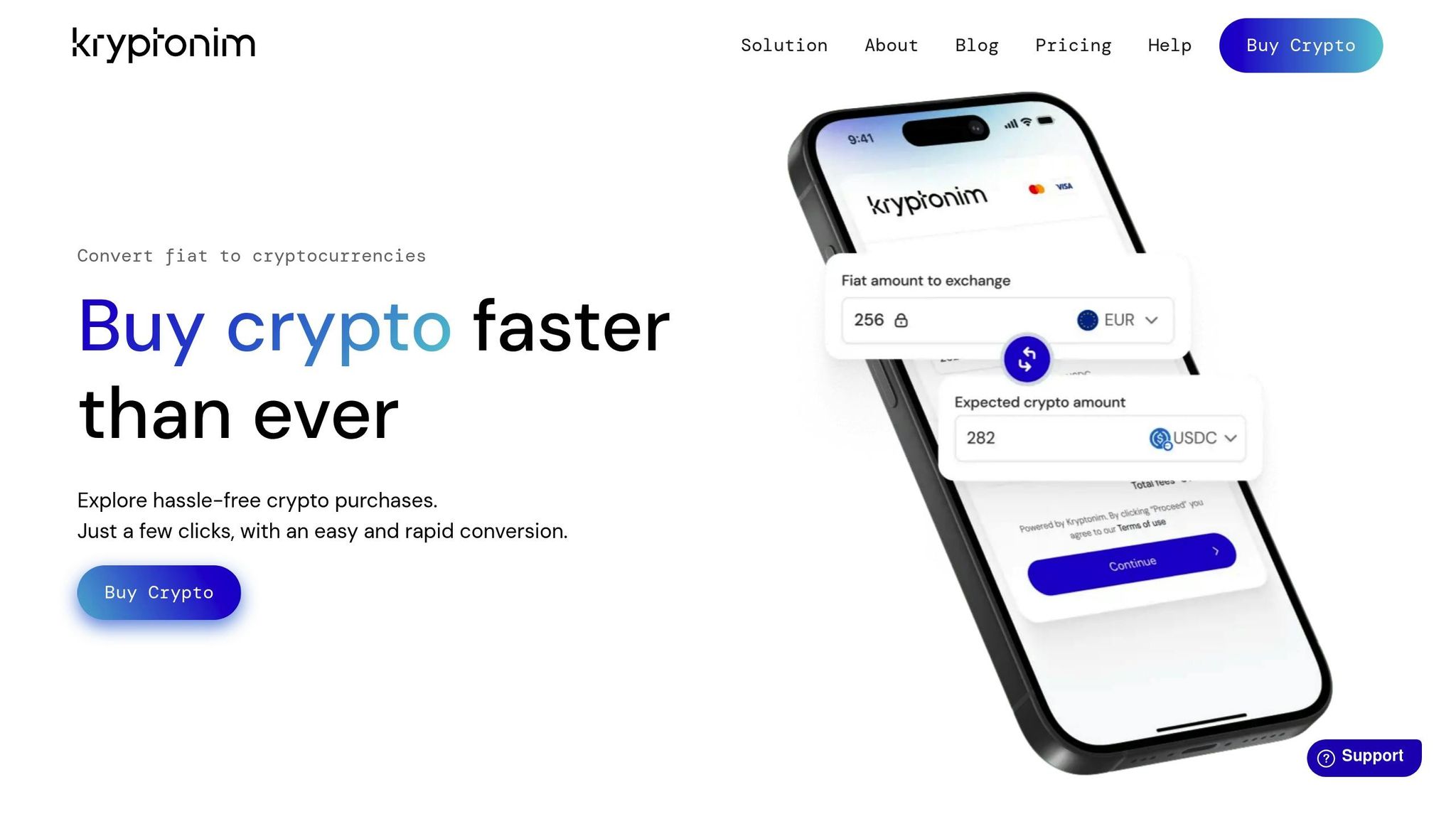
Whether you're adding funds or rebalancing, a secure and user-friendly platform can make all the difference. Kryptonim, an EU-regulated non-custodial exchange, simplifies fiat-to-crypto transactions with options like card payments and local methods. According to Kryptonim:
"Kryptonim functions as a non-custodial hybrid exchange, combining the best of centralized convenience with decentralized control."
Kryptonim stands out with zero withdrawal fees for most cryptocurrencies and competitive rates, helping you protect your portfolio's value. It supports multiple blockchains, making it easier to diversify your holdings from one platform. For beginners, there's even a "no KYC" option for low-volume users, allowing fast and hassle-free trading. Features like instant swaps and an integrated education hub not only help you maintain your portfolio allocations but also deepen your understanding of market trends. Kryptonim streamlines the process of managing portfolio adjustments while ensuring your transactions remain secure and efficient.
Building a Strong Crypto Portfolio
Creating a strong crypto portfolio comes down to three key principles: smart diversification, disciplined risk management, and using effective tools to implement your strategy. Start by anchoring your portfolio with established assets like Bitcoin and Ethereum. These market leaders offer greater stability and liquidity, making them a reliable foundation for your investments.
Next, diversify across market capitalizations. Large-cap assets provide lower volatility, mid-caps offer growth potential, and small-caps present higher-risk, high-reward opportunities. But don’t stop there - spread your investments across different sectors and use cases. For instance, consider DeFi protocols like Aave and Uniswap, smart contract platforms such as Solana and Cardano, and infrastructure tokens, each serving unique roles within the crypto ecosystem.
It’s also wise to keep part of your portfolio in stablecoins like USDC or USDT. These can act as a buffer during market fluctuations and provide liquidity when new opportunities arise. Experts suggest holding between 10 and 30 distinct assets to balance diversification without making your portfolio overly complex.
When it comes to allocation, moderate-to-aggressive portfolios often allocate 2% to 4% to individual assets, while high-conviction strategies might push this to 7.5%. As Caleb & Brown advises:
"There's one golden investment rule across both crypto and the traditional stock market - never invest more than you can afford to lose".
A practical way to test your portfolio’s balance is the “sleep test.” If your investments are keeping you up at night, it’s a sign that your portfolio may need rebalancing. Historical data backs up the value of disciplined allocation. For example, portfolios with a 4% to 7.5% Bitcoin allocation delivered annualized returns of 16.2% to 20.3% from 2017 to mid-2025.
To manage your portfolio efficiently, using secure platforms like Kryptonim can make a big difference. Kryptonim, an EU-regulated platform, offers competitive rates - 2% per transaction for EU users and 4% for others - and simplifies fiat-to-crypto purchases without the need for account creation. Whether you’re building your portfolio from scratch or fine-tuning it, having access to transparent pricing and local payment options can make portfolio management smoother and more effective.
FAQs
How do I pick a crypto allocation that matches my risk tolerance?
When deciding how much to allocate to crypto, it’s important to assess two key factors: your emotional tolerance for market volatility and your financial ability to withstand potential losses. Crypto markets are notoriously unpredictable, so understanding your comfort level with risk is crucial.
Diversification can play a big role in managing that risk. If you lean toward a more cautious approach, you might allocate a smaller portion to crypto and focus more on stable, less volatile assets. On the flip side, if you’re willing to take on higher risk, you could allocate a larger share to crypto - but keep in mind that this comes with the possibility of dramatic price swings.
How often should I rebalance my crypto portfolio?
The best rebalancing frequency hinges on factors like your investment strategy, risk tolerance, and how the market is behaving. Some investors stick to an annual or semi-annual schedule, which helps them keep their portfolio aligned with their goals while keeping trading costs manageable. Others might opt for quarterly or even more frequent rebalancing to respond to market shifts. The key is to pick a schedule that fits your objectives and the level of volatility in your portfolio, without falling into the trap of overtrading unnecessarily.
How many coins should a beginner hold to stay diversified?
For those just starting out, managing 3 to 5 coins is a practical way to begin diversifying. Start with major assets such as Bitcoin (BTC) and Ethereum (ETH), then add 1 to 3 others from categories like DeFi or stablecoins. This approach keeps your risk lower while remaining easy to handle. As you become more familiar with the market, you can gradually add more assets, but keeping it simple at first allows you to focus and build your knowledge.