
Web3 Game Economies: Smart Contract Examples
Compare reward pools, marketplaces, treasuries, and rentals — how value, permissions, off-chain reliance, and exit risk differ.

If you can’t explain who controls the contract, where the money goes, what data it depends on, and how you exit, don’t use it.
I’d boil this topic down to four contract models:
- Reward pools pay players after results are confirmed
- Item marketplaces swap game assets for payment
- Guild treasuries hold and spend group funds
- Rental contracts give time-limited use without full ownership
The article’s main point is simple: Web3 game assets may sit in your wallet, but the game rules, access rights, fees, and admin powers still shape what those assets are worth and how they work. A player might earn 250 tokens, buy a $100 NFT item, join a 3-of-5 guild wallet, or rent gear for 14 days - but each action comes with a different control setup and a different failure point.
Before I interact with any game contract, I’d check:
- Contract address: Is it the official one?
- Approvals: Can it move one asset, or my whole inventory?
- Admin power: Can someone pause, upgrade, mint, burn, or freeze?
- Off-chain reliance: Does the system depend on server data, an oracle, or staff approval?
- Exit terms: Can I sell, claim, withdraw, or let access expire cleanly?
- Total cost: Gas, marketplace fees, royalties, and token price swings
Quick Comparison
| Model | What I get | What moves on-chain | Main control point | Main risk |
|---|---|---|---|---|
| Reward pool | Payout | Tokens or NFTs | Admin/distributor + claim rules | Bad result data or bad payout logic |
| Item marketplace | Item ownership | Payment + asset transfer | Listing rules + approvals | Approval abuse, bad pricing, low liquidity |
| Guild treasury | Shared fund access | Group capital | Multisig or governance | Key compromise, collusion, poor spending |
| Rental system | Temporary use | Payment + time-based access record | Owner terms + game enforcement | Game ignores rental status or access timing issues |
What matters most is not just the code. It’s the mix of value flow, permissions, server reliance, and user rights. That’s the lens I’d use to read the rest of the article.
sbb-itb-0796ce6
1. Reward Pool Contracts
Reward pools are the clearest example of automated payouts in Web3 games. The basic setup is simple: a contract holds rewards like tokens, stablecoins, or NFTs, and players claim what they’re owed once eligible results are verified.
Value flow
Say a pool is funded with 10,000 tokens. If a player’s leaderboard share is 5%, the payout comes to 300 tokens. After the claim goes through, the contract marks that wallet as paid, which stops the same reward from being claimed twice.
Control model
These contracts usually split control across a few roles:
- Funder
- Reward approver
- Pause role
- Admin
Major changes often go through a timelock or multisig, which adds a layer of review before anything big happens.
Automation requirements
For the contract to work, it needs a few core inputs: the reward token, season ID, eligible wallets, payout amounts, and a deadline. In most cases, it also depends on either signed server data or a Merkle claim list. With a Merkle claim, a player submits cryptographic proof that their address and amount are part of an approved distribution.
That’s the key point: the hard part isn’t just sending the payout. It’s proving that the payout is correct in the first place.
Primary risks
Even a secure payout contract can still lean on weak off-chain verification. That’s where things can go sideways. It’s also safer to use individual claims instead of batch payouts, because one failed transfer can block the whole batch.
Unlike reward pools, item marketplaces move value through direct trade rather than scheduled payouts.
2. Item Marketplace Contracts
Where reward pools hand out value, marketplaces move it through direct trades. Item marketplace contracts let players buy and sell game assets on-chain without the game operator stepping in to settle each deal by hand. In a single transaction, the contract checks ownership, confirms the listing hasn't expired, collects payment, transfers the item, and sends the proceeds to the right parties.
Value flow
On a $100 sale, a contract might send $95 to the seller, $3 to the marketplace, and $2 to the creator as a royalty - assuming the marketplace honors that royalty. EIP-2981 sets a standard way to look up royalty details, but it does not require every marketplace or peer-to-peer trade to pay them. So creator fees are better viewed as a marketplace rule, not a locked-in share.
Control model
Most marketplaces run on open trading with automatic rules. The contract handles price checks, expiration, payment token rules, and ownership checks on its own. Admin powers, like changing fees or pausing trading, should sit behind clear owner or role permissions, be documented in public, and ideally use a multisignature wallet.
Before you interact with a marketplace contract, check what powers it has. Some contracts only handle settlement. Others can also mint, burn, or freeze game items. That's a whole different level of control. In practice, access rules matter just as much as price rules. This setup fits liquid item trading, not payout distribution.
Automation requirements
The contract can handle ownership checks, price enforcement, fee calculations, and asset transfers by itself. What it can't do is verify facts that live off-chain, like whether an item still matters after a game update or whether centralized media tied to the item is still what it claims to be.
If pricing depends on outside data, the system needs a trusted game server or an oracle. And that data source should have freshness checks and sanity bounds. Otherwise, manipulated prices can slip through.
Primary risks
Open code doesn't remove economic risk. An item can lose its gameplay use after a patch, attract almost no buyers, or be listed in a token that swings hard in price.
On the contract side, the main risks are reentrancy attacks, where a contract is called again before the first call finishes, reused signatures, and overbroad token approvals. ERC-1155 uses an operator approval that applies to every item in the contract, not just one. That's handy, but it also means a compromised marketplace could reach your full inventory, not only the item you meant to sell.
A practical example: an ERC-1155 marketplace listing 10 healing potions at $2 each. A buyer purchases 3 for $6. The contract checks the listing, transfers 3 potions, reduces the remaining quantity to 7, and records the fee and royalty allocations. If the listing has expired or the seller's balance has dropped below 3 units, the purchase fails entirely.
3. Guild Treasury Contracts
Guild treasury contracts manage shared on-chain capital for a group. Put simply, a guild treasury is a shared on-chain wallet with spending rules enforced by code.
Value flow
Money can come in from several places: game rewards, NFT sales, membership contributions, grants, and sponsorships. It can go out just as fast through player scholarships, tournament prizes, asset purchases, and operating expenses.
Some guilds also set aside budgets for subguilds. Others move idle tokens into assets that are easier to trade when cash flow matters.
Control model
When money belongs to a group, the rules around control matter just as much as the balance itself. The most common setup is a multisignature (multisig) wallet. That means a transaction goes through only after a set number of signers approve it, such as 3-of-5.
More mature guilds often add extra layers on top of that, including:
- Role-based permissions for founders, managers, and signers
- Spending caps for routine payments
- Timelocks so members can review large proposals before they go through
That setup helps keep day-to-day payments moving without giving any one person too much power.
Automation requirements
A treasury contract can automate payouts and allocations, but it still needs trusted off-chain input for quest results. If a payout depends on whether a player finished a quest, the system needs a trusted data source, an oracle, or an authorized operator to confirm the result.
Primary risks
Multisig lowers single-key risk, but it doesn't make the treasury safe by default. Colluding signers, phishing attacks, or compromised devices can still empty the wallet.
Market risk is another problem. Token and NFT prices can drop hard, which cuts treasury value even if the balances don't change. Liquidity matters too: thinly traded assets may be difficult to sell without taking a steep discount.
And there’s a simple truth here: on-chain transparency can show where funds went, but it can’t show whether the spending choice was smart.
Guild treasuries manage shared capital; rental contracts manage temporary access.
4. Rental and Temporary Access Contracts
Unlike a marketplace sale, a rental pays for temporary use, not ownership. These contracts let a player use an in-game NFT for a set time without taking full control of it. One common setup uses ERC-4907, which adds a separate user address and an expires timestamp to ERC-721. The owner still holds the NFT and keeps transfer rights. The renter gets access for a limited window.
Value flow
A rental charges for time, not title. The owner lists an NFT, the renter pays a fee, and the contract sends that payment based on preset rules. For example, a $5.00 rental might send $4.50 to the asset owner and $0.50 to the protocol treasury. The contract defines the payment token, price, duration, and fee in advance.
Control model
The contract can record who has access, but the game still has to respect that record. ERC-4907 splits ownership, usage, and admin permissions: the owner keeps the NFT and sets the rental terms, while the game must check userOf and userExpires to enforce who can actually play. Once the expiration timestamp passes, the usage role ends without a second transaction to revoke it.
There’s a catch here. The standard does not define payments, collateral, or dispute handling on its own. Those parts need an extra marketplace or escrow layer.
Automation requirements
Expiration can end on its own during the next contract call, so there’s no need for a separate revocation transaction. But things get trickier when a system also needs to settle rewards, return collateral, or ping a game server on schedule. In those cases, an approved automation service may need to trigger those actions.
That means access control matters. Developers should lock down automation callbacks so only the approved account can call them.
Primary risks
The weakest point usually isn’t the contract code. It’s the connection between the contract and the game.
The biggest risk many beginners miss is integration failure. ERC-4907 can record a user on-chain, but it can’t force an external game server to honor that role. A game might ignore the renter completely, or keep giving access after the rental has expired.
There’s also a double-booking problem. If a platform doesn’t block a second lease while the first one is still active, the same NFT could be promised to two renters at once.
And there’s a plain business risk too: a renter can pay for an asset that stops being useful if the game changes its rules or the integration goes down. Clean on-chain logic doesn’t protect against that kind of failure.
How the Four Models Differ in Practice
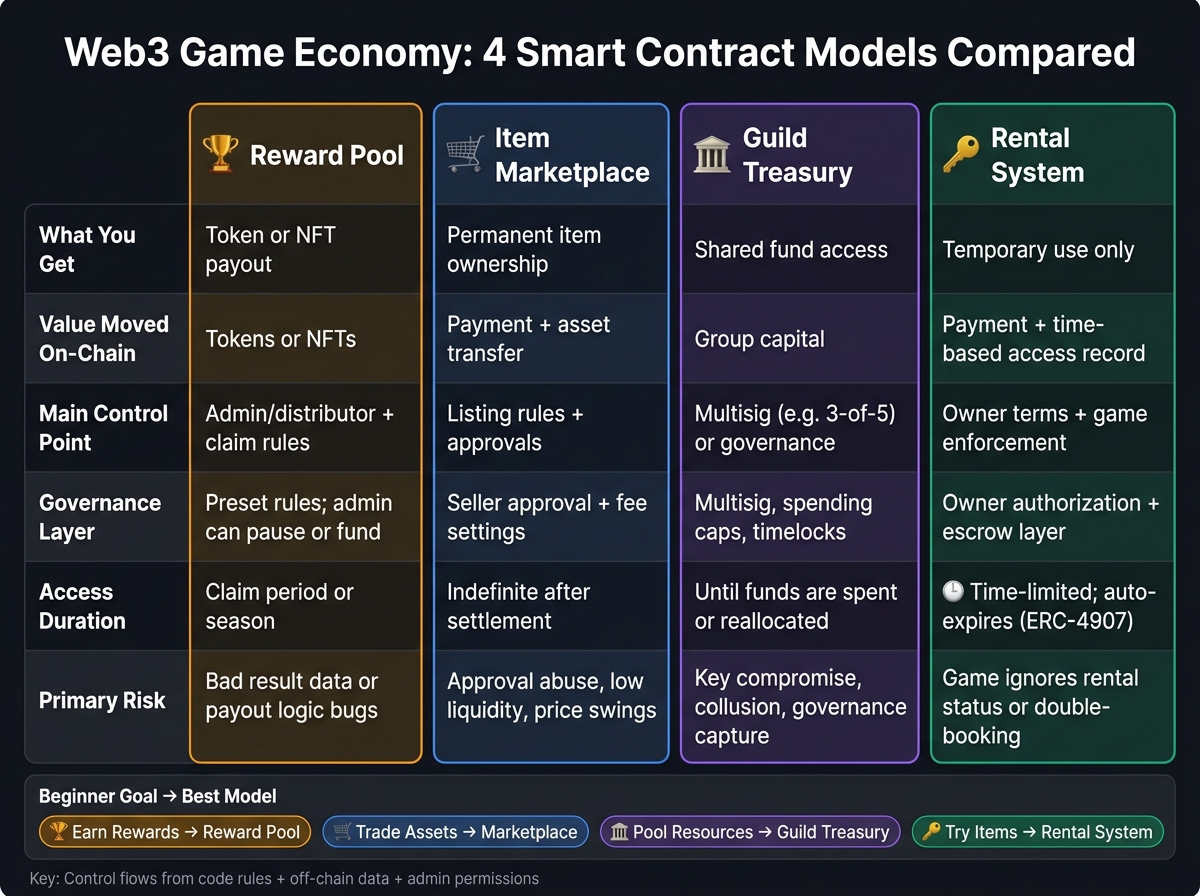
Web3 Game Contract Models: Reward Pools vs Marketplaces vs Treasuries vs Rentals
Each model moves value in its own way.
A reward pool pays players who meet set conditions. A marketplace moves an asset from a seller to a buyer. A guild treasury groups capital and sends it out through approved decisions. A rental system charges for short-term access while the owner keeps the asset. So the person on the receiving end gets one of four things: a payout, an item, access to shared funds, or temporary use.
This side-by-side view helps show how the same economy problem shifts depending on what the contract is doing: paying, trading, governing, or renting.
| Decision point | Reward pool | Item marketplace | Guild treasury | Rental system |
|---|---|---|---|---|
| Reward conditions | Player meets rules such as winning, completing a quest, or reaching a score; may depend on game inputs or an authorized distributor | No performance required; value changes hands when a buyer accepts a listing | Allocation depends on a proposal, signer approval, or governance vote | Renter pays or satisfies lease terms to receive temporary use |
| Settlement logic | Contract calculates and releases a payout in tokens or NFTs; claims may require a server or oracle to confirm eligibility | Contract transfers payment and asset atomically, deducting fees or royalties | Contract transfers pooled assets after authorization by signers or governance | Owner assigns a user and expiration; the game must enforce usage until the timestamp ends |
| Governance controls | Preset rules; admin roles may fund pools, pause claims, or submit results | Seller approval, listing cancellation, fee settings, and possible admin controls | Multisig signers, proposal thresholds, quorum, spending limits, and emergency controls | Owner authorization, rental terms, and any marketplace or escrow administrator |
| Access duration | Tied to a claim period, season, or ongoing eligibility rule | Ownership continues indefinitely after settlement unless the asset has restrictions | Treasury exposure lasts until funds are spent, withdrawn, or reallocated | Explicitly time-limited; ERC-4907 ends the user role automatically |
| Primary failure points | Excessive emissions, bot farming, incorrect game data, oracle compromise, reward-token inflation | Price volatility, low liquidity, counterfeit or misrepresented items, failed transfers, royalty disputes, and smart-contract bugs | Signer-key compromise, collusion, governance capture, poor investment decisions, and collective exposure to volatile assets | Collateral disputes, nonpayment, unauthorized use, unclear in-game rights, expiration or time-zone misunderstandings, and damage or loss that the contract cannot assess |
Public code lets anyone inspect the rules. But that doesn’t save a project from weak token economics, thin liquidity, or sloppy governance. Code can show how the system works. It can’t fix a bad setup.
These models also don’t live in separate boxes. One game economy can use several at the same time. A player might earn rewards, buy items, join a guild-backed pool, and rent gear for a weekend event - all inside the same system.
In practice, the big differences come down to a few things: what value moves, who can approve it, what off-chain data the system relies on, and where the main risks sit. That’s the part people sometimes miss. A smart-contract audit might check contract logic, but it won’t cover every economic or governance problem across all four models.
Pros and Cons of Each Contract Model
Strengths and weaknesses side by side
The comparison gets a lot easier when you strip each model down to three things: what it does well, where it can go wrong, and whether it makes sense for a beginner. Every model has trade-offs. The table below keeps that front and center.
| Contract type | Main advantages | Main disadvantages | Best use case | Best fit for beginners |
|---|---|---|---|---|
| Reward pool | Automates payouts and makes distribution rules public. | Rewards may lose value after payout; payout logic can contain bugs; often depends on off-chain game results or oracles. | Distributing prizes or incentives under fixed, predefined rules. | Beginners who want to earn rewards and understand the payout rules before participating. |
| Item marketplace | Verifiable ownership; public transaction history; can automate royalties and settlement. | Fees, low liquidity, price swings, and contract/approval risk. | Buying, selling, or trading game NFTs and other digital items. | Beginners who want to buy or sell assets after verifying the contract address. |
| Guild treasury | Pools capital and adds shared approval controls. | Governance can be slow or concentrated; a compromised wallet may affect many assets; treasury value may depend on a single game or token. | Managing group funds, shared NFTs, grants, and player programs. | Beginners who want to manage group funds, but only after learning how wallets, permissions, and governance work. |
| Rental system | Lowers entry cost and separates use from ownership. | Expiration rules can be confusing; game compatibility may be limited; renters don't control the asset. | Accessing items without purchasing them permanently. | Beginners who want to try a game or use an item temporarily without paying full ownership cost. |
Which model fits which beginner goal
If you already know what you're trying to do, picking a model gets much simpler.
- Earn rewards → reward pool
- Trade assets → item marketplace
- Pool resources → guild treasury
- Use items temporarily → rental system
That said, risk doesn't vanish just because you picked the "right" model. It just moves. Access-control failures, weak governance, and token price drops can still hit hard.
Conclusion
Best contract model by game-economy goal
After looking at the four models side by side, the next step is simple: pick the one that matches your goal and the amount of risk you're willing to take.
Each model is built for a different job. Reward pools handle payouts. Marketplaces let people buy and sell assets. Treasuries hold and manage shared funds. Rentals give players temporary access. So the main question isn't just which model is this? It's who controls it, what it costs, and how you get out.
Beginner checklist before interacting with a contract
Once you've chosen a model, do one last pass before you sign anything. Focus on control, cost, and exit.
- Network and address: Confirm you're on the right chain and using the official contract address.
- Value flow: Track where the funds go, who can move them, and what fees are charged.
- Permissions: Check the owner, pausers, and any account that can change fees, payouts, or supported assets.
- Upgradeability: See whether the contract can be changed after you deposit and who has that power.
- Expiration and exit: For rentals, verify the end time, collateral terms, and whether access stops on-chain.
- Audit scope: Look for an audit of the deployed contract, not just a code sample.
- Fees in dollars: Estimate gas, commissions, royalties, and approval costs before signing.
If you can't explain value flow, control, fees, and exit, don't sign.
FAQs
Which contract model is safest for beginners?
For beginners, the safest smart contract setup is well-tested, audited code instead of custom logic. Stick with contracts built on established libraries like OpenZeppelin.
Also look for a reputable audit, emergency stop functions, and test your interactions on a testnet like Arbitrum Sepolia before using real funds.
How can I verify who controls a game contract?
Check the contract’s code and logic on a blockchain explorer. Pay close attention to multi-signature wallets. These wallets need approval from more than one party before changes go through, which helps reduce the risk of a single point of failure.
It also helps to review the project’s documentation and any third-party audit reports. Those sources often spell out the governance setup, admin permissions, and the control systems tied to the contract.
What should I check before approving a Web3 game contract?
Check whether the contract has a third-party audit. Then confirm that the listed address matches what you see on a blockchain explorer. It also helps if the contract uses well-tested libraries for standard features instead of custom code for common functions.
You should also look for an emergency pause function and clear event emissions for monitoring. And when you're approving token spending, don't give unlimited access if a tighter limit gets the job done.