
Ethereum Crowdfunding: Success vs Failure
Evaluate campaigns by platform, goals, token design, audits, and communication—not by raise size alone.

A big funding total does not mean a project will work. I’d judge any Ethereum crowdfunding campaign by five things right away: platform choice, funding goals, token design, audits, and communication.
Here’s the short version:
- Good campaigns make funds easy to track on-chain, use multisig wallets, set funding targets that include fees and overhead, and explain where the money goes.
- Bad campaigns often rely on weak contract setup, vague budgets, shaky token terms, no audit, and poor updates once money comes in.
- ConstitutionDAO is the clearest case: it brought in more than $47 million in under a week, but still lost the auction because the usable amount was lower after extra costs.
- PEPE showed the other side on contract setup: zero tax, renounced ownership, and 93.1% of LP tokens burned.
- Audit status matters a lot. In Q1 2024, over 84% of meme projects confirmed as rug pulls had no smart contract audit.
If I were screening a campaign fast, I’d ask:
- Is the treasury public and on-chain?
- Is there a soft cap and a budget that includes taxes, legal, and other costs?
- Does the token have a clear job?
- Is the code verified and audited?
- Does the team answer hard questions in public?
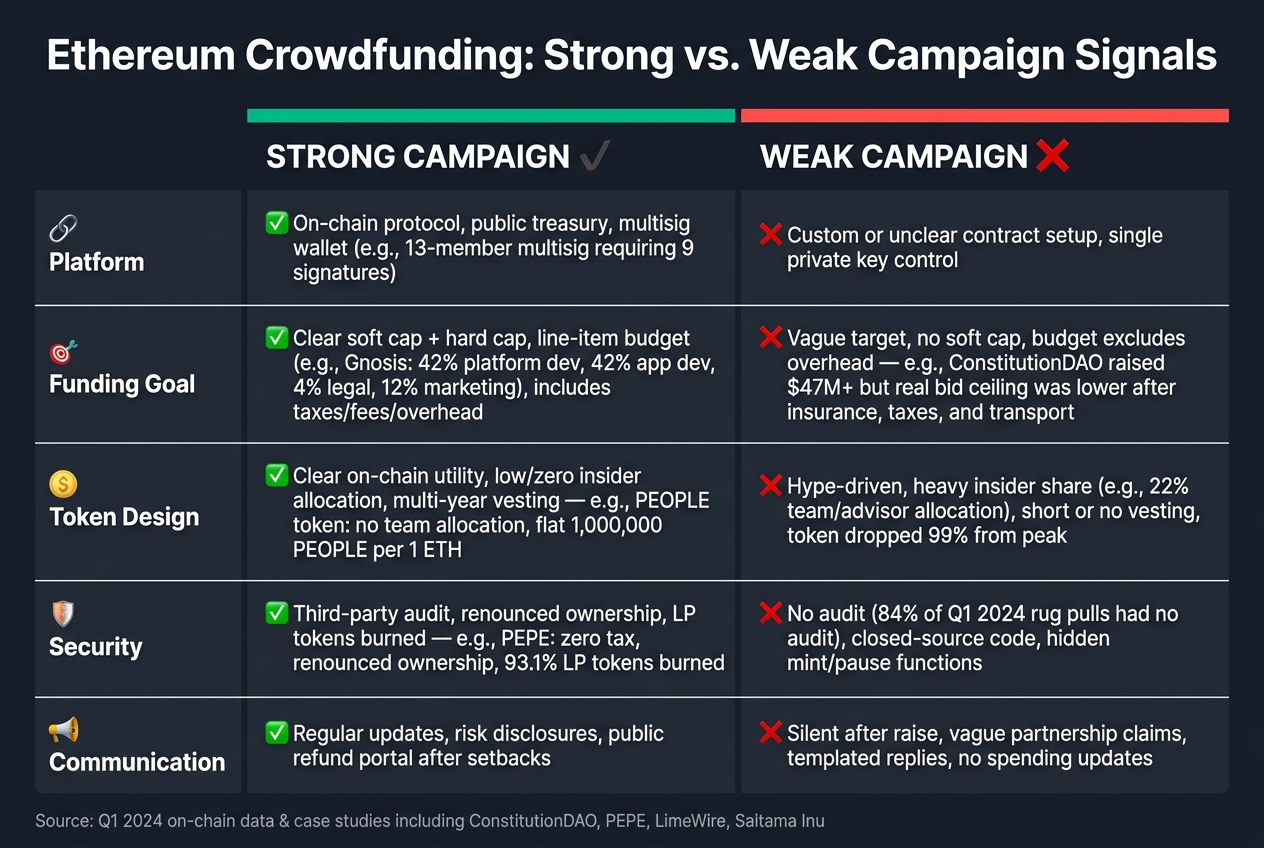
Ethereum Crowdfunding: Strong vs. Weak Campaign Signals
Quick Comparison
| Factor | Strong campaign | Weak campaign |
|---|---|---|
| Platform | On-chain protocol, public treasury | Custom or unclear setup |
| Funding goal | Clear caps and cost breakdown | Vague target, weak budget math |
| Token | Clear use, low insider tilt | Hype-driven, heavy insider share |
| Security | Audit, multisig, open code | No audit, single-key control |
| Communication | Regular updates, clear risk notes | Silence, vague claims, weak follow-up |
The core idea is simple: I’d treat Ethereum crowdfunding as a structure test first and a hype test never.
Platform choice and funding goals: strong setup vs. weak setup
Ethereum-native platforms that build trust
Platform choice sends a trust signal before anyone contributes. When a project uses established Ethereum-native tools like Juicebox, backers get direct on-chain visibility. Contributions, token issuance, and treasury balances can all be seen on-chain.
Juicebox also supports automatic refunds. If a project dissolves or fails to meet its goals, backers can redeem ETH from the contract. That's a big gap compared with campaigns built on custom-built contracts, where refunds often depend on the team taking manual action.
Wallet structure matters just as much as the platform itself. ConstitutionDAO used a 13-member multisig that required nine signatures for any transaction. In plain terms, no single person could move funds alone. Weaker campaigns often skip multisig controls and leave the treasury tied to one private key.
Still, even a trusted platform can't fix a bad fundraising plan. If the target is off or the spending plan doesn't make sense, the setup starts to look shaky fast.
Soft caps, hard caps, and use-of-funds plans
A realistic funding goal is one of the clearest signs that a campaign is being run with care. Strong campaigns set both a soft cap and a hard cap, then spell out what the money will cover.
Gnosis did this well. It published a budget breakdown with 42% for platform development, 42% for application development, 4% for legal, and 12% for marketing. That level of detail tells backers the team has thought past the fundraise and into execution.
ConstitutionDAO shows the other side of the coin. The campaign raised more than $47 million, but its real bidding ceiling was lower because millions had to be set aside for insurance, taxes, and transport costs. Those details were not fully communicated upfront. In a sealed-bid auction, that kind of gap can hurt, even when the fundraising process itself is open.
Poorly structured campaigns usually follow a familiar pattern:
- Inflated hard caps with no clear budget
- No soft cap, or one that's vague
- No milestone-based release schedule
You can see those gaps pretty clearly in the way the raise is set up.
Comparison table: platform and funding differences
| Factor | Strong Setup | Weak Setup |
|---|---|---|
| Platform | Established Ethereum-native protocols | Custom-built contracts with limited documentation |
| Source code | Publicly auditable | Closed or unverified |
| Fund control | Multisig wallet with multiple signers | Single key held by one party |
| Refund protection | Contract-enforced redemptions | Manual, developer-dependent process |
| Soft cap | Defined minimum with clear rationale | Missing or vague |
| Hard cap realism | Includes taxes, fees, and overhead | Reflects gross raise, not net purchasing power |
| Fund allocation | Detailed line-item breakdown | Vague or absent |
| Treasury rules | Defined release schedule or milestone gates | No release structure or controls |
Platform trust matters, but token terms and security controls shape what happens after the raise and whether backers stay protected.
Token design and audit status: what separates safe campaigns from risky ones
A launch can look polished and still hide problems. What matters later is the token itself: what it does, who holds it, when those tokens unlock, and whether the contract gives the team too much control.
Token utility, allocation, and vesting that support long-term value
Start with utility. Backers should ask a simple question: does the token do something the project actually needs, or is it mostly there to sell hype? A stronger campaign ties the token to a required on-chain function, not a vague promise about what it might do later. The token should open access to a real function, not sit there as a betting chip.
LimeWire is a good warning sign. The project raised about $17.5 million, but LMWR moved from NFTs to AI to DePIN in less than three years, and the token later dropped 99% from its 2024 peak. That kind of pivot-heavy path can point to weak utility. If the project keeps changing direction, the token can start to look optional.
Utility alone doesn't tell the whole story. Supply and vesting shape who wins first. ConstitutionDAO's PEOPLE token is a good example of plain, easy-to-check token distribution. It had no team allocation, and every token was issued at a flat rate of 1,000,000 PEOPLE per 1 ETH contributed. That level of clarity gave backers a strong trust signal.
LimeWire took a different route. It reserved 22% of its token supply for the team and advisors. When insider allocations get big, and vesting is short or loose, sell pressure can hit the market fast. That doesn't always mean a project will fail. But it does mean outside backers may be buying into a setup where insiders can exit early.
Even then, tokenomics on paper aren't enough. If the contract can be changed, paused, or quietly rewritten, the numbers stop meaning much.
Why audits, multisig controls, and public code matter
This is where many campaigns fall apart before most backers even notice. In Q1 2024, more than 84% of meme projects confirmed as rug pulls lacked any form of smart contract audit. That's a huge red flag.
An unaudited contract can hide all sorts of traps:
- Mint functions that let developers inflate supply
- Pause functions that freeze trading
- Honeypot logic that lets users buy but not sell
A third-party audit helps cut that risk. It's not magic, but it's a basic check that should be there.
Public code matters just as much. If a contract is verified on Etherscan and the repo is open on GitHub, people can review it all the time, not only on launch day. That ongoing visibility makes it harder to slip in hidden controls.
PEPE shows what that can look like in practice. It launched in April 2023 with a zero-tax structure and renounced contract ownership immediately, then burned 93.1% of its LP tokens to stop liquidity tampering. The remaining 6.9% was held in a plainly labeled multisig wallet, pepecexwallet.eth, for exchange listings.
That mix matters: open code, no admin backdoors, and locked liquidity. Think of it as the minimum safety gear, not a bonus feature. Once those checks are in place, the next issue is how the team handles communication before and after the raise.
Comparison table: tokenomics and security signals
| Signal | Safe Campaign | Risky Campaign |
|---|---|---|
| Token utility | Fixed, on-chain use case such as gas or storage | Vague, shifting, or purely speculative |
| Insider allocation | Low or zero, with no pre-mine | High or hidden team/advisor share |
| Vesting schedule | Multi-year or milestone-based unlocks | Immediate unlocks or no vesting |
| Audit status | Third-party audit with public report | Unaudited or self-reviewed code |
| Contract ownership | Renounced after deployment | Developer retains mint/pause rights |
| Code access | Verified on Etherscan, open on GitHub | Unverified or closed-source |
| Liquidity | LP tokens locked or burned | Unlocked and withdrawable at any time |
| Token supply | Fixed supply or milestone-based minting | Uncapped supply or hidden minting functions |
sbb-itb-0796ce6
Backer communication: transparent projects vs. silent ones
After tokenomics, look closely at how the team speaks to backers before, during, and after the raise. Communication is often the clearest live signal of whether a project can stay steady over time.
What high-transparency campaigns do before and after the raise
After tokenomics and security, communication becomes the last live test. You can learn a lot from how a team handles bad news.
After losing the auction to Ken Griffin, the ConstitutionDAO team launched a public refund portal. Contributors could burn their $PEOPLE tokens to reclaim ETH. That refund path showed the team had thought through what would happen if things fell apart.
Etheroll handled a crisis in a similar way in 2016. It raised 2,300 ETH, then chose to suspend the campaign and refund backers after The DAO hack.
Warning signs in low-transparency campaigns
When a team stops answering questions, it's usually not just a marketing problem. It's a deeper one.
Low-transparency campaigns tend to follow the same script. Saitama Inu promised a larger ecosystem, but hype kept moving faster than delivery. The token later dropped 50% in one night. The SEC later alleged that the promoter used social media to pump the token with misleading statements before insiders exited.
You’ll often see the same red flags show up together:
- Irregular updates
- Vague partnership claims
- Little or no technical progress
- Silence when backers ask hard questions
- Template-style replies or muted criticism
There’s another issue that gets missed: the real cost of the raise. In ConstitutionDAO's case, the headline total did not clearly show that insurance and transport costs would lower the effective bid ceiling, and Ken Griffin ultimately won at $43.2 million. So transparency isn’t just about how much money came in. It also has to cover what that money can actually do.
Comparison table: communication practices
| Practice | High-Transparency Campaigns | Low-Transparency Campaigns |
|---|---|---|
| Whitepaper quality | Technical mechanics, clear utility, and verifiable on-chain rules | Promotional language, vague technical details, or no clear legal/regulatory framework |
| Update cadence | Regular, predictable updates and immediate statements after setbacks | Irregular updates, silence after the raise, or hype-driven posts |
| Risk disclosure | Clear explanation of bid ceilings and non-refundable fees | Hidden non-project costs and vague partnership claims |
| Responsiveness | Open Q&A channels and active founder engagement | Ignoring DMs, kicking critics, or using templated replies |
| Use-of-funds reporting | Milestone-based spending updates | No spending updates after the raise |
| Handling delays | Honest timelines and proactive refunds | Radio silence or blame-shifting after setbacks |
These signals lead straight into the checklist you’d use before putting money into a campaign.
Key lessons from Ethereum crowdfunding wins and losses
Backers should favor projects that make verification simple, explain risk up front, and react fast when plans change. In Ethereum crowdfunding, the strongest signal isn’t hype. It’s whether the team gives people enough information to check what’s happening, what could go wrong, and what comes next.
Key lessons from Ethereum crowdfunding wins and losses
Winning campaigns don’t just pick a good platform and call it a day. They work because platform choice, funding goals, token design, security, and communication all line up. When projects fail, the problem is often the opposite: things look solid at first glance, then fall apart when it’s time to execute.
ConstitutionDAO is a clear example. It posted a big raise, but the budget didn’t fully cover the full cost of the auction. That’s the lesson in plain English: a big raise doesn’t fix weak planning. A campaign can bring in a lot of money and still miss the mark if the team gets the math, operations, or assumptions wrong.
The strongest campaigns start with the basics in place. They make the treasury easy to check, set funding goals that include overhead, give the token a clear job, treat security seriously, and keep people updated from day one.
A simple checklist for evaluating campaigns
Use the table below as a quick screen before you contribute. It turns the lessons above into a practical way to size up a campaign fast.
| Category | Strong Signal | Red Flag |
|---|---|---|
| Platform setup | Ethereum-native protocol with publicly auditable smart contracts and visible treasury balance | Off-chain custody; no public treasury |
| Budget logic | Funding goal includes reserves for insurance, taxes, legal fees, and other overhead | Goal excludes taxes, fees, and overhead |
| Token utility | Clear utility or governance rights; fair vesting and no insider-heavy allocation | Speculative token; lopsided vesting |
| Security | Credible third-party audit; multisig controls; open-source code | No audit; closed code; no multisig |
| Communication | Immediate public statements after milestones or setbacks; regular updates | Silent updates; unclear voting rights or refund terms |
FAQs
How can I verify a campaign’s treasury on-chain?
Use a blockchain explorer to inspect the project’s smart contract or official wallet address. Since blockchain records are public and can’t be changed after the fact, you can track contributions, look through transaction history, and check the current treasury balance in real time.
Just make sure you verify the official contract address in the project’s whitepaper or official communications before you trust what you see.
What should a realistic funding goal include?
A realistic funding goal starts with clear, verifiable project needs - not a wish list.
That means your target should cover the actual cost of building and launching the project, plus the extra charges that often get missed. These usually include transaction fees, which are often 2% to 8%, along with smart contract deployment or listing costs.
The strongest campaigns connect that number to a clear roadmap, useful tokenomics, and specific milestones. People want to see where the money goes and what happens next.
Be direct about fund allocation, audit costs, liquidity planning, and vesting schedules. If those details are vague, trust can fall apart fast.
Why does token utility matter in crowdfunding?
In token crowdfunding, utility gives a token a job to do beyond pure speculation. It might grant access to decentralized services, pay for transaction fees, or let holders take part in governance across an ecosystem.
When a token’s value is tied to actual demand instead of hype, it tends to build trust, encourage active use, and support long-term staying power.