
Stablecoins in Remittances: User Benefits Explained
USD-pegged stablecoins can settle cross-border transfers in minutes, reduce fees dramatically, and reach unbanked users - caveats apply.

If you want to send money abroad with less delay and lower fees, stablecoins can be a better option than bank wires or money transfer services.
From what I see in the article, the main user gains are simple:
- Faster delivery: some transfers settle in under 1 minute, instead of 3–5 business days
- Lower cost: sending $200 can cost about 6.5%–6.62% with standard remittance services, while some stablecoin routes are closer to 1%–3%
- More access: people can receive funds with a phone, internet connection, and wallet app, even without a bank account
- Steadier value: dollar-pegged coins like USDC and USDT are built to stay near $1.00
- Better tracking: senders and recipients can often check transfer status in near real time
A stablecoin remittance works like this: you pay in regular money, the service converts it into a dollar-pegged token, sends it over a blockchain network, and then pays out either local currency or the stablecoin itself. The big idea is not crypto speculation. It’s moving money with fewer delays, fewer middlemen, and less guesswork.
That said, I’d keep one thing in mind: the on-chain part may be fast and cheap, but the full transfer still depends on cash-out speed, FX spread, payout coverage, and licensing. So the best test is the all-in cost and the end-to-end delivery time.
| What matters | Standard remittance services | Stablecoin remittances |
|---|---|---|
| Delivery time | 3–5 business days | Minutes or under 1 minute on some networks |
| Cost on $200 | About 6.5%–6.62% | About 1%–3% on some routes |
| Access | Often tied to bank or agent network | Can work with a smartphone wallet |
| Value during transfer | May lose more to fees and FX markup | Usually tied to $1.00 |
| Tracking | Often limited | On-chain status is easier to check |
If I were choosing a service, I’d compare total fees, FX markup, payout method, delivery time, and regulatory status before sending.
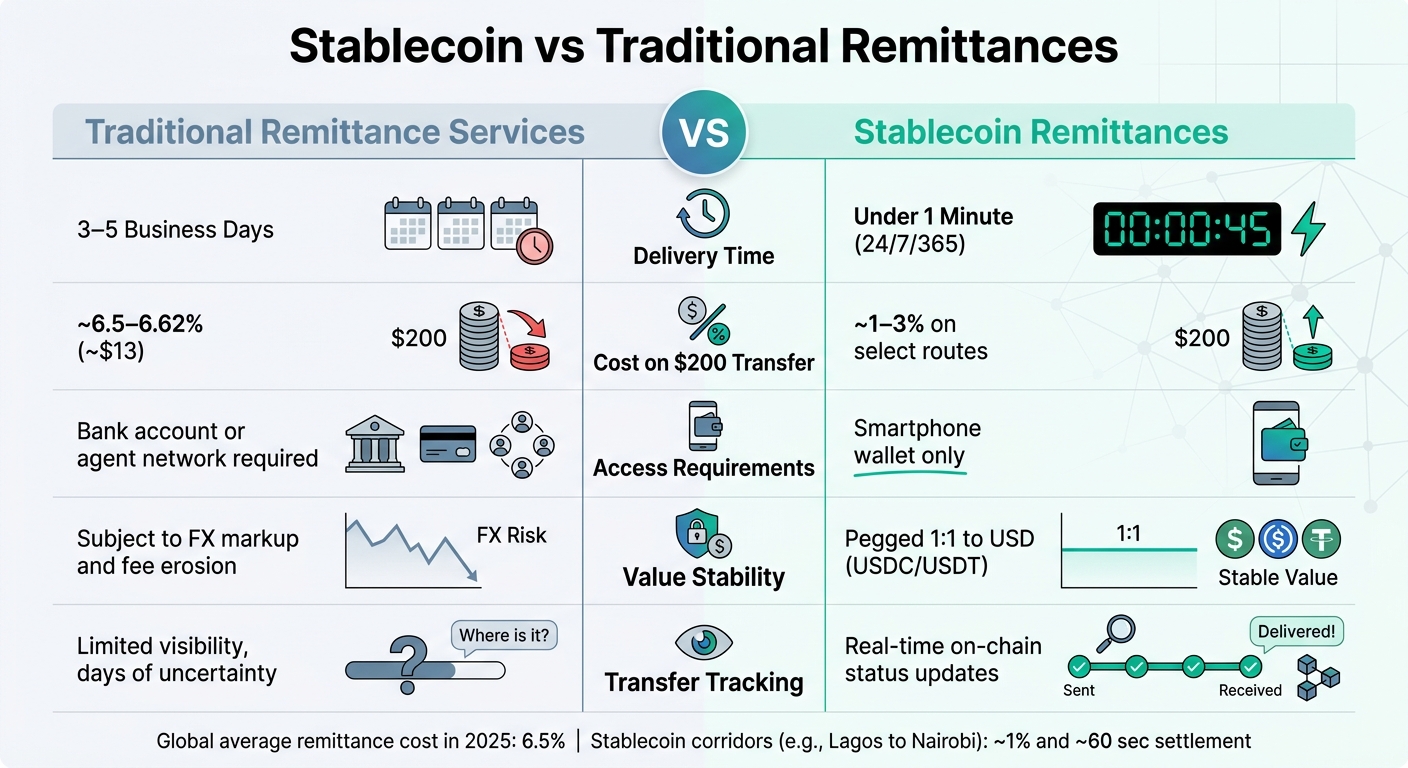
Stablecoin vs Traditional Remittances: Speed, Cost & Access Compared
What Stablecoin Remittances Are
A stablecoin remittance is a cross-border transfer that uses a 1:1 fiat-pegged token, usually a USD stablecoin, to move money between countries. The sender pays in U.S. dollars, the platform converts that amount into USDC or USDT, and the token moves on-chain to the recipient or to a local payout rail. The recipient then gets either local currency or the stablecoin in a wallet.
How a Stablecoin Transfer Works, Step by Step
The process has four basic stages, even though most people only notice the beginning and the end:
- Fund the transfer in fiat: The sender pays with a debit card, ACH, or another bank-linked payment method.
- Convert to stablecoin: The platform turns the funds into USD-pegged stablecoins at a near-parity rate and shows a clear fee before the sender confirms the transfer.
- Blockchain transfer: The stablecoins move across a network like Stellar, Solana, or Ethereum, reaching a local payout rail in under a minute.
- Payout in local currency: The recipient gets local currency in a bank account or mobile wallet at the exchange rate shown upfront.
From the user's side, it feels simple. The blockchain settlement is there, but it stays in the background.
How Stablecoins Differ From Other Crypto Assets
The main difference is price stability. Assets like Bitcoin or Ether can swing by several percentage points in a single day. That kind of volatility makes them a bad fit for day-to-day transfers, where the recipient needs the full amount to arrive without surprise losses.
Stablecoins are built to avoid that problem. They keep a 1:1 peg to a fiat currency by holding reserves in cash or short-term securities, which helps keep the value steady from the moment the sender starts the transfer to the moment the recipient gets access to the funds. Fiat-backed stablecoins like USDC and USDT - the ones used most often in remittances - are made for payments, not speculation. And for cross-border payments, that steady value is the whole point.
sbb-itb-0796ce6
The Two Main User Benefits: Speed and Lower Costs
Stablecoin remittances stand out for two simple reasons: they move faster and they usually cost less. Since the value stays close to parity, most people judge them on what they care about day to day: how fast the money arrives and how much of it gets eaten up by fees.
Faster Settlement and 24/7 Transfers
A transfer sent on Sunday night moves the same way it would on Tuesday morning. That’s a big shift from bank wires and money transfer operator payments, which can take several business days to settle a cross-border transfer. The reason is pretty plain: the payment has to pass through several institutions, each working within banking hours. Weekends and holidays can slow it down even more.
You can see the gap clearly on live payment routes. On networks like Solana or Base, USDC transfers can settle in under a minute. In a corridor such as Lagos to Nairobi, stablecoin transfers have been shown to settle in about 60 seconds, versus 3–5 business days with conventional rails.
| Transfer Method | Typical Settlement Time | Available Hours |
|---|---|---|
| Traditional bank wire or money transfer operator | Several business days | Limited hours |
| Stablecoin transfer (e.g., USDC on Solana/Base) | Under 1 minute | 24/7/365 |
For someone waiting on rent money or grocery funds, the gap between tomorrow and right now isn’t small. It can change what they’re able to do that day.
Lower Transfer Costs and a Clearer Fee Structure
Cost is the other big draw. Traditional remittances often move through several middlemen, and each one can add a fee, an FX spread, or both. For a $200 transfer, the global average cost for traditional services is 6.62%, or a little over $13.
Stablecoin transfers remove most of those extra layers. Funds move directly on-chain, without correspondent banks sitting in the middle, and the fees are often lower and easier to spot. On some low-fee networks, on-chain fees can be under $0.01. Research across comparable routes puts average stablecoin costs at around 1%, compared with 5.8% for traditional remittance pricing.
| Cost Component | Traditional Remittance | Stablecoin Remittance |
|---|---|---|
| Service fee | Fixed fee plus spread | Often lower and more transparent |
| FX markup | About 3–5% | About 0.5–1% |
| Correspondent bank fees | Often embedded | Not applicable |
| Network / on-chain fee | Not applicable | Under $0.01 on low-fee networks |
| Total cost on a $200 transfer | 6.62% on average | Around 1% on comparable routes |
That fee gap matters most for smaller transfers. If you’re sending $200 and more than $13 disappears into charges, you feel it. If the cost lands closer to 1%, more of the money gets where it’s supposed to go - and the sender can see the math more clearly.
Access, Stable Value, and Confidence in Your Transfer
Speed and cost matter, but remittances also need to arrive dependably and keep their value until the money is used.
Reaching Users Without Full Banking Access
Around 1.4 billion adults worldwide are unbanked, and in Sub-Saharan Africa, more than 57% of adults are still unbanked. So even the fastest, cheapest transfer means little if the person on the other end can't get to the funds. A stablecoin remittance can land on a mobile phone without a bank account. In many setups, the app creates a wallet during signup, and incoming transfers show up as a simple dollar balance - like "$50.00" - instead of a long wallet address.
That said, access isn't automatic. The recipient still needs a phone, some internet or mobile connectivity, and a local way to cash out. Some wallets work on low-powered phones and feature phones, which helps. But ID checks are still a big sticking point. Responsible providers require them, and that can block access in places where formal identification is hard to get.
Once the funds arrive, the next issue is simple: will the money still be worth the same amount when it's time to spend it?
Stable Value for Recipients Managing Daily Expenses
If a family is waiting on $200 for rent, even a small drop in value can cause problems. Stablecoins are pegged 1:1 to a fiat currency like the U.S. dollar, so the amount the sender starts with is, in most cases, the amount the recipient gets - without the same-day price swings tied to Bitcoin or Ether. That matters when the money is meant for rent, groceries, or utility bills.
This matters even more in places with high inflation. When local currency loses buying power fast, holding funds for a short time in a dollar-pegged stablecoin can help protect the value of a remittance until the recipient is ready to cash out or pay a bill. For households planning around fixed monthly costs - rent due dates, utility shutoff dates, school fees - that kind of predictability isn't just helpful. It's what makes the transfer usable in day-to-day life.
Predictable value helps, but people also want to know where their money is and when it arrived.
Transparency and Control Over Transfer Status
Traditional wire transfers can leave both sender and recipient guessing for days. Stablecoin transfers work in a more visible way: each transaction is recorded on the blockchain, which creates a trail that can be checked in real time. After a sender starts a transfer, the payment gets a unique ID and can show as pending, confirmed, or failed within seconds or minutes.
For families living on a tight budget, that visibility can ease a lot of stress. A recipient can show proof of payment or plan a bill payment with more certainty. And if something goes wrong, on-chain records give support teams a clear path to follow instead of forcing them to chase updates across a string of correspondent banks.
Conclusion: When Stablecoins Make Remittances Work Better
Traditional remittances often take 2–5 business days. Stablecoin rails can settle in minutes and, in many cases, cost less from start to finish. That difference matters. If you're sending money home, waiting days and losing a big chunk to fees can feel like salt in the wound.
The cost gap is hard to ignore. In 2025, the global average cost to send $200 was 6.5%. By contrast, stablecoin-based transfers in favorable corridors can land around 1%–3%, depending on the platform and how the payout is handled.
That said, the blockchain is only one piece of the transfer. Fast on-chain settlement sounds great, but it doesn't mean much if the money gets stuck at the cash-out stage. Slow off-ramps, FX markups, and thin local payout coverage can eat up the time and money you thought you were saving.
Regulation shapes the day-to-day user experience too. Licensed providers are more likely to stay online, sort out failed transfers, and keep payout networks running without constant friction. Kryptonim, for example, is an EU-regulated fiat-to-crypto on-ramp that makes the on-ramp step easier with fast conversions and no account creation required.[Kryptonim] More broadly, it's smart to check licensing on both sides of the transfer before you commit to any platform.
Here’s a simple checklist to test whether a platform’s promised savings are real:
| What to Check | Why It Matters |
|---|---|
| All-in cost (fees + FX spread) | The blockchain fee is often small; the FX markup and service fee are where costs add up |
| Settlement time, end to end | On-chain speed means little if the cash-out takes days |
| Payout options in the destination | Bank deposit, mobile money, and cash pickup vary by corridor |
| Regulatory status | Licensed providers offer stronger consumer protections and long-term reliability |
| Tracking and transparency tools | Real-time status updates reduce uncertainty for both sender and recipient |
Stablecoins tend to shine when speed, cost, and access matter most. And the platforms that do this well usually aren’t just fast on-chain - they’ve also put real work into local off-ramp networks, clear pricing, and compliance so those gains actually reach the sender and the recipient.
FAQs
Are stablecoin remittances safe to use?
Stablecoin remittances are generally safe if you use trusted platforms and stick to good security habits.
That said, there’s one thing you can’t afford to get wrong: blockchain transactions are irreversible. Once funds are sent, you usually can’t pull them back. So before you hit send, double-check the wallet address and make sure both parties are using the same blockchain network.
For larger transfers, it’s smart to start with a small test transaction first. It takes a little extra time, but it can save you from an expensive mistake.
Using a reputable platform like Kryptonim can also help, since it provides a secure, regulated setting for fiat-to-crypto transactions.
What can slow down a stablecoin transfer?
Stablecoin transfers are often faster than bank transfers, but they’re not always instant. A few things can slow them down:
- Network congestion can lead to delays and higher fees, especially on Ethereum.
- Using the wrong or incompatible blockchain network can stop or disrupt the transfer.
- If you’re buying stablecoins or converting currency through a platform, your payment method plays a big role. For example, a standard bank transfer can take up to 3 business days before the crypto transfer even begins.
Do both sender and recipient need a crypto wallet?
Yes. Both the sender and the recipient need a digital wallet to send, hold, and receive stablecoins.
They also need to use the same blockchain network. For example, if someone sends assets on Ethereum to a wallet that only supports Tron, it can lead to a permanent loss of funds. That’s an expensive mistake.
If you need to buy stablecoins, Kryptonim lets you send them straight to your wallet without creating an account.