
Layer 1 and Layer 2: How They Work Together
Explains how Layer 1 and Layer 2 work together to boost transaction speed, lower fees, and preserve security for DeFi, NFTs and small payments.

Layer 1 and Layer 2 solutions are the backbone of blockchain scalability. Layer 1 refers to the main blockchain networks like Bitcoin and Ethereum, which prioritize security and decentralization but face limitations in transaction speed. Layer 2 operates on top of Layer 1, processing transactions off-chain to improve speed and reduce costs while maintaining the security of the underlying blockchain.
Key Points:
- Layer 1 (Base Layer): Handles security, decentralization, and transaction finalization. Examples: Bitcoin (7 TPS), Ethereum (15–30 TPS).
- Layer 2 (Scaling Layer): Processes transactions off-chain, bundles them, and submits them to Layer 1. Examples: Arbitrum, Optimism, Polygon.
- Transaction Speed: Layer 2 systems like rollups can handle up to 40,000 TPS compared to Layer 1's limited throughput.
- Cost Reduction: Layer 2 reduces fees by spreading costs across bundled transactions, making payments faster and cheaper.
- Collaboration: Layer 2 enhances Layer 1 by improving scalability without compromising security or decentralization.
This combination addresses blockchain's scalability challenges, enabling faster, cheaper, and more efficient transactions for applications like DeFi, NFTs, and micropayments. Platforms like Arbitrum and Polygon highlight how this synergy transforms blockchain usability.
What is Layer 1?
Layer 1 refers to the main blockchain network responsible for recording and processing transactions. Think of it as the backbone of blockchain ecosystems - a primary highway where all transactions occur. Examples of Layer 1 blockchains include Bitcoin, Ethereum, and Solana.
These networks are self-sufficient, validating and securing transactions through their own consensus mechanisms, such as Proof of Work (PoW) or Proof of Stake (PoS). Layer 1 blockchains serve three essential purposes: they secure the network, validate transactions, and store the entire transaction history. For instance, as of July 2022, Bitcoin’s security relied on a global network of approximately 15,733 nodes, while Ethereum operated with around 4,457 nodes. This decentralized structure ensures no single entity has control, maintaining the integrity of the blockchain.
However, this level of security and decentralization comes with limitations. The blockchain trilemma highlights a tough choice: a Layer 1 network can typically excel at only two of the three key aspects - decentralization, security, and scalability. That’s why Bitcoin processes just 7 transactions per second (TPS), and Ethereum manages about 15 TPS - far slower compared to centralized systems like Visa, which can handle up to 65,000 TPS.
Let’s take a closer look at some key examples of Layer 1 blockchains.
Examples of Layer 1 Blockchains
Bitcoin
As the original Layer 1 blockchain, Bitcoin prioritizes security and decentralization above all else. Its Proof of Work consensus mechanism, combined with a vast network of nodes, makes it one of the most secure blockchains. However, this comes at the cost of speed, as Bitcoin processes transactions at just 7 TPS.
Ethereum
Ethereum serves as a Layer 1 platform for smart contracts and decentralized applications. In September 2022, Ethereum underwent a major upgrade known as “The Merge”, transitioning from Proof of Work to Proof of Stake. This shift dramatically reduced the network’s energy consumption by an estimated 99% while maintaining its security. As of August 2023, Ethereum dominated the decentralized finance (DeFi) space, accounting for 68% (around $50 billion) of the total value locked in DeFi protocols.
Solana
Solana takes a different approach to Layer 1 design, leveraging a unique combination of Proof of History and Proof of Stake to achieve high transaction throughput directly at the base layer. Unlike Bitcoin and Ethereum, Solana was designed from the ground up to handle a much higher volume of transactions without relying on additional scaling solutions.
Each of these Layer 1 blockchains operates using its own native token: BTC for Bitcoin, ETH for Ethereum, and SOL for Solana. These tokens are used to pay transaction fees and reward validators who help secure the network.
sbb-itb-0796ce6
What is Layer 2?
Layer 2 refers to a protocol built on top of Layer 1 that processes transactions off the main blockchain. Instead of running every transaction directly through Layer 1, Layer 2 solutions handle them externally and then consolidate the results for submission to the base blockchain. As explained on ethereum.org:
"A layer 2 is a separate [blockchain] that extends Ethereum and inherits the security guarantees of Ethereum".
In this setup, Layer 1 acts as the foundation for security and settlement, while Layer 2 focuses on improving transaction speed and reducing costs. It’s important to note that Layer 2 doesn’t replace the main blockchain. Instead, it enhances its functionality. By anchoring transaction data or cryptographic proofs back to Layer 1, these solutions maintain the security of the base layer while preventing it from becoming overloaded.
Layer 2 solutions work by bundling multiple transactions into a single batch and submitting that batch as one transaction to Layer 1. This approach significantly reduces the data burden on the base blockchain and spreads transaction fees across all users in the batch. As a result, Layer 2 networks are capable of processing 11–12 times more transactions than Ethereum’s main chain. Some solutions, like Starknet, even offer confirmation times as short as 2 seconds, with fees that are often less than one cent. Unlike sidechains, which rely on their own consensus mechanisms, true Layer 2 solutions derive their security directly from the Layer 1 mainnet. This off-chain processing complements the security of Layer 1, enabling the efficient scaling of blockchain technology.
Examples of Layer 2 Solutions
Optimistic Rollups are one of the most commonly used Layer 2 scaling methods. Solutions like Arbitrum and Optimism assume transactions are valid unless proven otherwise, relying on fraud proofs to verify any disputes. By June 2022, Optimistic Rollups had secured over $2.71 billion in total value locked, showcasing their growing adoption.
Zero-Knowledge (ZK) Rollups use a different strategy. Networks like zkSync and Scroll employ mathematical validity proofs to confirm transactions without exposing the underlying data. These proofs ensure that transactions are correct before being submitted to Layer 1, offering near-instant finality.
State Channels represent another method for scaling. For instance, the Lightning Network enables users to perform unlimited off-chain transactions, only recording the opening and closing balances on the Layer 1 blockchain. This approach is particularly useful for frequent, small-scale transactions, such as micropayments or gaming applications.
The impact of these solutions is transformative. While Ethereum Layer 1 can handle about 15 transactions per second, rollups can boost capacity by up to 100 times. Validium chains, which process data off-chain, can potentially reach speeds of 10,000 transactions per second. This surge in throughput helps address the blockchain trilemma, achieving scalability without sacrificing security or decentralization.
Key Differences Between Layer 1 and Layer 2

Layer 1 vs Layer 2 Blockchain Comparison: Speed, Cost, and Security
Bitcoin manages around 7 transactions per second (TPS), while Ethereum handles approximately 15 TPS. Compare that to Layer 2 solutions like Arbitrum and Optimism, which can handle up to 40,000 TPS. Why the dramatic difference? Layer 1 focuses on security and decentralization, which inherently limits its throughput. On the other hand, Layer 2 is designed for speed and cost efficiency, making it a game-changer for scaling.
Transaction fees highlight another major difference. In 2023, Ethereum’s Layer 1 gas fees averaged over $7, with congestion spikes pushing fees past $40. Meanwhile, Layer 2 fees are a fraction of a penny. This is possible because Layer 2 solutions bundle hundreds of transactions into a single submission to Layer 1, spreading the costs across multiple users.
Security is another key distinction. Layer 1 blockchains, like Bitcoin and Ethereum, rely on their own consensus mechanisms - whether it’s Proof of Work or Proof of Stake - backed by thousands of nodes. For instance, Bitcoin operates with 15,733 nodes, and Ethereum runs on 4,457 nodes. In contrast, Layer 2 solutions don’t have independent consensus mechanisms. Instead, they depend on the security of Layer 1 by batching transactions and anchoring them to the main chain.
This all ties back to the blockchain trilemma. Layer 1 prioritizes security and decentralization, which limits scalability. Layer 2 sidesteps these limitations by processing transactions off-chain while leveraging the robust security of Layer 1. It’s a balance of trade-offs that allows for both speed and reliability.
How Layer 1 and Layer 2 Work Together
Picture Layer 1 as the sturdy foundation of a building and Layer 2 as the additional floors constructed above it. Layer 1 ensures a secure and decentralized base, while Layer 2 handles the day-to-day traffic of transactions, making the entire system more efficient.
Here’s how it works: Layer 2 processes transactions off-chain, bundling hundreds of them into a single batch. This batch is then submitted to Layer 1 as one transaction. This approach allows Layer 2 solutions like Arbitrum and Optimism to handle up to 40,000 transactions per second (TPS), compared to Ethereum’s Layer 1, which manages only 15 to 30 TPS. By anchoring these transactions to Layer 1, disputes are resolved, and the blockchain’s immutability is maintained.
A crucial concept here is security inheritance. Layer 2 relies on Layer 1 for its security by anchoring itself through smart contracts. Once a batch of transactions from Layer 2 is recorded on Layer 1, reversing it would essentially require undoing the entire blockchain - a feat that’s nearly impossible given Layer 1’s high level of decentralization.
Layer 1 also acts as a data availability layer. For example, in Optimistic Rollups, if there’s a dispute, Layer 1 provides the necessary data to resolve it using fraud proofs. On the other hand, Zero-Knowledge Rollups use cryptographic validity proofs to instantly confirm that a batch of transactions is legitimate.
This synergy between Layer 1 and Layer 2 tackles the blockchain trilemma head-on. Layer 1 prioritizes security and decentralization, while Layer 2 focuses on scalability. By early 2024, Layer 2 networks were already processing 11–12 times more transactions than Ethereum’s main chain, proving how well this collaboration works and opening doors for practical applications.
Examples of Layer 1 and Layer 2 Collaboration
The partnership between Layer 1 and Layer 2 blockchains shows how scalability and efficiency can transform blockchain ecosystems. Let’s look at some key examples.
Ethereum and Polygon highlight a strong collaboration between these layers. Ethereum acts as the main Layer 1 chain, offering decentralized security and consensus, while Polygon operates as a Layer 2 solution, handling transactions off-chain before linking them back to Ethereum. This setup not only expands Ethereum’s blockspace but also processes transactions faster and at a lower cost. By maintaining Ethereum’s security and decentralization, Polygon addresses the scalability issue while significantly boosting transaction throughput.
For instance, during periods of high activity, Ethereum gas fees once soared above $40, making transactions too costly for many users. Polygon addressed this by bundling transactions together, spreading the costs across multiple operations, which drastically reduced fees and improved affordability.
This collaboration has unlocked new possibilities for blockchain applications. Sectors like DeFi, NFT marketplaces, and decentralized commerce have thrived thanks to the efficiency of Layer 2 solutions. High-frequency use cases - such as micropayments and real-time gaming - previously hindered by congestion and high fees on Layer 1, now operate seamlessly on Layer 2 networks. As of February 2026, the Coinbase-backed Base network holds around $4 billion in total value locked (TVL), while Arbitrum has secured over $2 billion. These numbers highlight how real-world applications and significant capital are moving to these collaborative systems.
This evolution has also led to the rise of application-specific Layer 2s, which focus on niche markets. For example, networks like Immutable cater to gaming, while Zora supports creator economies. These Layer 2 solutions leverage Ethereum’s security while providing features tailored to their specific audiences. Jesse Pollak, Head of Base at Coinbase, emphasized this shift:
"Future Layer 2s must offer unique value beyond cost savings".
In Q2 2023, Layer 2 transactions grew by 60% compared to the previous quarter, making up 56% of all Layer 1 and Layer 2 transactions. This rapid growth shows how these collaborations are reshaping blockchain technology - making it faster, more affordable, and accessible for everyday users.
Benefits and Challenges of Combining Layer 1 and Layer 2
The collaboration between Layer 1 and Layer 2 solutions plays a key role in improving blockchain scalability. Together, they significantly boost performance. For example, Layer 2 rollups currently handle between 1,000 and 4,000 transactions per second (TPS), with projections reaching up to 100,000 TPS once danksharding is fully implemented. This approach balances scalability, cost efficiency, and security - directly addressing the blockchain trilemma.
One major advantage is cost reduction. We've seen historical gas fees spike to over $40, making transactions prohibitively expensive. Layer 2 solutions tackle this by bundling hundreds of transactions into a single submission to Layer 1. This spreads the fees across multiple users, cutting costs to mere fractions of a cent. Such affordability opens the door for microtransactions, real-time gaming, and high-frequency trading. As Ethereum.org explains:
"The Ethereum ecosystem is firmly aligned that layer 2 scaling is the only way to solve the scalability trilemma and remain decentralized and secure".
But this collaboration isn't without challenges. Liquidity fragmentation is a pressing issue. Assets spread across multiple Layer 2 networks can make transfers cumbersome and reduce market efficiency. On top of that, many current Layer 2 solutions depend on centralized sequencers to batch transactions, which introduces single points of failure. For users, moving funds between layers often involves learning new tools and managing different wallet setups, complicating the experience.
Timing can also be problematic. Optimistic rollups, for instance, require a dispute resolution period of roughly seven days before funds can be returned to Layer 1. Additionally, while Layer 2 processes transactions off-chain, it still relies on Layer 1 for final settlement. During high congestion on the base layer, this reliance can lead to fee spikes as Layer 2 solutions compete for limited block space.
Security remains another critical factor. Layer 2 inherits the strong security of its underlying Layer 1 chain, but these technologies are relatively new compared to established mainnets like Bitcoin and Ethereum. Ethereum co-founder Vitalik Buterin has pointed out:
"ZK-rollups will win out in all use cases as ZK-proof technology improves".
This shows that the landscape is still evolving, with current solutions likely to be replaced by even more advanced technologies in the future.
Even with these challenges, the advantages of combining Layer 1 and Layer 2 are undeniable. For example, in Q2 2023, Layer 2 transaction volume saw a 60% quarter-over-quarter increase, accounting for 56% of all Ethereum-related transactions. This growing adoption highlights the potential for platforms like Kryptonim to harness these advanced scaling solutions effectively.
How Kryptonim Benefits from Layer 1 and Layer 2 Advancements
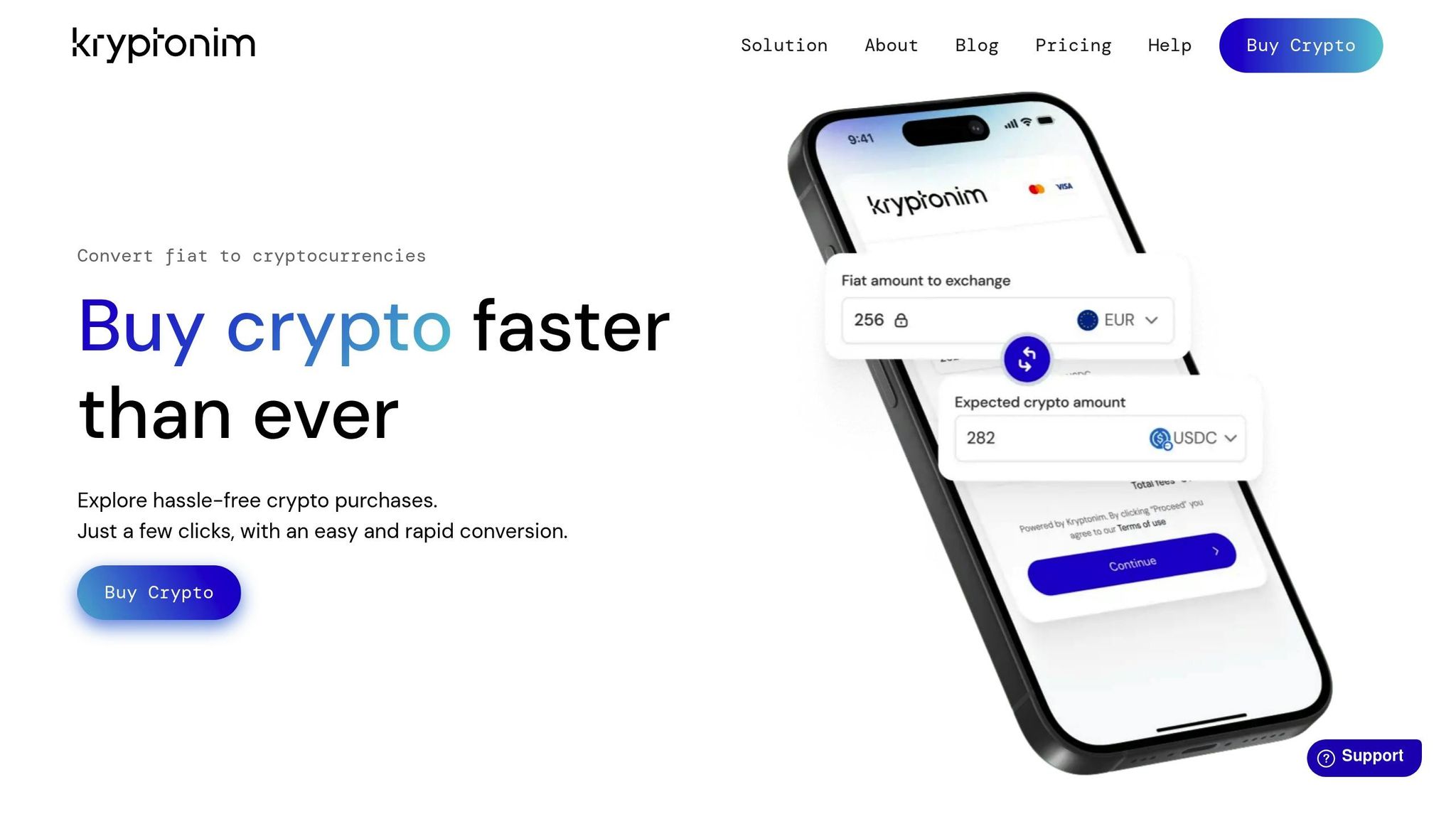
Kryptonim taps into the strengths of Layer 1 blockchains like Ethereum and Bitcoin to ensure secure transaction settlement. These networks rely on well-established consensus mechanisms - Ethereum's Proof of Stake and Bitcoin's Proof of Work - to deliver robust security for every transaction.
To enhance speed and reduce costs, Kryptonim integrates Layer 2 solutions, which group hundreds of transactions into a single submission on the Layer 1 blockchain. This method spreads gas fees among multiple users, bringing individual transaction costs down to fractions of a cent. Technologies like Starknet, with confirmation times as fast as 2 seconds, enable near-instant purchases, offering a smooth and efficient user experience. These improvements allow Kryptonim to outperform traditional transaction systems in both speed and cost-efficiency.
While Ethereum's Layer 1 can handle only 20–30 transactions per second (TPS), Layer 2 networks such as Arbitrum and Optimism can process up to 40,000 TPS. This capability far exceeds traditional systems like Visa, which manages around 24,000 TPS. Kryptonim leverages this massive increase in throughput to deliver faster transaction processing, a key advantage over conventional payment systems.
Kryptonim’s architecture prioritizes Layer 2 networks for most operations, reserving Layer 1 for secure settlement. This strategy maximizes scalability and efficiency, with Layer 2 networks currently handling 11–12 times more transactions than Ethereum’s main chain. Future upgrades like danksharding are expected to push transaction capacity beyond 100,000 TPS, ensuring Kryptonim remains well-positioned to grow alongside these advancements.
Additionally, Kryptonim’s EU-regulated framework and transparent pricing - 2% per transaction for EU users and 4% for others - benefit directly from the reduced costs of Layer 2 solutions while inheriting the security of Layer 1 networks. Features like Account Abstraction on select Layer 2 platforms further simplify wallet management and make onboarding easier for new users, creating a streamlined and cost-effective crypto purchasing experience.
Conclusion
Layer 1 and Layer 2 solutions tackle one of blockchain's toughest hurdles: balancing security, decentralization, and scalability. Layer 1 blockchains, like Ethereum and Bitcoin, serve as the secure foundation where transactions are finalized, while Layer 2 networks handle multiple transactions off-chain, bundling them into a single update for Layer 1. This teamwork enables blockchain networks to reach impressive speeds of up to 40,000 transactions per second (TPS).
These two layers aren’t competing - they work hand in hand. As Binance Academy explains:
"The future of blockchain will likely rely on a mix of both systems, using Layer 1 for security and settlement while relying on Layer 2 for higher speeds and lower costs."
Layer 2 networks now process 11–12 times more transactions than Ethereum’s main chain.
For everyday users, this collaboration means faster transactions, lower fees, and more accessibility. Platforms like Kryptonim showcase how these advancements come to life. By incorporating Layer 2 networks like Arbitrum, Optimism, and Polygon, Kryptonim processes transactions within 2 to 20 minutes while maintaining the robust security of Layer 1. Their transparent pricing - 2% per transaction for EU users and 4% for others - highlights the cost efficiencies made possible by Layer 2 technology. Kryptonim’s approach is a clear example of how these innovations benefit practical, real-world applications.
As blockchain technology evolves, the partnership between Layer 1 and Layer 2 will remain at the core of its growth. This modular design supports everything from micropayments to high-frequency applications while ensuring the security and decentralization that give blockchain its value. The balance between speed, security, and decentralization is the foundation for blockchain's ongoing development, as explored throughout this guide.
FAQs
When should I use Layer 1 instead of Layer 2?
When deciding between Layer 1 and Layer 2 solutions, it’s all about what you prioritize. Layer 1 is the go-to choice when decentralization and security are at the top of your list - perfect for the main blockchain network. On the other hand, Layer 2 steps in when speed and cost-efficiency are key. It offers faster transaction processing and reduced fees while still relying on the robust security foundation of Layer 1.
How do I move funds between Layer 1 and a Layer 2?
To move funds between Layer 1 and Layer 2, you’ll generally need a bridge. The process is straightforward: connect your wallet to the bridge, specify the amount you want to transfer, and confirm the transaction. The bridge handles the process to ensure your funds are transferred securely and smoothly.
What risks should I know about using Layer 2?
Layer 2 solutions come with certain risks that users should be aware of. One key concern is security vulnerabilities, as these solutions might not completely benefit from the security features of the main blockchain. Another risk involves the need to trust the validity and data availability of the Layer 2 protocol. If these aspects are not implemented correctly, they could be compromised, leading to potential issues. Being aware of these risks is crucial for making informed decisions when using Layer 2 networks.