
Fastest Blockchains by TPS: 2026 List
Throughput on paper rarely matches real-world blockchain speed—TPS hides finality, fees, and usability trade-offs.

If you only want the short answer: Solana leads this 2026 list on live TPS, while Ethereum and Bitcoin stay much slower on their base layers by design. But advertised TPS and day-to-day TPS are often very different.
I’m looking at 10 major blockchains here: Solana, Sui, Aptos, BNB Chain, Polygon, Avalanche, Tron, XRP Ledger, Ethereum, and Bitcoin. The big pattern is simple: some chains post huge top-end TPS claims, but live throughput is often far lower. At the same time, speed alone does not tell you how a chain feels to use. You also need to look at finality, fees, validator setup, and security trade-offs.
Here’s the article in plain English:
- Solana has the highest throughput in this group, with live non-vote TPS often around 1,500–4,000
- Sui is listed, but this source set does not give verified TPS or finality data
- Aptos advertises up to 160,000 TPS, but normal measured activity is far lower
- BNB Chain aims for fast confirmations, though this source set gives no firm TPS figure
- Polygon advertises about 5,000 TPS, while live activity is often around 68–109 TPS
- Avalanche advertises up to 4,500 TPS, but typical live usage is much lower
- Tron often sits around 100–200 TPS in daily use and is heavily used for USDT transfers
- XRP Ledger advertises about 1,500 TPS, but normal throughput is much lower; settlement is often 3–5 seconds
- Ethereum mainnet handles about 12–30 TPS, while its full ecosystem with Layer 2s reached about 3,382 TPS in one August 2, 2026 snapshot
- Bitcoin remains the slowest here at about 5–7 TPS, with about 10-minute blocks
The main takeaway: TPS is a starting point, not the whole answer. A blockchain can look fast on paper and still feel slow or costly when the network gets busy.
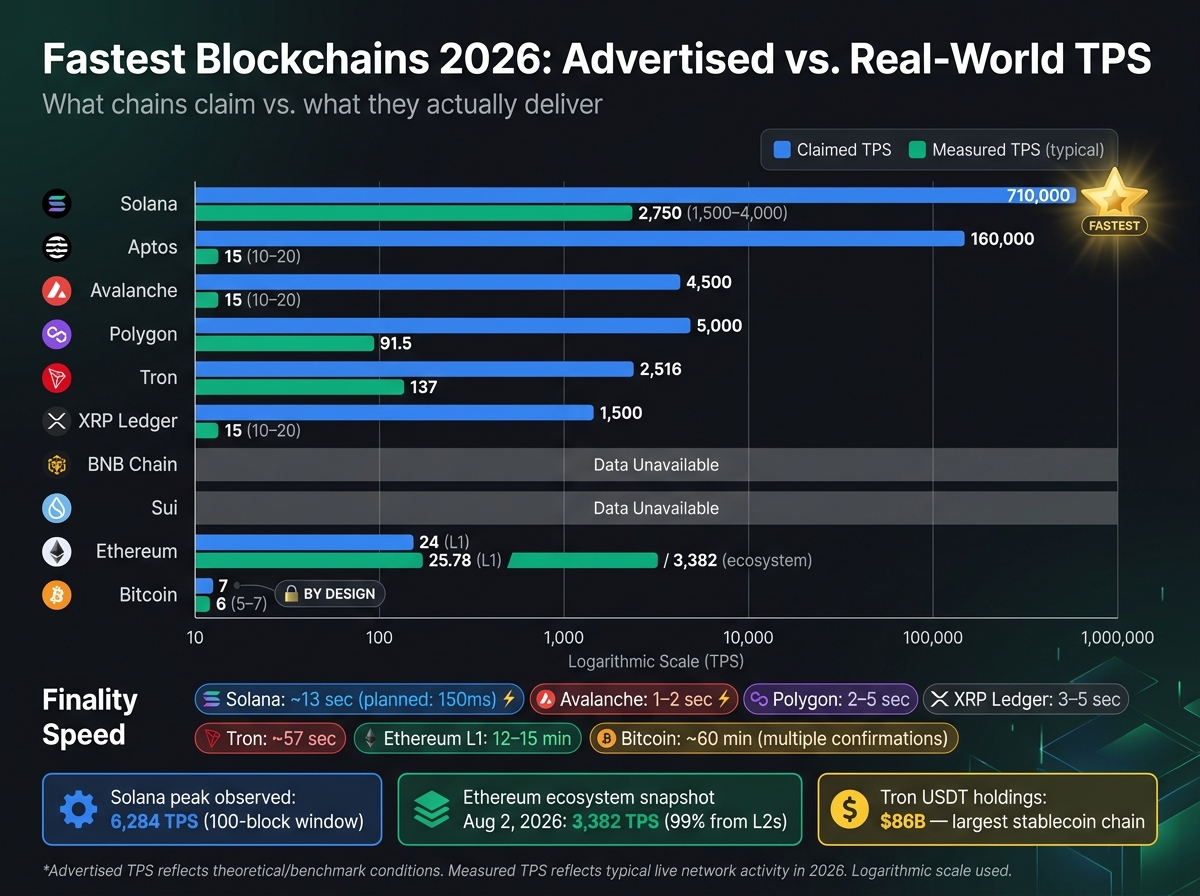
Fastest Blockchains 2026: Advertised vs. Real-World TPS Compared
Quick Comparison
| Blockchain | Claimed / Advertised TPS | Measured TPS Snapshot | Finality / Settlement Note |
|---|---|---|---|
| Solana | 65,000–710,000 | 1,500–4,000 typical; peak 6,284 | About 12.8–13 seconds today |
| Sui | Not verified here | Not verified here | Not verified here |
| Aptos | 160,000 | About 10–20 under normal load | Not stated here |
| BNB Chain | Not pinned down here | Not pinned down here | Fast confirmations; depends on conditions |
| Polygon | 5,000 | 68–109 typical; avg 91.5 in Q1 2026 | About 2–5 seconds |
| Avalanche | 4,500 | About 10–20 under normal load | About 1–2 seconds |
| Tron | 2,000–2,516 | Avg 137 in Q2 2026; peaks near 1,033 | About 57 seconds for full finality |
| XRP Ledger | 1,500 | About 10–20 under normal load | Ledger close in 3–5 seconds |
| Ethereum | About 24 on L1 | 13.67–25.78 avg on L1; ecosystem snapshot 3,382 | About 12–15 minutes on L1 |
| Bitcoin | Not framed as a high-TPS chain | 5–7 | Often treated as settled after multiple confirmations |
So if you’re scanning this list for the “fastest blockchain,” the short version is easy: Solana leads on throughput, Tron and Polygon sit in the middle with different trade-offs, and Ethereum plus Bitcoin stay slower at the base layer on purpose. The rest of the article breaks down what those numbers mean before you treat TPS like the full scorecard.
sbb-itb-0796ce6
1. Solana
Solana is one of the fastest major blockchains. Its Proof of History (PoH) setup, paired with parallel transaction processing, lets the network handle many transactions at the same time.
Advertised TPS
Solana’s whitepaper estimates up to 710,000 TPS on a 1 Gbps network with very small transactions. Solana’s own materials also cite 65,000 TPS as a benchmark for simple transfers. Those numbers reflect near-perfect conditions: top-tier hardware, fast networking, and ideal load. So they’re best read as design ceilings, not what users should expect day to day.
Measured TPS
In 2026, third-party trackers usually place Solana’s live non-vote TPS at 1,500–4,000. One 2026 snapshot showed 1,899 TPS with a 404 ms block time. Over a 100-block window, throughput peaked at 6,284 TPS.
That said, raw TPS can be a little slippery. Some figures include validator vote transactions, which help the chain reach consensus but don’t reflect direct user activity. So user-facing throughput comes in lower.
Finality Speed
TPS and finality are not the same thing. Solana’s block time sits at about 400 ms, which is why transactions often show up in wallets almost right away. But final settlement takes longer: about 12.8–13 seconds, since the network needs 32 confirmed slots.
The planned Alpenglow upgrade aims to cut that from about 12.8 seconds to roughly 100–150 milliseconds. If that lands as planned, settlement could feel almost instant.
Network Context
That speed comes with trade-offs. Higher throughput means heavier validator demands, including stronger hardware and more bandwidth. In plain terms, Solana pushes performance hard, but that can narrow decentralization compared with chains that ask less from validators.
Firedancer is meant to help on both fronts by improving performance and resilience.
| Metric | Figure |
|---|---|
| Theoretical TPS | 65,000–710,000 |
| Real-world non-vote TPS (2026) | 1,500–4,000 typical |
| Peak observed TPS | 6,284 (100-block window) |
| Block time | ~404 ms |
| Time to finality | ~12.8–13 seconds |
| Planned finality (Alpenglow) | ~100–150 ms |
Next up, Sui takes a different approach to high throughput.
2. Sui
This source set does not provide verified Sui TPS or finality figures, so the ranking moves on to Aptos.
3. Aptos
Aptos aims for the same high-throughput target as other newer layer-1 networks, but actual TPS on the live network shifts with conditions.
It’s built for speed. Under ideal conditions, Aptos advertises throughput of up to 160,000 TPS. On the live network, though, measured TPS usually lands around 10–20 TPS during normal load, with higher bursts showing up in stress tests. Like other chains, actual throughput changes based on network load and how the data is measured.
Next, BNB Chain shows how high throughput can come with a different validator model.
4. BNB Chain
BNB Chain makes a good contrast with Aptos. It aims for fast settlement, but it gets there with a different validator setup.
Finality Speed
BNB Chain confirms transactions fast, but final settlement still depends on network conditions. Confirmation time can change based on congestion and the type of transaction, and day-to-day speed is often lower than the headline TPS numbers suggest.
In plain English: BNB Chain is built to feel fast. That comes in part from a validator model that leans toward speed instead of maximum decentralization.
That trade-off helps BNB Chain stay competitive, while other networks make different choices around speed, validator design, and decentralization.
5. Polygon

Polygon gets to high throughput in a different way than a base-layer L1. It runs as an Ethereum-connected sidechain with its own validators, then posts periodic checkpoints to Ethereum. Because of that setup, Polygon PoS TPS isn't a direct apples-to-apples match with Ethereum mainnet.
Advertised TPS
Polygon's advertised capacity is about 5,000 TPS for simple payment-style transfers. Rio increased the gas limit and shortened block times to around 1.5–2 seconds, which pushed that figure into theoretical ceiling territory rather than something you should expect day to day.
So the headline number is useful, but it doesn't reflect normal live usage.
Measured TPS
In live conditions, throughput is much lower. Polygon averaged about 91.5 TPS in Q1 2026, with live monitoring usually showing 68–109 TPS and peak activity above 600 TPS during heavy-traffic periods.
That's a big gap from the 5,000 TPS headline. Even so, the network still posts strong numbers in practice.
Finality Speed
After Heimdall v2, Polygon finalizes transactions in about 2–5 seconds and produces blocks every 2–2.3 seconds.
Network Context
Polygon's speed comes with tradeoffs. As a sidechain with about 100 validators, it gives up some decentralization and changes the security assumptions in exchange for faster blocks and higher throughput.
Usage data helps show that this isn't just a lab number. Stablecoin activity points to heavy on-chain demand, including about 178 million stablecoin transactions in March 2026. Still, that 5,000 TPS claim is less comparable to the throughput of a base-layer L1, since Polygon reaches it through a different security model.
6. Avalanche
Avalanche scales with its own validator-based setup and subnet design, and that makes it different from Polygon’s sidechain model. Each subnet runs as its own chain, with its own validators and rules. So instead of trying to squeeze more out of one chain, Avalanche grows by adding more chains.
Avalanche advertises up to 4,500 TPS on its primary network. In practice, measured throughput under normal load usually lands around 10–20 TPS, with bursts during busier periods. That gap matters. It shows the difference between peak claims and day-to-day performance.
Finality is one of Avalanche’s clearest strengths. The Avalanche consensus protocol reaches finality in about 1–2 seconds, and it does so without needing multiple block confirmations. That speed comes from the way its consensus works, not from cutting down the validator count. At the same time, subnet validators secure only their own subnet, not the full network, which changes how security is spread across the ecosystem.
Next, Tron shows how a payment-focused network can also deliver high throughput.
7. Tron
Tron uses Delegated Proof-of-Stake (DPoS). In practice, 27 elected Super Representatives produce blocks every 3 seconds. That design makes block production steady and gives Tron a fast, predictable rhythm.
Advertised TPS
Tron often cites a theoretical throughput of about 2,000 TPS. Some protocol-level studies put the ceiling a bit higher, at roughly 2,516 TPS.
Measured TPS
Day-to-day throughput is far lower than the headline number. Token Terminal's Q2 2026 report said Tron averaged 137 TPS, up from 126 TPS in Q1 2026 and 88.57 TPS in Q1 2025.
When traffic spikes, Tron can go much higher. Observed peaks have reached about 1,033 TPS, and stress tests have pushed it closer to 1,200 TPS. For normal usage, though, Tron usually sits in the 100–200 TPS range.
Finality Speed
With a 3-second block time, most transactions show up in about 3–6 seconds. Full finality takes longer. Tron needs 19 of 27 SRs to build on a block, which comes out to roughly 57 seconds.
That gap matters in practice. Many exchanges wait for around 19–20 confirmations before they credit deposits.
Network Context
Tron is built for low-cost payments, and the usage numbers line up with that goal. As of Q1 2026, the network handled about 10.9 million transactions per day. Its all-time daily high was 14.3 million on June 10, 2026.
A big share of that activity comes from TRC-20 USDT transfers. Tron also holds more USDT than any other chain, with about $86 billion on the network as of April 2026.
The tradeoff is pretty clear: Tron's DPoS setup gives up some decentralization in exchange for short block times and sub-minute finality. That's a good fit for stablecoin remittances and exchange withdrawals.
Next, XRP Ledger shows another fast-payments network with a different consensus model.
8. XRP Ledger
The XRP Ledger (XRPL) uses the XRP Ledger Consensus Protocol (RPCA). In plain English, that means validator nodes can agree on the state of the ledger fast, without the heavy energy use tied to Proof of Work.
On paper, XRPL advertises about 1,500 TPS as its top-end ceiling. On the live network, though, measured throughput usually sits around 10–20 TPS under normal load. That gap matters. The headline number shows what the system can target, while the live figure shows what people tend to see day to day.
Finality Speed
XRPL’s big selling point is deterministic finality. A new ledger closes every 3–5 seconds. Once a transaction lands in a validated ledger, that transaction is final.
That’s a big deal for payments. There’s no long wait and no nagging “did it stick?” feeling after the transfer goes through.
Network Context
XRPL is often used for cross-border payments and institutional transfers, where fast settlement and low fees matter most.
Next, Ethereum shows how a much larger ecosystem can still have far lower base-layer TPS.
9. Ethereum
Ethereum works a bit differently from the payment-first chains above. Instead of pushing all activity through the base chain, it splits work between Layer-1 and rollups. That means Ethereum mainnet on its own handles a modest number of transactions per second, while the full Ethereum ecosystem can handle far more once Layer-2 activity is included.
Advertised TPS
Ethereum’s Layer-1 ceiling is about 24 TPS for simple transfers under current gas limits. If the network is handling heavier smart contract activity, actual throughput comes in lower.
Measured TPS
On mainnet, TPS is still fairly modest. A 2026 arXiv paper found that Ethereum mainnet average TPS went from 13.67 in Q1 2024 to 25.78 in Q1 2026.
Once you look at the full ecosystem, the story changes. A Growthepie snapshot from August 2, 2026 showed Ethereum processing about 3,382 TPS in total. Of that, mainnet handled 29.8 TPS, while Layer-2s made up the other roughly 3,352 TPS - or about 99% of total throughput. The same paper also reported combined L2 TPS rising from 78.60 in Q1 2024 to 226.92 in Q1 2026.
That distinction matters. Layer-1 TPS refers only to what Ethereum mainnet processes by itself. Ecosystem TPS includes rollups such as Arbitrum, Optimism, and zkSync, which process transactions off-chain, batch them, and then settle back to Ethereum. So when you see claims that Ethereum handles thousands of TPS, that usually points to the full ecosystem, not the base chain alone.
Finality Speed
After the Merge, Ethereum runs on 12-second slots. Full finality takes about two epochs, which works out to roughly 12–15 minutes.
Network Context
This lower Layer-1 throughput is by design. Ethereum keeps the base layer conservative to support decentralization, then leans on rollups for scale. Its roadmap aims for about 100x to 1,000x more capacity, with most of that expected to come from Layer-2 growth.
| Metric | Ethereum Layer-1 | Ethereum Ecosystem (mainnet + L2s) |
|---|---|---|
| Typical TPS | roughly 12–30 TPS | 3,382 TPS snapshot on August 2, 2026 |
| Block time | 12-second slot cadence | L2s vary; L1 anchor stays 12 seconds |
| Finality | about 12–15 minutes | L2s confirm faster; security still ties back to L1 |
10. Bitcoin
Bitcoin ends this list as the slowest base layer. That’s by design.
On mainnet, it handles about 5–7 TPS, which is the lowest figure in this ranking. Instead of aiming for speed, Bitcoin leans toward security and decentralization. In plain English: it gives up throughput on purpose.
| Metric | Bitcoin |
|---|---|
| Typical TPS | 5–7 TPS |
| Block time | ~10 minutes |
| Finality | Confirmed transactions are effectively irreversible |
| Fee behavior | Fees rise and fall with demand |
That context matters when you read the beginner guide that follows.
What TPS Numbers Mean for Beginners
Use the rankings above as a throughput guide, not a full scorecard for blockchain quality.
TPS tells you how many transactions a blockchain can handle per second. That's useful. But it doesn't tell you everything that matters when you're moving money or using an app on-chain.
Real use depends on a few other things too: fees, congestion, finality, and wallet support.
| Criterion | What It Tells You | Why It Can Mislead You |
|---|---|---|
| Fees | The cost to process a transaction. | Fees are driven by real-time demand and congestion, so a high-TPS network can still become expensive during peak usage. |
| Throughput and finality | The theoretical capacity for transactions per second. | Actual delivery times can be impacted by congestion. |
| Ecosystem Maturity | The level of support for wallets and secondary networks. | A fast network may lack the robust support and compatibility needed for seamless use with common wallets and apps. |
Here's the plain-English version: the fastest chain isn't always the best pick for every transaction.
A blockchain can post high TPS numbers and still run into fee spikes. It can also slow down when traffic piles up. So if you're choosing a network, don't look at speed alone.
One more thing matters a lot: blockchain transfers are irreversible, so mistakes usually cannot be undone.
Pros and Cons by Blockchain
Raw TPS only tells part of the story. Every network makes trade-offs between speed, cost, finality, and ease of use. So the fastest chain on paper isn't always the one people find easiest to use.
| Blockchain | Key Advantage | Key Trade-off |
|---|---|---|
| Solana | Very high throughput; sub-second block times | Heavy validator hardware requirements; narrower decentralization |
| Sui | Designed for parallel transaction processing | Newer ecosystem; less battle-tested at scale |
| Aptos | High theoretical TPS; modern Move-based architecture | Large gap between advertised and measured TPS under normal load |
| BNB Chain | Fast confirmation times; low fees | Smaller validator set limits decentralization |
| Polygon | Strong Ethereum compatibility, including broad wallet support | Sidechain security model differs from a base-layer L1 |
| Avalanche | Fast finality (1–2 seconds); flexible subnet design | Subnet validators secure only their own subnet, not the full network |
| Tron | Low-cost payments; high stablecoin volume | DPoS concentrates block production among 27 Super Representatives |
| XRP Ledger | Deterministic finality every 3–5 seconds; built for payments | Low measured TPS under normal load relative to its ceiling |
| Ethereum | Massive ecosystem; strong Layer-2 scaling roadmap | Base-layer TPS is modest; full finality takes 12–15 minutes |
| Bitcoin | Maximum security and decentralization | Deliberately capped at 5–7 TPS; slowest chain in this ranking |
Among these networks, Polygon stands out for one practical reason: it works well with the Ethereum world people already know. If you've used Ethereum wallets and tools before, Polygon usually feels familiar from the start. That lowers friction a lot.
The trade-off is straightforward, though. Polygon's sidechain design does not carry the same security model as a base-layer L1, so users need to weigh convenience against that difference.
Conclusion
The 2026 TPS landscape breaks into three broad tiers. Solana sits at the top for throughput, with Aptos and newer high-throughput chains not far behind. BNB Chain, Polygon, Avalanche, Tron, and XRP Ledger land in the middle tier, and each one is built around a different goal, from Ethereum scaling and DeFi infrastructure to stablecoin transfers and payment-focused workflows. Ethereum and Bitcoin post lower base-layer throughput, but they still matter because of their scale, security, and long track record.
That ranking only helps if you compare headline speed with what happens on an actual network. A chain can look fast in a benchmark and still feel slow in day-to-day use if congestion, fees, validator limits, or reliability problems cut into usable throughput. For beginners, it helps to treat advertised TPS as a ceiling, not a guarantee. TPS is the place to start, not the whole decision.
Ethereum scales through rollups. Bitcoin stays slow on purpose to protect security and decentralization. In practice, TPS should sit next to finality, fees, reliability, decentralization, and use case and network fit. Speed matters, but it is only one part of network quality.
FAQs
Why is advertised TPS different from live TPS?
Advertised TPS is usually a blockchain’s theoretical top speed under ideal conditions.
Live TPS is lower. Why? Because actual transactions depend on network design trade-offs, congestion, and fees that shape how fast validators move them through the system.
Blockchains also handle finality in different ways. So even if TPS looks “instant” on paper, confirmation can still take longer when blocks are full.
Put simply, marketed TPS doesn’t show what happens under normal demand, system limits, or different transaction settings.
What matters more than TPS when choosing a blockchain?
More than TPS, what matters is how fast and how reliably your transaction gets confirmed when people are actually using the network. That comes down to the chain’s design trade-offs, day-to-day congestion, and the fees users are willing to pay.
Some networks lean into speed. Others put more weight on security and decentralization. Layer 2 networks can also feel faster because they handle transactions off-chain, then anchor that security back to the base chain.
Does Ethereum TPS include Layer 2 networks?
No. Here, Ethereum TPS means Layer 1 main-chain throughput: about 14–30 TPS or 15–30 TPS.
Layer 2 networks are covered separately as scaling solutions that process transactions off-chain, then submit batched data back to Ethereum.