
DeFi Primer: How Decentralized Finance Works
Plain-English DeFi primer: how blockchains, smart contracts, and wallets power lending, trading and yield—plus key risks and safety tips.
DeFi lets you lend, borrow, trade, and earn with crypto from your own wallet - but if you make a bad move, there may be no bank, no support line, and no refund.
If I had to boil this down, I’d say DeFi runs on three parts: blockchains record activity, smart contracts run the rules, and wallets approve transactions. To use it, I usually think in four steps: buy crypto, send it to my wallet, connect the wallet, and sign. The upside is more control and open access. The downside is clear too: smart-contract bugs, liquidations, oracle errors, thin liquidity, and wallet mistakes can cost real money.
Here’s the short version:
- DeFi is finance on a blockchain, not through a bank or brokerage
- My wallet controls my assets, not an account at a company
- Every action needs a network fee, paid in the chain’s native coin
- Approvals matter because they can let a protocol spend my tokens
- Lending can earn yield, but borrowing can trigger liquidation
- DEX trading uses liquidity pools, not the same setup many exchanges use
- Yield comes from interest, trading fees, or incentive tokens
- There is usually no deposit insurance and limited help if funds are lost
- Hack losses were about $3.1 billion in 2022 and about $1.1 billion in 2023
- Starting with $10–$50 is enough to learn the flow with less money at risk
A few numbers make the tradeoffs easier to see. A $1,000 USDC deposit at 4% APY would earn about $40 in one year. A borrower might deposit $1,500 in ETH to borrow $900 in USDC. If the collateral value drops too far, liquidation bots can step in, and the penalty often lands in the 5%–15% range.
Before I use any DeFi app, I keep the checklist simple:
- Match the wallet, token, and network
- Send a small test transaction
- Keep some ETH or other native coin for gas
- Check the site URL
- Avoid unlimited token approvals
- Never sign a transaction I don’t understand
This piece is a plain-English walk-through of how DeFi works, how money moves through it, what the main use cases are, and where risk tends to show up first.
The Core Building Blocks: Blockchains, Smart Contracts, and Wallets
DeFi runs on public blockchains, not company databases. These three parts work together in a pretty simple way: the blockchain records what happened, the smart contract applies the rules, and the wallet gives approval. In practice, a DeFi action happens when your wallet signs a transaction that a smart contract then executes on a blockchain.
How Blockchain Networks Record DeFi Activity
First comes the blockchain. A public blockchain is a shared ledger run by thousands of independent computers. Every transfer, deposit, or smart contract interaction gets grouped into a block and added to a chain of earlier blocks. If you want to check what a wallet has done, you can look up its address in a block explorer and view its transaction history. Once a transaction is recorded, it usually can't be reversed.
Each on-chain action also comes with a network fee, paid in the network's native token. Those fees move up and down with demand. When the network gets crowded, fees go up. When activity cools off, fees usually drop.
What Smart Contracts Do
A smart contract is a program deployed on a blockchain that runs automatically when preset conditions are met. Think of it like code that doesn't wait for a staff member to step in.
In a lending protocol like Aave, smart contracts take your collateral, work out how much you can borrow, and liquidate your position automatically if your collateral value falls too far. On a decentralized exchange like Uniswap, a smart contract holds tokens in a liquidity pool and completes your swap once the coded conditions are met.
How Wallets Control Access to Funds
A wallet holds the keys that show you control your assets and let you move them. The assets themselves stay on the blockchain. Your private key is what signs and approves transactions. Lose that key, and access can't be recovered. That's why it's smart to store your recovery phrase offline in a secure place.
Once your wallet is funded, the next step is signing an on-chain action.
sbb-itb-0796ce6
How Users Move Money Through DeFi
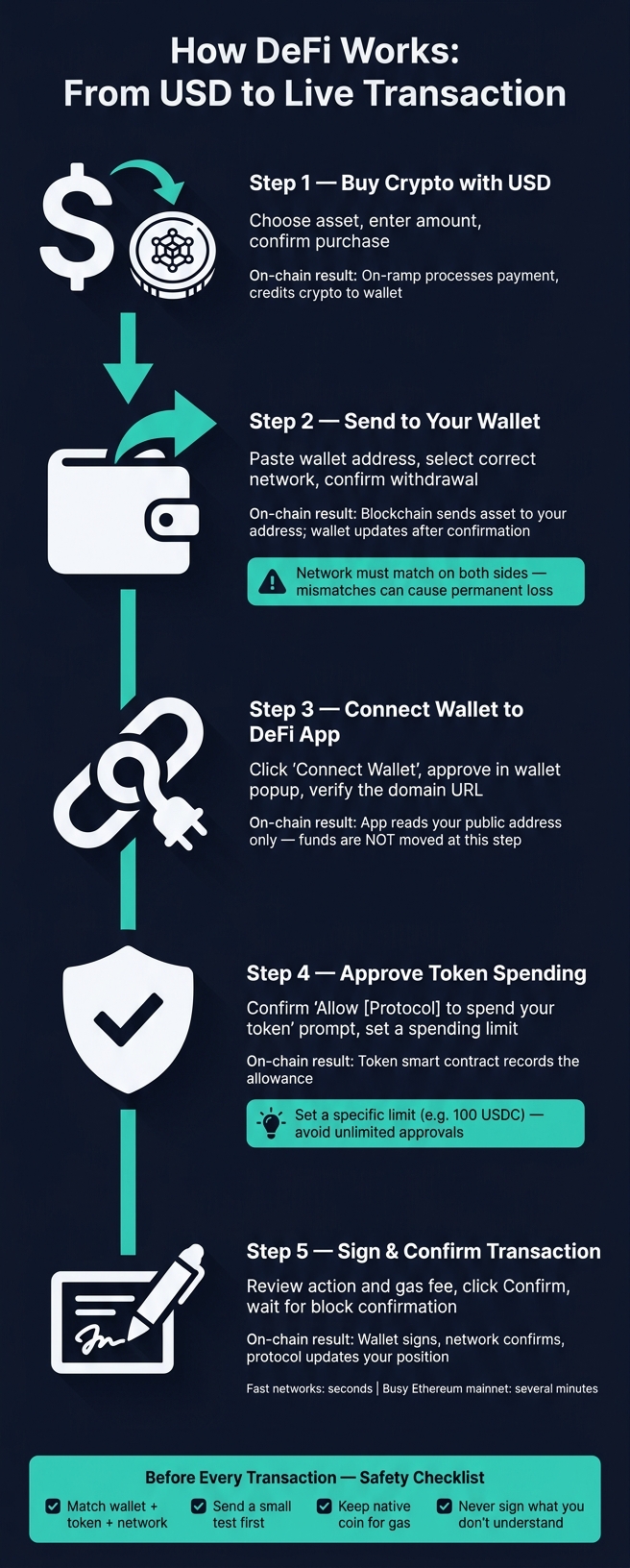
How DeFi Works: 5 Steps from USD to Live Transaction
Moving money into DeFi usually follows four steps: buy, send, connect, and sign. Your wallet signs the action, the blockchain records it, and the protocol does the rest.
From U.S. Dollars to a Funded Wallet
Once your wallet is set up, the next job is putting funds on the correct network. Most beginners in the U.S. start with a fiat-to-crypto on-ramp. That’s a service that turns U.S. dollars into a crypto asset and sends it to the personal wallet address you enter. Kryptonim lets users buy crypto and send it straight to a personal wallet without creating an account.
Before you click “Send,” there’s one thing that matters more than anything else: the network must match. Your wallet, the withdrawal network, and the DeFi protocol all need to run on the same network. USDC on Ethereum and USDC on Polygon may share the same name, but they’re different tokens on different networks. You can’t swap them in for one another. If you send funds on the wrong network, the loss can be permanent.
A simple routine can help lower that risk:
- Check the first and last four characters of your wallet address
- Make sure the network name matches on both sides
- Send a small test amount before sending a larger amount
There’s also one more cost to plan for: gas fees. You pay these fees in the network’s native token, not in the token you’re moving. On Ethereum, for example, gas is paid in ETH. So if you’re depositing USDC on Ethereum, you still need a small amount of ETH in the wallet. If you’re funding a new wallet for Ethereum DeFi, it often makes sense to send a little extra ETH with your main asset so you can cover approvals, swaps, and deposits.
Connect, Approve, Sign, and Confirm
Here’s what the full path looks like from dollars to a live DeFi transaction. Each step includes something the user does and something that happens on-chain.
1. Buy crypto with USD
Choose an asset, enter the amount, review the estimated crypto and fees, and confirm. The on-ramp processes the payment, locks in the exchange rate, and credits the crypto balance.
2. Send to wallet with funds
Paste your wallet address, pick the network, confirm the withdrawal, and wait. The blockchain sends the asset to your address, and your wallet updates after on-chain confirmation.
3. Connect wallet
Click Connect Wallet and approve the site in the wallet popup. Check the domain name carefully. It should match the official project URL exactly. At this stage, the wallet shares your public address and lets the app ask for signatures. It does not let the app move your funds.
4. Approve token
You may see a prompt like “Allow [Protocol] to spend your USDC?” along with a gas fee estimate. Choose a limit and confirm. A set limit - say 100 USDC when you plan to deposit 90 - is safer than giving an unlimited approval, especially if you haven’t used that protocol before. The token’s smart contract then records that allowance, which lets the protocol access up to that amount.
5. Sign and confirm the transaction
Review the action, check the gas fee, click Confirm, and wait. Both the wallet and the app will show the transaction as pending until the block confirms it. On fast networks, this can take a few seconds. On a busy Ethereum mainnet, it can take several minutes based on the gas fee you paid. The wallet signs, the network confirms, and the protocol updates your position.
That same flow is used for lending, swaps, and yield tools.
The Main DeFi Use Cases: Lending, Borrowing, Trading, and Yield
Once your wallet has funds and is connected, most DeFi actions work in pretty much the same way: you sign a transaction, the smart contract runs it, and the result shows up on-chain. For most people, the first steps fall into four buckets: lending, borrowing, trading, or earning yield.
The flow may look similar each time, but your money behaves differently in each case. And so does the risk.
Lending and Borrowing Through Collateral Pools
Lending is usually the easiest place to start. You deposit a token - say, $1,000 in USDC - into a lending protocol like Aave. Your deposit goes into a shared pool. Borrowers take funds from that pool, pay interest, and you earn part of that interest in return. If the average deposit APY is 4%, you’d make about $40 over one year on that $1,000.
Borrowing flips the setup, but there’s a catch: you have to deposit more than you want to borrow. This is called overcollateralization. Say you deposit $1,500 worth of ETH and borrow $900 in USDC. That extra cushion helps protect the loan if the value of your ETH drops.
The protocol keeps track of your position with a health score. If that score gets too low, automated bots can step in and sell part or all of your collateral to pay back the loan. Their liquidation bonus usually falls in the 5%–15% range, and that comes out of your collateral. So yes, you still have the USDC you borrowed - but you can lose some, or even all, of the ETH you posted.
Rates on both the lending and borrowing side are usually variable. That means they move based on how much of the pool is already being borrowed. When utilization is high, borrowing gets more expensive and lenders earn more. When utilization is low, rates usually drift down.
Trading with Swaps and Liquidity Pools
DEXs don’t use order books the way many stock apps or large exchanges do. Instead, they run on liquidity pools - smart contracts that hold two tokens, like ETH and USDC. When you swap ETH for USDC on a DEX like Uniswap, you trade against that pool, not against another person directly.
The price comes from a formula tied to the pool’s token balances. After each trade, the balances change, and the price updates with them.
The fees from those swaps go to liquidity providers, or LPs, rather than to a company in the middle. That’s the upside. The downside is impermanent loss. If one token in the pair moves hard in price, LPs can end up with less total value than if they had just held both tokens in their wallet.
A pair like USDC/USDT cuts that risk by a lot because those tokens usually stay close in price. That’s a big reason stablecoin pools are often the first stop for people who want fee income without taking on the same kind of price swings.
That same pool setup is also what lets LPs earn yield.
Yield Tools and How Returns Are Generated
Yield in DeFi doesn’t come from thin air. It usually comes from a few main sources: lending interest paid by borrowers, trading fees paid by swappers, and incentive tokens handed out by protocols that want more liquidity.
Some tools, like Yearn, try to handle the heavy lifting for you. They can move funds between different strategies - like lending, liquidity provision, and staking - with the goal of getting better returns and compounding them over time.
That sounds great on paper. But the headline APY can mix several things together: interest, fees, and incentive tokens. So before chasing a high number, check where the return is coming from. A bigger APY can also mean more moving parts, more price swings in the payout, or more smart-contract risk stacked on top.
Those moving parts are what create the main risk points covered next.
Where DeFi Risk Enters and What Beginners Should Know
The same things that make DeFi open - self-custody, token approvals, and code that runs on its own - also create the biggest risks.
DeFi is open and easy to trace onchain. But it is not safe by default. Bugs, bad price feeds, and sharp market moves can wipe out a position fast. And unlike a bank account, DeFi usually comes with no deposit insurance and no guaranteed fraud reversal.
Smart-Contract, Liquidation, Oracle, and Liquidity Risks
Most DeFi blowups come from four places: smart contracts, liquidations, oracle feeds, and liquidity.
Smart-contract risk is the risk that a protocol’s code has a flaw that someone can exploit. Audits help, but they are not a promise that the code is safe. According to Chainalysis, DeFi hacks led to about $3.1 billion in losses in 2022 and about $1.1 billion in 2023.
Liquidation risk hits closer to home. If you borrow against crypto collateral and its price drops far enough, the protocol can sell part of your position on its own once your collateral ratio falls below the required level. That sale often comes with a penalty. You may still have the borrowed funds, but you can lose a large share of the assets you put up.
Oracle risk is easier to miss. DeFi apps depend on outside price feeds to figure out what collateral is worth. If that data is late, wrong, or manipulated, the protocol can liquidate users by mistake or price loans the wrong way.
Liquidity risk makes bad situations worse. In thin pools or during a rush for the exits, you may face heavy slippage or long withdrawal delays. On paper, your assets may look fine. In practice, getting out can cost more than you expected.
Wallet Security and Governance Changes
Your wallet is your control center, but it won’t save you from a bad signature. If you lose your seed phrase, access to your funds may be gone for good. If you approve a malicious contract, an attacker may drain your tokens with a single approval.
A few habits go a long way:
- Verify the URL every time
- Bookmark DeFi sites you use often
- Use a hardware wallet
- Revoke token approvals you no longer need
There’s also governance risk. DAOs can change borrowing rates, collateral rules, or liquidation penalties fast. That means the terms can shift after you deposit. Before putting money in, check how much voting power is held by a small group.
Start small - $10 to $50 is enough to learn. Double-check the network, read the audit history, and never sign a transaction you don’t understand.
FAQs
How much money do I need to start with DeFi?
You don’t need a lot of money to get started with DeFi, but you do need to meet the platform’s minimum buy amount. With Kryptonim, the minimum fiat amount for an exchange is $10.00.
You should also factor in network transaction fees, which change from one blockchain to another. Some networks, like Polygon, may cost less than $0.01 per transaction, while others can get much more expensive when traffic spikes.
Only use money you can afford to lose.
What happens if I send crypto on the wrong network?
Sending cryptocurrency on the wrong network can lead to permanent loss of funds. Blockchain transactions can't be reversed, so if you send assets to an address on a network that doesn't match, those funds usually can't be recovered.
To avoid that kind of mistake, always check that the network you selected matches the recipient's address before you confirm the transaction.
How can I tell if a DeFi app is safe to use?
Look for transparent, regulated platforms when you can. Check for regular security audits, clear reserve backing for stablecoins, and AML/KYC compliance. If the platform uses smart contracts, make sure those contracts are secure and reviewed. It also helps to know the main risks up front, including smart-contract bugs, bridge failures, and Layer 2 issues.
On your side, use a non-custodial wallet and turn on 2FA when it’s available. Always double-check wallet addresses before sending anything. And start with small amounts. In crypto, transactions are irreversible, so a small test first can save you from a costly mistake.