
3 Crypto Verification Tiers and Limits
Overview of basic, standard, and advanced crypto KYC tiers and how they affect deposits, withdrawals, and trading limits.

Before depositing crypto or dollars, I check 3 things: deposit, withdrawal, and trading limits. Permission to deposit doesn’t mean you can trade or withdraw that money right away.
Here’s how I compare the 3 common verification tiers:
- Basic: Personal details, with ID sometimes required; funding and withdrawals may be restricted.
- Standard: Government-issued ID, sometimes with proof of address; more payment options and higher limits.
- Advanced: More address and source-of-funds documents; the highest available limits, but transactions can still face review.
Quick Comparison
| Tier | Typical checks | Deposit access | Withdrawal and trading limits |
|---|---|---|---|
| Basic | Personal details; ID may be required | Limited or unavailable | Low or disabled |
| Standard | ID; address proof may be requested | More supported methods | Higher, platform-specific caps |
| Advanced | Address and source-of-funds proof | Higher approved caps | Highest approved caps |
These tiers aren’t universal. I check the platform’s current rules, per-transaction and daily or monthly caps, and U.S. state restrictions before funding. <u>Higher verification doesn’t remove holds or further checks.</u>
No account doesn’t mean no verification, either. Kryptonim checks identity during checkout and sets requirements based on transaction risk rather than fixed tiers.
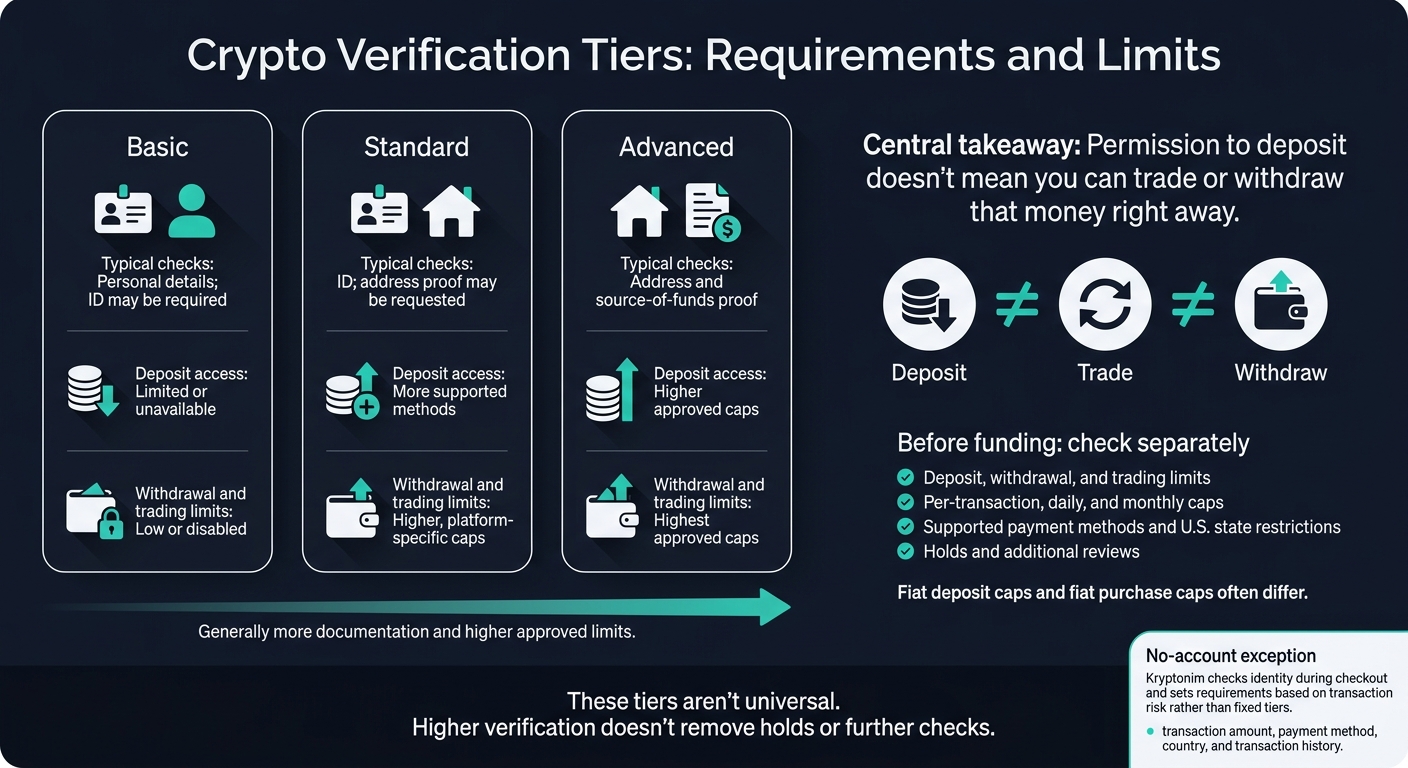
Crypto Verification Tiers: Requirements and Limits
How Deposit, Withdrawal, and Trading Limits Work
Deposits, withdrawals, and trading have different limits, and verification tiers affect each one differently. Fiat deposit caps and fiat purchase caps often differ. Purchase caps are usually lower because bank payments carry higher fraud and chargeback risk.
Crypto deposits can come with separate holds or reviews, so funds that arrive may not be ready to trade or withdraw. Identity checks and reviews of unusual activity can also delay access.
Withdrawal caps usually increase with each verification tier. Basic verification often limits withdrawals. Standard verification can increase those caps and open access to fiat-to-crypto trading, while advanced verification usually offers the highest limits. Even at higher tiers, reviews and temporary holds can still apply.
In the U.S., your location can affect access, too. State rules can determine which funding methods, trading pairs, and features you can use. Check state-specific disclosures before assuming a feature is available to you.
sbb-itb-0796ce6
1. Basic Verification
Basic verification is the lowest tier, so it usually comes with limited access.
Required Information and Documents
Basic verification, sometimes called Starter or Light, usually asks you to verify your email and phone number and provide your legal name, date of birth, and residential address. These labels aren’t standardized. Some platforms also require a government-issued photo ID before you can buy or withdraw.
Enter your name exactly as it appears on your driver’s license, passport, or state ID. If the platform requests proof of address, use a recent utility bill or bank statement issued within the past 3 months. Details that don’t match, expired IDs, or unsupported documents can delay approval or lead to another verification check.
Deposit Access and Payment Methods
Basic access may let you make small crypto deposits or purchases. But bank transfers and debit-card purchases are often blocked until you pass identity and payment checks. Check which funding methods you can use - having an account or a deposit address doesn’t mean you can fund it through every method.
Withdrawal and Trading Limits
Withdrawals to an external wallet may have low limits or stay disabled. Access to the trading screen doesn’t mean you can trade. Check your limits page for caps on individual transactions or across a rolling period.
Restrictions and Further Reviews
A new payment method, a failed identity check, or unusual activity can prompt another ID, address, or payment verification. Submit the documents the platform requests. Higher tiers usually provide more access and higher limits.
2. Standard Identity Verification
Standard verification is the next step up from Basic, with stronger identity checks.
Required Information and Documents
You’ll typically need to provide your full name, residential address, date of birth, and government-issued ID. Platforms may also ask for proof of address and an explanation of where your funds come from.
Deposit, Withdrawal, and Trading Limits
Approval often gives you access to more deposit methods and higher funding caps. Location and payment checks still apply.
Standard verification also usually increases withdrawal and trading limits, though caps vary by platform.
Restrictions and Further Reviews
Incorrect or outdated documents can slow down the review. Higher-risk or unusual activity may prompt additional checks and temporarily restrict funding, withdrawals, or trading.
Keep records showing where your funds come from available. If the platform needs more assurance, it may move you to advanced verification.
3. Advanced Verification
If Standard verification doesn’t give you the limits you need, an exchange may require Advanced verification. This tier asks for stronger proof of identity, address, and funds. Often called Verified Plus or enhanced due diligence, it’s usually reserved for higher-volume or higher-risk users.
Required Information and Documents
Beyond Standard documents, you’ll need more detailed proof of address and proof of income or source of funds.
These may include utility bills, bank statements, pay stubs, tax returns, or asset-sale paperwork.
Address documents often need to be 3 to 6 months old. You may also need to complete a compliance questionnaire or video interview, so keep your physical ID ready.
Deposit Access and Payment Methods
Advanced approval may increase your deposit limit, but it doesn’t guarantee access to every payment method. Before funding your account, check your approved limit and confirm that your payment method is available for your location and profile.
Withdrawal and Trading Limits
This tier usually offers the highest withdrawal and trading limits - not unlimited access. Confirm your approved limits before planning a large transfer. Larger transactions must still match the financial profile you provided.
Restrictions and Further Reviews
Approval doesn’t remove holds or further compliance checks. The exchange may still request updated documents, screen for sanctions, check for politically exposed person status, or review specific transactions. It can also decline a transaction if the risk is too high, even if the amount falls within your approved limits.
Compare Verification Requirements and Limits
Verification tiers have different names across platforms. Use this table as a general guide - not a guarantee of access or limits. Your limits depend on risk review, account history, location, payment method, asset type, and compliance controls.
| Verification tier | Typical information or documents | Fiat deposit access | Crypto deposit access | Withdrawal capacity | Trading capacity | Common restrictions |
|---|---|---|---|---|---|---|
| Basic | Name, email, date of birth; ID may be required | Restricted or unavailable | Low-volume deposits only | Low daily or monthly limits | Basic pairs or low trading volumes | No fiat withdrawals; restricted in high-risk jurisdictions |
| Standard | Government-issued ID and selfie; proof of address may be required | Supported fiat methods | Unrestricted for most assets | Moderate retail limits | Full access to exchange features | Monitoring for unusual patterns |
| Advanced | Proof of address and source-of-funds documentation | High-volume access | Unrestricted | Highest available limits | Highest limits | Additional compliance review may apply to high-risk profiles |
Limits may vary by transaction type and apply per transaction, daily, or monthly.
Limits stated in BTC or ETH don't represent a fixed USD amount. Their dollar value changes with market prices.
For a simpler fiat-to-crypto process, the next section covers a no-account option.
Kryptonim: Verification Without Account Creation
Verification doesn’t always mean signing up for an account. Kryptonim lets you buy crypto with fiat without creating one, though it still checks your identity during checkout.
Kryptonim uses a risk-based approach rather than fixed tiers. Your transaction amount, payment method, country, and transaction history determine verification requirements and order limits. Higher-risk orders may require extra checkout checks and requests for proof of where your funds came from.
Check the checkout screen for your order’s exact document requirements and limits before funding a purchase. Have a government-issued ID and proof of address ready if requested. If you’re in the U.S., also confirm that your state and payment method are supported.
Conclusion: Check Limits Before Funding
Basic tiers limit access, standard tiers cover everyday use, and advanced tiers allow higher volumes. Higher limits don’t rule out review or rejection if activity looks unusual.
Before funding, check deposit, withdrawal, and trading limits separately, including per-transaction, daily, and monthly caps. Being allowed to deposit an amount doesn’t mean you can withdraw or trade that same amount right away.
Use official platform documentation and AML/KYC policies - not third-party ranges. Check each page’s “Last Updated” date, and ask support to confirm any unclear limits before funding.
FAQs
How do I know which verification level I need?
Check your account profile or checkout screen to see your current verification status and limits. Requirements generally depend on your transaction volume, risk profile, and applicable regulations.
You’ll usually start with standard identity verification, such as a government-issued ID and a selfie. For larger transactions or higher limits, you may need Enhanced Due Diligence. This requires additional documents, such as proof of address or proof of funds.
What should I do if my funds are on hold?
Check your email and in-app notifications for verification updates or requests for more documents. If your status hasn’t changed after three business days, contact support through in-app live chat or email. Include details about the issue, any error messages, relevant screenshots, and the email address you used for the transaction.
Some platforms may hold deposits for up to seven days to prevent fraud.
Can I use Kryptonim without proof of income?
Yes, but Kryptonim may ask where your funds come from as part of Customer Due Diligence (CDD). Standard verification typically requires a government-issued ID and proof of address.
To comply with anti-money laundering regulations, Kryptonim may also ask you to explain your source of funds or wealth. This is especially likely for higher-risk users or those requesting higher transaction limits, who may need to undergo Enhanced Due Diligence (EDD).