
Ultimate Guide to Crypto Tutorials
Step-by-step beginner's guide to wallets, security, orders, fees, and a 90-day plan to safely make your first crypto trades.

Most new crypto users do not lose money because they missed a chart pattern. They lose money because they skip wallet setup, fees, and security.
If I were starting crypto in the U.S. on July 25, 2026, I’d keep the goal simple: learn the basics, set up security first, understand how orders and fees work, and make one small test transaction before sending more than a few dollars. That is the shortest path from confusion to safe first action.
Here’s what this guide helps me do:
- Learn the right order: basics → wallets → security → buying tools → practice
- Check whether a tutorial is worth using: clear sequence, recent updates, known author, no wild profit claims
- Avoid beginner mistakes: wrong wallet address, wrong network, weak passwords, skipped 2FA, hype-based decisions
- Use a platform with less guesswork: know what fees I’m paying, what wallet I need, and what happens after I click “buy”
- Build a 90-day habit: month 1 for setup and study, month 2 for small orders and fee tracking, month 3 for review and mistake control
A few facts matter right away:
- Crypto transfers are often final
- Network fees can change based on demand
- A market order buys or sells at the current price
- A limit order waits for the price I choose
- A seed phrase can control my wallet, so if I lose it or share it, I can lose my coins
The short version: a good tutorial should teach me how crypto works, how wallets work, how to stay safe, how to place a first order, and how to spot bad advice before it costs me money.
| What I should look for | What I should avoid |
|---|---|
| Clear steps for beginners | “100x” or “guaranteed income” claims |
| Plain fee breakdowns | Hidden costs or vague “platform fee” labels |
| Wallet and 2FA setup help | Tutorials that skip security |
| Small test transfer advice | Pressure to act now |
| Recent update date and named author | Anonymous pages built around affiliate links |
If I use this article the right way, I should finish with a simple checklist: know the terms, secure my accounts, pick a wallet, test with a small amount, and ignore hype.
Core Topics Every Beginner Crypto Tutorial Should Cover
If a tutorial skips any of these areas, it leaves you underprepared before you put real money on the line.
Crypto Basics, Wallets, and Key Terms
A good tutorial starts with the basics. Cryptocurrency is a digital asset secured by cryptography, and blockchain is the public ledger that records transactions.
It should also explain wallets in plain English. Your public address works like an account number that you share to receive funds. Your private key and seed phrase give you control over your wallet. If you lose them, you can lose access for good.
Wallet types matter too:
- Hot wallets are connected to the internet. They're easy to use, but they come with more risk.
- Cold wallets are offline hardware wallets. They're a better fit for larger holdings or coins you plan to keep for a long time.
Before you trade, you also need a few basic terms. Fiat means government-issued currency like USD, which people use to buy digital assets. Gas fees are the fees paid to a network to process transactions, and they go up or down based on demand. Liquidity refers to how easily an asset can be sold without changing its price too much.
Buying, Selling, and Using Exchange Tools
Once the basics are clear, the tutorial should walk through a first transaction step by step. That includes how to fund an account with USD or another fiat currency, plus the difference between a market order and a limit order.
A market order fills right away at the current price. A limit order fills only if the asset reaches the price you set.
Fees need to be spelled out clearly. A complete tutorial covers trading fees, deposit and withdrawal fees, and network fees, which come from the blockchain rather than the exchange. It should also point out a simple tradeoff: bank transfers usually cost less but take more time, while card payments are faster but cost more.
One point many tutorials gloss over: crypto transactions are irreversible. If you send funds to the wrong address, there isn't an undo button.
Risk Management and Security Basics
Any tutorial that skips security is incomplete. The first rule is simple: only use money you can afford to lose in full. Crypto prices can move hard and fast in short periods.
A tutorial should tell you to turn on 2FA before you add funds to any account. It should also stress strong, one-of-a-kind passwords. Phishing is one of the most common ways beginners lose money. That's why it's smart to bookmark official platform URLs and go there directly instead of clicking links from ads, emails, or DMs.
It should also tell you to send a small test amount first. That extra step helps confirm both the wallet address and the network before you move more money.
Last, beginners should learn what stop-loss orders do. They automatically sell an asset when the price hits a preset level.
Use these basics to judge whether a tutorial is worth following.
How to Evaluate Crypto Tutorials and Learning Resources
Not every tutorial deserves your time. Some teach. Others are sales pages wearing a teacher’s hat. Before you spend hours on a course - or spend a single dollar - check the resource first.
Signs a Tutorial Is Clear and Worth Using
Once you know the main topics you need to learn, the next step is simple: check whether the tutorial teaches them in the right sequence.
A good tutorial moves in a sensible order: basics → wallets and security → order types → practice. That flow matters. If a course throws you into chart patterns or token picks before you even understand the basics, it’s skipping the hard part and rushing to the flashy stuff. Pass on it.
Good tutorials also explain why things work, not just where to click. They should tell you why a fee changes, how a transaction gets confirmed, and what can happen if you make a mistake. That kind of teaching helps you think for yourself instead of copying steps blindly.
It also helps to check a few trust signals:
- A recent update date
- A clear author bio
- Credentials you can verify
If a resource checks those boxes, then it’s worth looking at the warning signs that can still sink it.
Red Flags That Signal Poor-Quality Education
The biggest warning sign is a promise. Any resource claiming "100x gains", "risk-free returns", or "guaranteed passive income" is not teaching you - it’s selling something. Good tutorials say the quiet part out loud: you can lose money.
Urgency is another bad sign. Phrases like "limited time" or pressure to sign up right away often mean the page was built to drive referrals, not help beginners learn. And if a tutorial skips basic security steps, it’s not ready for new users.
"If a platform spends more time hyping up a project's price target than explaining its smart contract risks or token distribution, walk away." - 99Bitcoins
You should also watch for hidden incentives. A lot of "best crypto tutorial" lists are little more than paid rankings. The top spot may go to the company paying the highest affiliate commission, not the one that teaches beginners well. If a site doesn’t explain how it makes money, treat its picks with caution.
Comparison Table: Strong Tutorials vs. Weak Tutorials
| Feature | Strong Tutorials | Weak Tutorials |
|---|---|---|
| Structure | Basics → wallets/security → order types → practice | Jumps straight to trading signals or hot coins |
| Content focus | Teaches process, mechanics, and risk management | Pushes tokens or sign-ups |
| Security coverage | Clearly teaches safety steps | Mentions security only in passing |
| Profit claims | Realistic; makes clear that losses are possible | Promises "100x gains" or "guaranteed" wealth |
| Fee explanation | Covers network gas fees and slippage | Ignores fees or calls them a flat "platform charge" |
| Transparency | Clear author bios and affiliate disclosures | Anonymous authors, hidden commercial relationships |
sbb-itb-0796ce6
How to Use Platforms and Tutorials Together
Use tutorials to learn the rules. Use platform guides to put those rules into practice. Once you’ve got the basics down, the next job is simple: pick platforms based on how easily they help you make a first purchase.
What to Look For in a Beginner-Friendly Crypto Platform
A good beginner platform should make the basics easy to follow. It should clearly separate processing fees from network fees, support common payment methods, and keep the flow simple enough that you can finish it without second-guessing every step.
It also helps when verification is spelled out in plain English. Clear onboarding makes it much easier to apply what you picked up from a tutorial instead of getting stuck halfway through.
How Kryptonim Fits Into a Beginner Learning Path
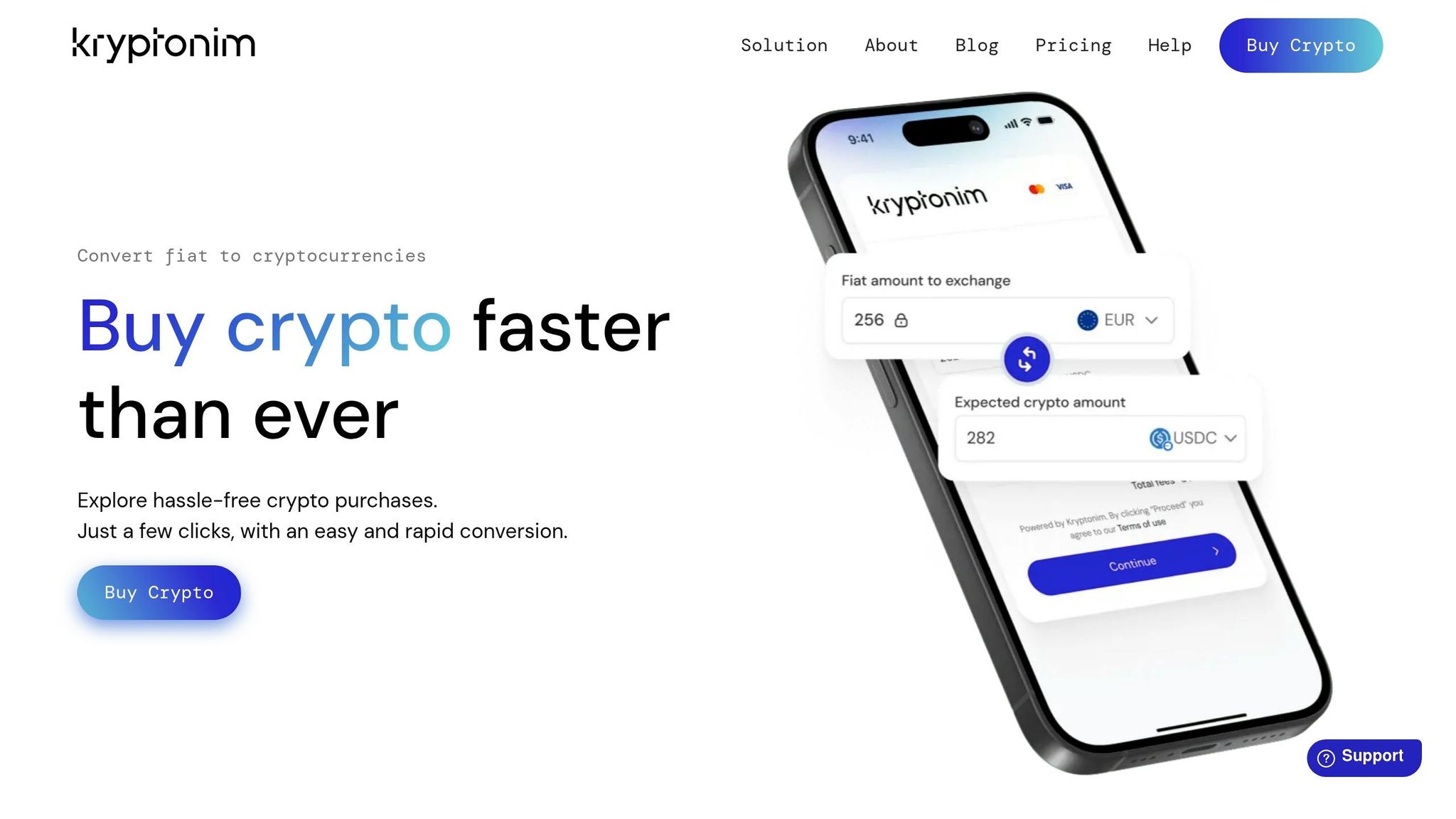
Once you understand wallets, private keys, network fees, and transaction finality, Kryptonim can work as a first-buy on-ramp.
Kryptonim is an EU-regulated fiat-to-crypto platform that lets you buy assets including BTC, ETH, and SOL using USD without opening an account. You enter an email, billing address, and wallet address, then pay with a supported payment method.
Because Kryptonim is non-custodial, it does not hold your funds or give you a built-in wallet. That means you need to have your own wallet ready before you start. Before making your first purchase, double-check that your wallet supports the exact network for the asset you’re buying. Sending crypto to the wrong network can lead to permanent loss.
Once that part is set, the next move is choosing the learning format that fits the job.
Comparison Table: In-App Guides, Articles, and Videos
Each format teaches in a different way, so it helps to know when to use which one.
| Format | Learning Speed | Depth | Ease of Review | Best Use Case |
|---|---|---|---|---|
| In-App Walkthroughs | Fast/Immediate | Low | High | First-time USD purchase |
| Long-Form Articles | Moderate | High | High | Understanding order types, fees, and security rules |
| Video Tutorials | Slow | Moderate | Low | Visualizing wallet setup and UI navigation |
Articles are best for building your base. Videos help when you need to watch a process play out on screen, like setting up MetaMask for the first time. Match the format to the task, then apply it in the 90-day plan below.
A 90-Day Crypto Learning Plan and Next Steps
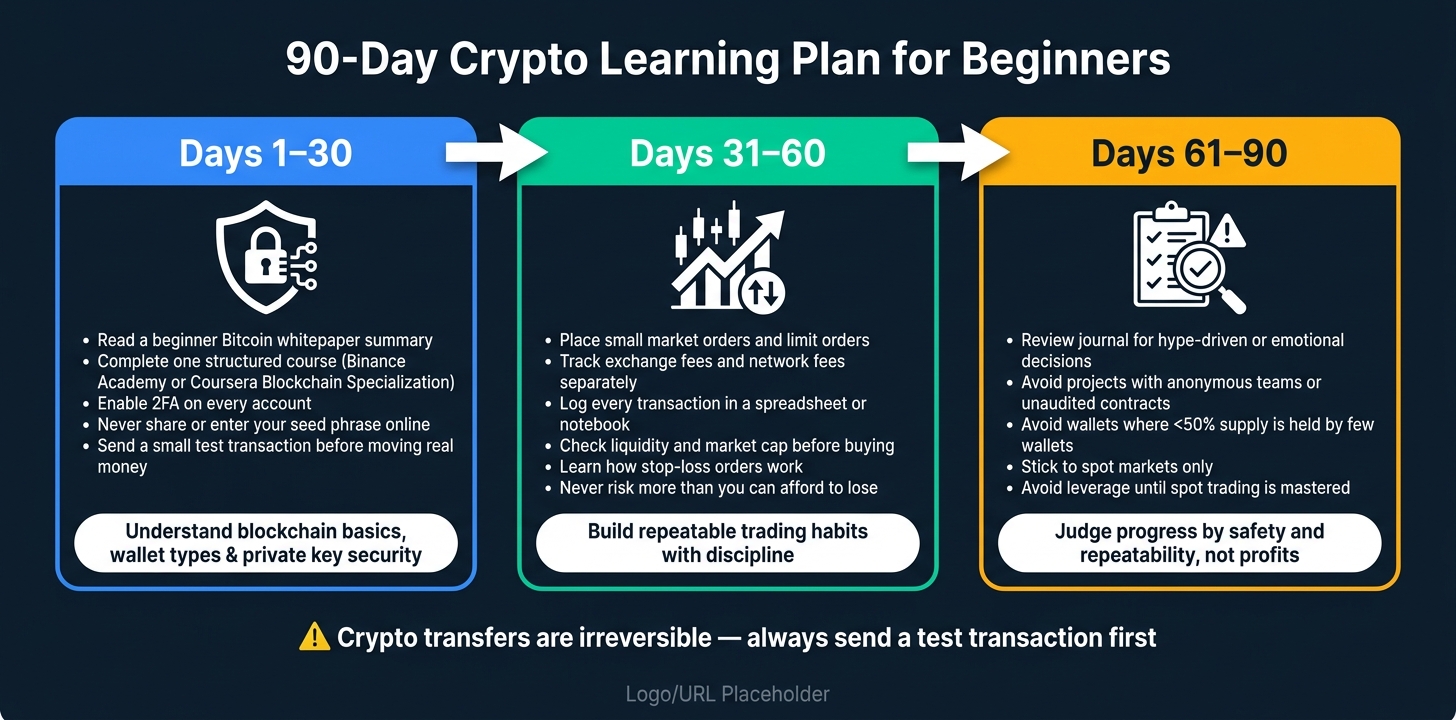
90-Day Crypto Learning Plan for Beginners
After you pick a tutorial format, use this 90-day plan to turn what you study into actual practice.
Days 1 to 30: Learn the Basics and Set Up Security
Use the first month to get the core ideas down. Read one beginner-friendly summary of the Bitcoin whitepaper, go through one structured course like Binance Academy or Coursera's Blockchain Specialization, and set up 2FA on every account you open.
Security comes first. Never type your seed phrase into a website or share it with anyone. If you lose it, you can't get it back. Before you move any real money, send a small test transaction. Crypto transfers can't be reversed, and one wrong address can lead to permanent loss.
By day 30, you should understand blockchain basics, wallet types, and private key security. If any of that still feels fuzzy, go back and review before moving ahead.
Days 31 to 60: Practice Orders, Fees, and Risk Rules
Once the basics make sense, shift from learning to small, controlled practice.
Start with small market orders and limit orders. Track exchange fees and network fees as separate costs, and write down every transaction in a simple spreadsheet or notebook. Before you buy any asset, check its liquidity and market cap.
This is also the time to build risk rules that you can stick to:
- Never put more into one position than you're prepared to lose
- Learn how stop-loss orders work before you're in a stressful trade
Discipline matters more than volume here. The point isn't to make as many trades as possible. The point is to build habits you can repeat without second-guessing yourself.
Days 61 to 90: Review Progress and Avoid Common Mistakes
Use the last month to review your habits, not to ramp up activity.
Go back through your journal and look for hype-driven or emotional decisions. Those patterns can cloud judgment and lead to mistakes you could have avoided. Stay away from projects with anonymous teams, more than 50% of supply held by a small number of wallets, or no audits. Stick with spot markets, and avoid leverage until you have a strong grasp of how spot trading works.
Judge your progress by the safety and repeatability of your process.
FAQs
How do I choose my first crypto wallet?
Choose based on security, convenience, and your own comfort with the tech.
Hosted wallets are beginner-friendly and work well for frequent transactions because the provider manages your private keys. That makes them simple to use, but it also means you're trusting someone else with access.
If you want full control, non-custodial wallets let you hold your own keys. The trade-off is that you need to manage your recovery phrase safely. Lose it, and getting back in can be a headache - or flat-out impossible.
For long-term storage of large holdings, hardware wallets offer the highest level of security. One more thing: make sure the wallet supports the blockchain network you plan to use. A wallet can look perfect on the surface and still be the wrong fit if it doesn't work with your network.
What should I do before my first crypto purchase?
Before you make your first cryptocurrency purchase, set up a personal, non-custodial wallet and keep your wallet address ready to go. You’ll also want a valid government-issued photo ID, a secure device, and a stable internet connection.
Just as important, pick a platform with a solid reputation that follows the rules. Use a strong password, turn on two-factor authentication, and keep a record of your transaction details for tax reporting later.
How can I tell if a crypto tutorial is trustworthy?
Look for clear, evidence-based education, instructor bios you can verify, and material updated within the last 18 months. The best tutorials spend more time on risk management, security, and core concepts than on hype or big promises.
A few warning signs should make you pause:
- Guaranteed profits
- Anonymous authors
- Pressure to join paid groups
- Undisclosed commercial relationships
If something feels off, trust that instinct and cross-check the claims with reputable data sources.