
Crypto Influencers: Risks and Rewards for Beginners
How crypto influencers help beginners, the scams and emotional risks to watch for, and practical steps to research and buy safely.
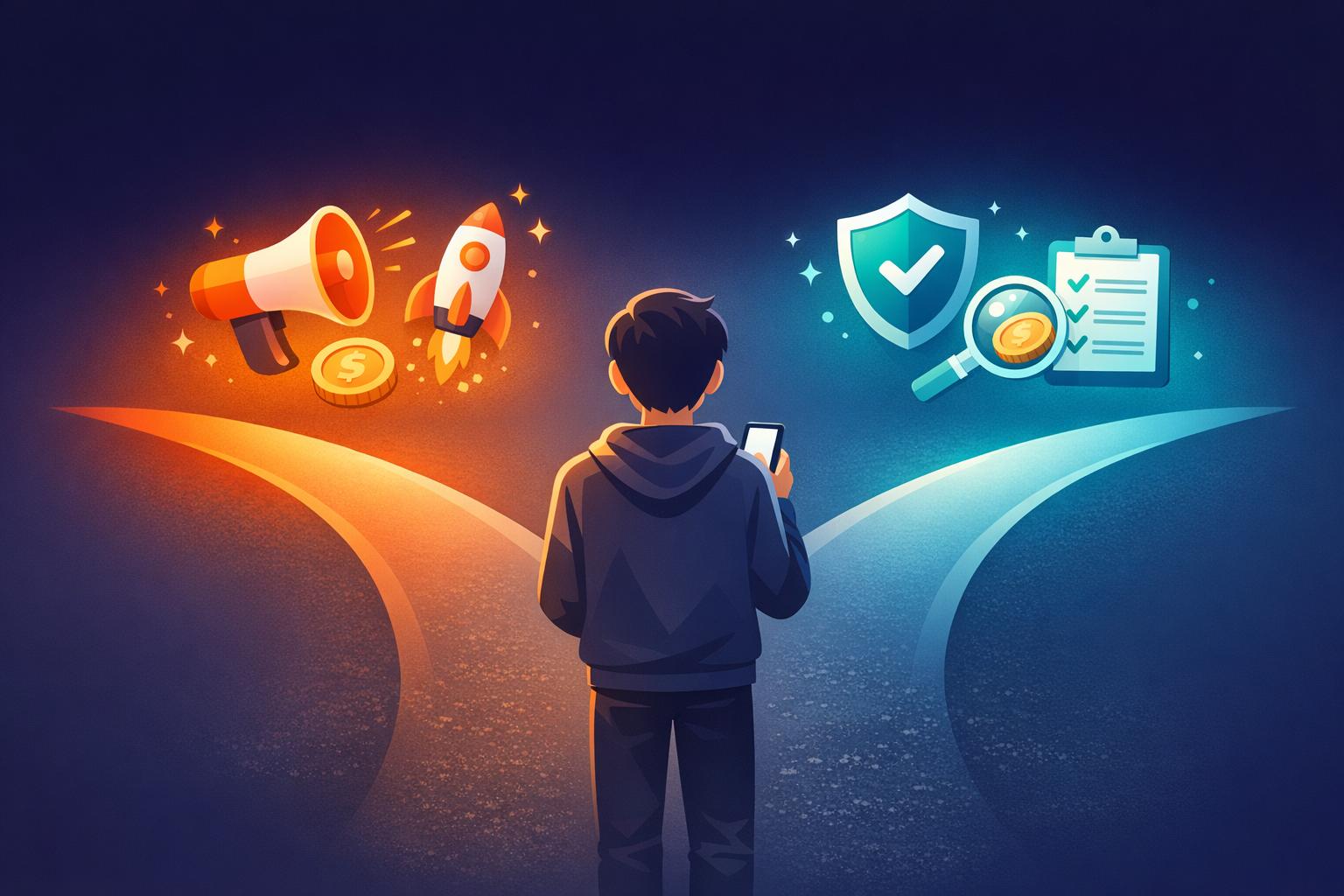
Crypto influencers simplify complex cryptocurrency ideas, making them accessible for beginners. They often share insights, trends, and investment tips on platforms like YouTube, TikTok, and Instagram. However, while influencers can help newcomers learn faster, relying solely on their advice comes with risks, including financial losses, emotional trading, and exposure to scams.
Key Points:
- Why Follow Influencers? They break down crypto jargon and highlight trends, but emotional triggers like FOMO can lead to impulsive decisions.
- Types of Influencers: Traders, educators, project founders, researchers, and meme creators cater to different needs.
- Risks: Influencer hype can cause financial losses, and some promote tokens without transparency.
- Red Flags: Watch for guaranteed returns, FOMO tactics, and undisclosed sponsorships.
- Safe Practices: Always do your own research, verify influencer claims, and use regulated platforms for transactions.
Quick Tip:
Use influencer insights as a starting point, not a final decision. Always cross-check information and prioritize secure platforms for crypto investments.
Benefits of Following Crypto Influencers
How Influencers Help Beginners Learn Faster
Getting into crypto can feel overwhelming. Whitepapers are dense, on-chain data is highly technical, and traditional finance resources rarely cover digital assets in depth. That’s where influencers step in - breaking down these complex topics into bite-sized, easy-to-understand content.
As Randa Moses, Editor at Cryptopolitan, explains:
"The new generation of crypto influencers simplifies complex ideas. They react to trends, entertain, and build community engagement around Web3 topics."
For beginners, platforms like YouTube Shorts and TikTok are goldmines. These platforms, where over 83% of Gen Z users logged in daily in 2025, offer visual content that’s much easier to digest than lengthy articles. Influencers also provide real-time insights during fast-paced market events, helping newcomers keep up with the rapidly changing crypto landscape. Plus, their ability to spotlight emerging trends makes them a valuable resource for anyone trying to stay ahead.
Spotting Trends and Sentiment Shifts
Influencers are often the first to notice and highlight shifting market sentiment. Whether it’s buzz around AI-integrated crypto, Real World Assets (RWAs), or Layer 2 solutions, credible influencers can identify these narratives well before they hit mainstream media. Their knack for condensing these complex ideas into quick, actionable insights is a huge advantage, especially when compared to the slower pace of traditional research.
For beginners, this speed can be a game-changer. For example, if a particular token suddenly starts trending, influencers often provide context in hours, not days. However, it’s crucial to remember that these insights should spark deeper research, not impulsive decisions.
Using Influencer Insights to Guide Research
The real value of influencer content lies in its ability to guide further exploration. When a trusted creator highlights an early-stage project or explains a new protocol, it’s not an automatic buy signal - it’s an invitation to dig deeper.
As Tang My Sang, a researcher at PLOS One, points out:
"Social media financial influencers significantly shape investors' attitudes and also exert a direct influence on investment decisions, highlighting both attitudinal and behavioral pathways."
sbb-itb-0796ce6
Risks of Relying on Crypto Influencers

Crypto Influencer Risks: Key Stats Every Beginner Must Know
Financial Risks from Influencer Hype
Relying on crypto influencers can lead to quick profits, but these gains often come with significant financial risks. Research reveals that while influencer mentions might initially boost cryptocurrency returns by around 1.83% on the first day, losses tend to follow. On average, investors face a 2.2% drop by day 10, which deepens to 6.5% by day 30.
The situation becomes even riskier with highly volatile assets like meme coins. These coins, often aggressively promoted by influencers, can lose nearly all their value shortly after a price spike. For instance, Logan Paul's promotion of the meme coin "Elongate" in May 2021 caused its price to skyrocket over 6,000%, only to crash soon after, leaving many investors with substantial losses.
Liquidity issues add another layer of risk. As Joseph Pacelli, Associate Professor at Harvard Business School, points out:
"No one is telling you when to get out, and it's sometimes difficult to get out of crypto. Some of these coins aren't super liquid, so people are potentially getting stuck in this position and losing lots of money."
Beyond these financial pitfalls, deceptive practices by influencers further amplify the dangers.
Red Flags to Watch for in Influencer Content
Not all influencers are upfront about their intentions. Some accept payments to promote tokens without disclosing their financial ties - a practice that's often illegal. A high-profile example occurred in October 2022, when Kim Kardashian faced SEC charges and paid $1.26 million in penalties for promoting EthereumMax (EMAX) on Instagram without revealing she had been paid $250,000 for the endorsement . Former SEC Chair Gary Gensler highlighted the importance of transparency:
"If a celebrity is promoting a particular crypto token, they are 'supposed to tell you if they get paid, how much they get paid, whether they own the tokens, whether they made money on the tokens, whether they actually know something about the project'."
To protect yourself, keep an eye out for these common red flags in influencer content:
- Guaranteed returns: Claims like "fixed daily returns" or "zero losses" are major warning signs.
- Referral-only focus: Heavy emphasis on sign-up links without addressing risks or project fundamentals.
- Anonymous project teams: Lack of identifiable founders, a legal entity, or a verifiable office address.
- Urgency and FOMO tactics: Phrases like "Get in now before it's too late" that push emotional decisions over rational thought.
Scammers are also leveraging technology to deceive investors. AI-enabled crypto scams, including deepfake videos mimicking real influencers, are becoming increasingly profitable. These scams were found to generate 4.5 times more revenue than traditional schemes, contributing to a staggering $17 billion in global crypto scam losses by 2025.
How Influencers Can Trigger Emotional Trading
Even well-meaning influencers can unintentionally encourage impulsive trading. Platforms like X (formerly Twitter) and Reddit often prioritize content that drives engagement, even if it sacrifices accuracy. This means users are more likely to see posts that align with their existing beliefs, while critical or cautionary information is filtered out.
This creates a feedback loop: the more bullish content you engage with, the more similar posts you’ll encounter. As Shyla Khan from Yellow.com explains:
"The infrastructure of cryptocurrency social media is not a passive information source - it is a behavioral architecture that systematically degrades the quality of trading decisions."
The consequences can be severe. About 75% of retail Bitcoin investors have lost money, with emotional decision-making playing a significant role. Beginners are particularly at risk. A study published in PLOS One found that people with greater digital financial literacy are often more prone to impulsive investments. In other words, the more confident someone feels using crypto tools, the more likely they are to act quickly - sometimes without fully considering the risks.
How to Safely Use Crypto Influencer Content
Do Your Own Research Before Acting on Influencer Advice
Considering the financial risks and the hype that often surrounds crypto, it's essential to conduct your own thorough research. Influencer advice can provide guidance, but it’s rarely the full picture. Always cross-check their claims with reliable sources like the project’s whitepaper, smart contract, and on-chain data.
To evaluate influencer claims effectively, use the "Four Pillars" framework:
- Authority: Does the influencer have relevant credentials or access to project insiders?
- Accuracy: Are their statements consistent with official documents?
- Objectivity: Do they disclose financial ties to the project?
- Recency: Is their information up-to-date?.
For a deeper dive, on-chain tools can be incredibly helpful. Platforms like Etherscan, Solscan, or BscScan allow you to analyze raw transaction data. To screen for potential scams like honeypots - contracts designed to let you buy but not sell - services such as Token Sniffer or DEXTools Audit are useful. Start by confirming that the contract is verified, liquidity is locked, and no single wallet holds more than 5–10% of the total token supply. For context, in April 2024 alone, approximately 850,000 tokens were created on the Solana network.
How to Evaluate Whether an Influencer Is Trustworthy
A study found that 68% of crypto advice on TikTok is misleading, and only 0.3% of influencers have relevant qualifications. This shows that follower count isn’t a reliable indicator of trustworthiness.
Instead, focus on their actions. Trustworthy influencers are transparent - they disclose their holdings, paid partnerships, and always include risk disclaimers. They prioritize education over pushing specific tokens. Be cautious of anyone telling you exactly how much to invest; half of misleading crypto videos suggest specific dollar amounts, ignoring individual financial circumstances. Another red flag? Influencers heavily promoting paid subscription groups - 70% of crypto TikTok influencers use their platforms to sell their own services.
Verification is crucial. Check whether the influencer is linked on the project’s official website or verified Discord server. If you can’t confirm their connection to the project, approach their advice with skepticism. Once you’ve assessed their credibility, protect your investments by using a regulated platform.
Using Secure Platforms When You Are Ready to Buy
After thorough research, the platform you choose to buy from is just as important as the asset itself. Rushing into purchases on unverified platforms - often due to influencer hype - can expose you to fraud.
Opt for a regulated, EU-compliant platform like Kryptonim for added security. Kryptonim is registered as a virtual asset service provider under Polish law and ensures its services align with your financial knowledge, experience, and situation.
"Its services are designed to enable organised and reliable exchange from fiat currencies to cryptocurrencies."
This structured approach, which includes identity verification, wallet compatibility checks, and transparent pricing without hidden fees, helps protect users from impulsive decisions. For beginners converting dollars to crypto for the first time, these safeguards can provide much-needed stability.
Conclusion
Crypto influencers make it easier for newcomers to grasp complex topics and stay updated on trends, but relying on them comes with some risks.
Key Takeaways
A 2026 study highlights how social media influencers significantly shape investor behavior, often leading to decisions made without thorough personal analysis.
"In practice, many cryptocurrency investors often rely on direct recommendations from finfluencers without much consideration for their personal financial knowledge." - Tang My Sang, Author and Researcher, Ho Chi Minh University of Banking
This points to the importance of conducting your own research before making investment decisions. Building digital financial literacy can act as a safeguard - by double-checking information and learning the basics of cryptocurrency, you can avoid falling into the trap of making decisions driven by hype or emotion. Use influencer content as a helpful starting point, but never as your sole guide.
When your research supports an investment decision, the platform you choose is just as critical. Opt for regulated services like Kryptonim, which allow conversions from USD to over 100 digital assets. With features like transparent pricing, identity verification, and no hidden fees, such platforms provide a secure and beginner-friendly way to enter the crypto world.
Stay informed by following influencers, but don’t mimic their trades blindly. Verify every claim and always prioritize using regulated platforms to protect your investments.
FAQs
How can I tell if a crypto influencer is being paid to promote a token?
When evaluating influencers in the crypto space, pay attention to disclosures of paid partnerships. Ethical influencers should clearly reveal any financial relationships they have. If an endorsement feels too glowing or biased without clear transparency, it’s worth questioning. A lack of disclosure might suggest the influencer is being compensated to promote the token without openly stating it.
What steps should I take to verify a token before buying it?
To verify a token, start by checking if its smart contract is verified on platforms like Etherscan or Solscan. This ensures transparency in how the contract operates. Next, confirm that liquidity is either locked or burned - this reduces the risk of rug pulls. It's also important to ensure the token's owner doesn’t have the ability to mint unlimited tokens, which could devalue the supply.
Take a close look at the token's distribution to spot any signs of potential manipulation, like a single wallet holding a large percentage of the supply. Tools like blockchain explorers can make this process easier, allowing you to quickly review contract safety, liquidity status, and holder details. Following these steps can help you avoid scams or risky tokens.
How do I avoid FOMO and emotional trading from influencer hype?
FOMO and emotional trading often stem from the buzz created by influencers and social media. To keep your decisions grounded, stick to disciplined strategies like dollar-cost averaging, which involves investing a fixed amount regularly, regardless of market conditions. Set clear entry rules in advance to guide your trades, and use a trade journal to track your decisions and learn from past outcomes.
Be cautious about the sway of social media. Avoid acting on hype or endorsements without proper research. Keeping a long-term perspective and resisting the temptation to chase market highs can help you stay level-headed, even during periods of market volatility.