
Crypto Broker vs Exchange: Which Fits Beginners
Compare brokers vs exchanges: ease, fees, wallet control — brokers for fast small buys; exchanges for lower recurring costs.

If I were buying crypto for the first time, I’d pick based on one thing: do I want the easiest first buy, or do I want lower costs over time? That’s the whole split here. A broker is simpler and often feels like online checkout. An exchange usually costs less per trade, but it asks me to learn more first.
Here’s the short answer:
- I’d use a broker if I want to buy $50 to $200 fast, with fewer steps
- I’d use an exchange if I plan to buy often, like $100 each week
- Brokers often fold costs into the price, with total buy costs often around 1% to 3%, and card buys sometimes around 3% to 5%
- Exchanges often charge trading fees around 0.10% to 0.60% per side, but I still need to watch for spread, slippage, and withdrawal fees
- Brokers may send crypto straight to my wallet
- Exchanges usually hold crypto in my account first, then I withdraw it myself
A simple example shows why this matters. A $3 fee on a $100 buy equals 3%. The same $3 fee on $500 is only 0.6%. And if Bitcoin is trading at $40,000 but I’m quoted $40,800, that gap is a 2% spread built into the price.
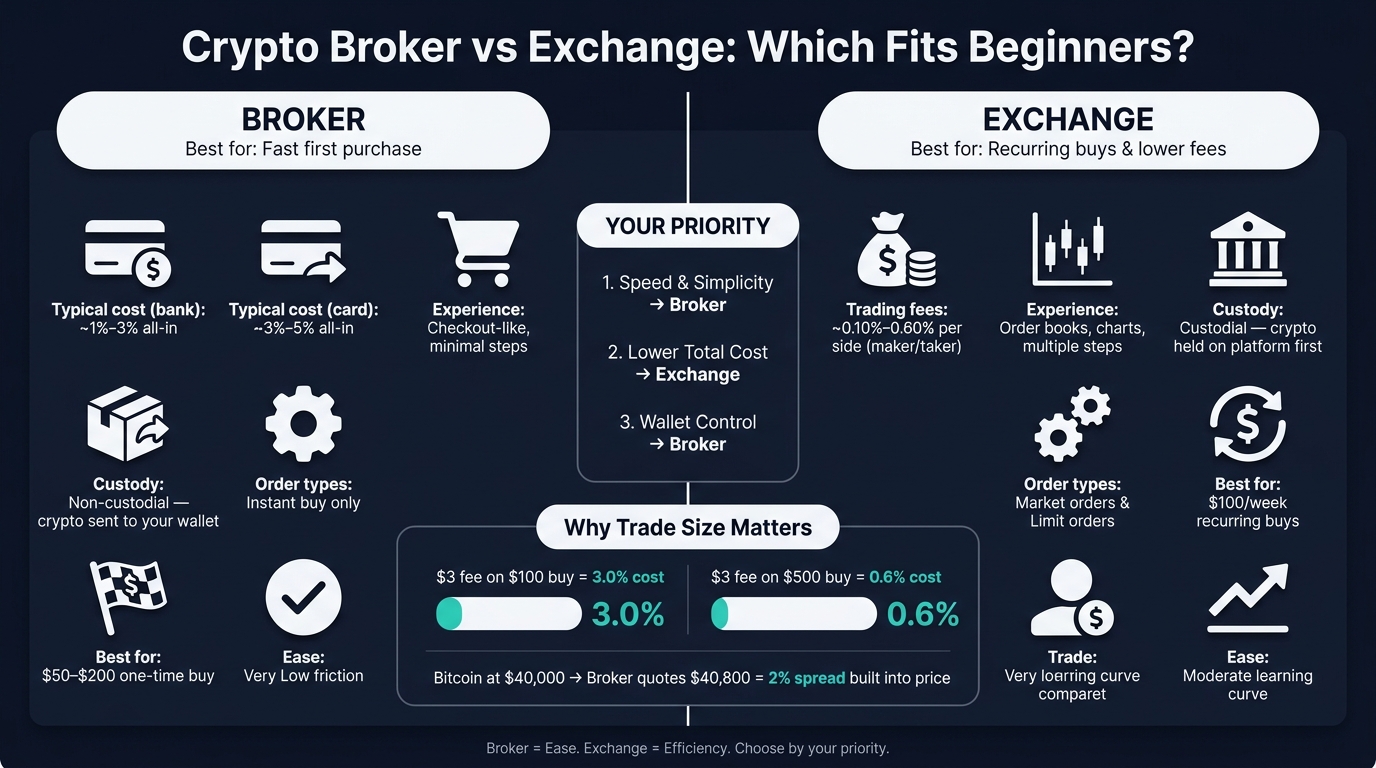
Crypto Broker vs Exchange: Beginner's Cost & Control Comparison
Quick Comparison
| What I care about | Broker | Exchange |
|---|---|---|
| First buy experience | Simple checkout | More setup |
| Pricing | Cost often built into quote | Market price plus trading fee |
| Typical small-buy cost | Often higher | Often lower |
| Order choices | Usually just buy now | Market and limit orders |
| Wallet access | May go straight to my wallet | Usually stays on platform first |
| Best for | Fast first purchase | Repeat buying and more control |
My rule of thumb: if I want the least friction, I’d start with a broker. If I want to cut costs over many buys, I’d spend the time to learn an exchange.
Below, I’d break down the trade-offs in crypto trading fees, control, and wallet access so I can pick the one that fits me now.
sbb-itb-0796ce6
Price and Fees: Simple Checkout vs Trading-Based Pricing
The main pricing gap comes down to where the cost shows up.
How Brokers Build Cost Into the Quoted Price
With a broker, you usually get one all-in USD quote: pay a set amount, receive a set amount of crypto. Part of the cost sits inside the spread, and some platforms also tack on a separate checkout fee.
That detail matters a lot for small first buys. Some broker-style apps end up around 1%–3% all-in once spread and fees are added together, and card purchases can land around 3%–5% all-in when platform, spread, and processing fees are included.
A quick example makes this easier to see. A flat $3 fee on a $100 buy is already 3%. On a $500 buy, that same $3 drops to 0.6%. Same fee, very different impact.
Here’s how the spread works in practice: if Bitcoin is trading at $40,000 and the broker quotes $40,800, that extra $800 is a 2% spread built into the quote instead of listed as a separate fee.
How Exchanges Separate Trade Price and Fees
Exchanges handle pricing in a more direct way. They show the market price first, then add a trading fee.
Many use a maker-taker model. Market orders usually pay taker fees. Limit orders often get lower maker fees, though that’s one of those things that can take a bit of time for beginners to get used to.
Maker-taker fees on exchanges often range from 0.10% to 0.60% per side. That can be cheaper than a broker’s built-in spread. But there’s a catch: you still need to factor in the trade price, the fee, and slippage to figure out what you’re paying in total. Some exchanges also add separate deposit or withdrawal fees, which makes the final cost less obvious at a glance.
| Broker / Simple Checkout | Exchange / Order Book | |
|---|---|---|
| Pricing model | All-in USD quote; cost built into the spread, sometimes plus a service fee | Live market price shown separately; explicit maker/taker fee schedule |
| Fee visibility | Partly embedded in the price; may not be itemized until checkout | Visible in a fee schedule, but requires interpretation |
So the trade-off is pretty simple. For a first $100 buy, ease of use may be worth paying more. If you plan to buy again and again, exchange fees start to matter a lot more.
Once price makes sense, the next issue is control: how much of it you want over the trade.
Control and Order Types: How Much Choice Do You Need
After price, the next thing most beginners look at is control.
Instant Buys for Fast First Purchases
With a broker-style checkout, the process is simple. You enter how much you want to spend, check the quoted price, and confirm. The platform takes care of the rest.
The downside is pretty clear: you get less control. You accept the price on screen, not one you set yourself. And the quoted amount usually locks in only when payment clears. That matters because bank transfers take longer, which leaves more time for the quote to change. Card purchases often wrap up in minutes, while bank transfers can take days.
Market and Limit Orders on Exchanges
Exchanges give you more say through order types.
A market order buys at the best current price available. It’s fast, but you don’t get to control the exact rate.
A limit order works differently. You set the price you want and wait. If the market hits that price, your order goes through. If it doesn’t, the order stays open.
That extra control can be useful, but it also adds one more thing to learn. For first-time buyers, a limit order only helps once you already know the price you’re aiming for.
| Feature | Instant-Buy (Broker) | Market Order (Exchange) | Limit Order (Exchange) |
|---|---|---|---|
| Control | Low (accept quoted price) | Medium (current market) | High (set specific price) |
| Execution | Guaranteed upon payment | Immediate at best price | Only if price is met |
| Speed | Minutes (card); days (bank) | Instant | Variable |
| Learning | Minimal | Low | Moderate |
Next comes wallet access: where the crypto goes after you buy.
Wallet Access and Learning Curve for First-Time Buyers
Once you pick how to buy, the next thing to figure out is where your crypto actually goes.
Custody and Wallet Access After Checkout
On exchanges, your crypto usually stays on the platform right after purchase. The exchange holds it for you, which is known as custodial storage. If you want to move it to a personal wallet like MetaMask or Trust Wallet, you need to make a separate withdrawal.
Some broker-style platforms work differently. They send the crypto straight to your wallet. You enter your wallet address before checkout, and once the payment clears, the crypto shows up there. That means you control the wallet from the start.
Crypto transfers can't be undone. Double-check that your wallet supports both the asset and the network, such as Polygon, before you pay.
This gap matters because it affects how fast a first-time buyer gets direct control of the asset.
| Feature | Crypto Broker | Crypto Exchange |
|---|---|---|
| Custody | Non-custodial; crypto sent to your personal wallet | Custodial; crypto held in platform account |
| Withdrawal Flexibility | Automatic; part of the purchase flow | Manual; requires a separate withdrawal step |
| Wallet Destination | Personal wallet you control | Platform account balance |
| Interface Complexity | Low; simple checkout widget | High; trading screens, order books, charts, and multiple balance types |
Which Setup Is Easier for a Complete Beginner
Broker-style platforms shrink the onboarding process quite a bit. Some ask for only an email and billing address to begin. Identity verification - which both brokers and exchanges must collect - is built right into checkout instead of being handled as a separate signup step. So the whole thing feels more like buying something online than opening a finance account.
Exchanges work in a more layered way. After you buy, the crypto lands in your platform account. If you want it in a personal wallet, you have to do a withdrawal after that. For a beginner, that's one more step and one more concept to figure out before they have full ownership.
For someone who just wants to buy a small amount of Bitcoin or Ethereum, broker-style checkout cuts down the distance between payment and control.
Which Option Fits Beginners Best
After fees, control, and wallet access, this choice mostly comes down to priorities. Your first buy usually hinges on one thing: speed, cost, or control.
Matching Your Priorities to the Right Platform
The main trade-off is ease vs. flexibility. Broker-style platforms roll their cost into the quoted price. Exchanges split the market price from the trading fee. That sounds simple on paper, but in practice, exchanges ask a bit more from you. You need to get comfortable with order types, funding steps, and withdrawals before the lower cost starts to matter.
Here’s a simple way to match your main goal to the platform that fits it best:
| Your Priority | Better Fit | Why |
|---|---|---|
| Fast, simple first purchase | Broker-style platform | Checkout-like flow, minimal decisions |
| Lower fees on recurring buys | Exchange | Transparent fee schedules, tighter spreads |
| Learning trading mechanics | Exchange | Order types, price charts, live order books |
| Immediate wallet control | Sends crypto directly to your wallet | Crypto goes straight to your wallet after checkout |
| Want to keep crypto on-platform for now | Custodial platform | No wallet transfer needed immediately |
If you just want to buy $50 to $200 of Bitcoin and see how it works, the fee gap between a broker and an exchange is usually pretty small. For most beginners, the bigger factor is friction. How many steps are you willing to deal with? If you want the cleanest path, a checkout-style platform is usually the easiest place to start.
If you plan to buy on a schedule - say, $100 each week - the fee gap starts to add up. Over time, that can make an exchange more appealing. In that case, spending a little time learning how the platform works can save money later.
A good way to decide is to rank these three things:
- Speed and simplicity
- Total cost
- Control over execution and custody
Whatever lands at the top should steer your choice right now.
FAQs
How do I compare the real total cost before I buy?
Compare the full price before checkout, including fees, exchange rates, and any markup. Watch out for vague pricing or costs tucked into the spread, because they can push up what you end up paying.
On Kryptonim, just enter the amount in USD in the converter to see the exact amount of crypto you’ll get. The checkout price already includes processing and network fees, so the total shown is the final total.
When should a beginner move crypto to a personal wallet?
A beginner should move crypto to a personal wallet when they want full control of their assets** and less exposure to risks like platform outages, account freezes, or hacking.
If your crypto is held by a custodian, moving it to your own wallet is an important security step. Before you transfer anything, make sure your wallet is set up safely and double-check any withdrawal fees.
Is a limit order worth learning for a first crypto purchase?
Usually, no.
For a first crypto purchase, a limit order can add extra hassle. It lets you choose a set buy price, but the order only fills if the market hits that price.
If you're new to crypto, simplicity and speed often matter more. A straightforward platform like Kryptonim can make things easier by showing the exact amount of crypto you’ll get at the current market rate.