
Challenges of Blockchain Adoption in Emerging Markets
Regulatory confusion, weak infrastructure, and fragmented blockchains are blocking emerging markets from realizing blockchain's promise.
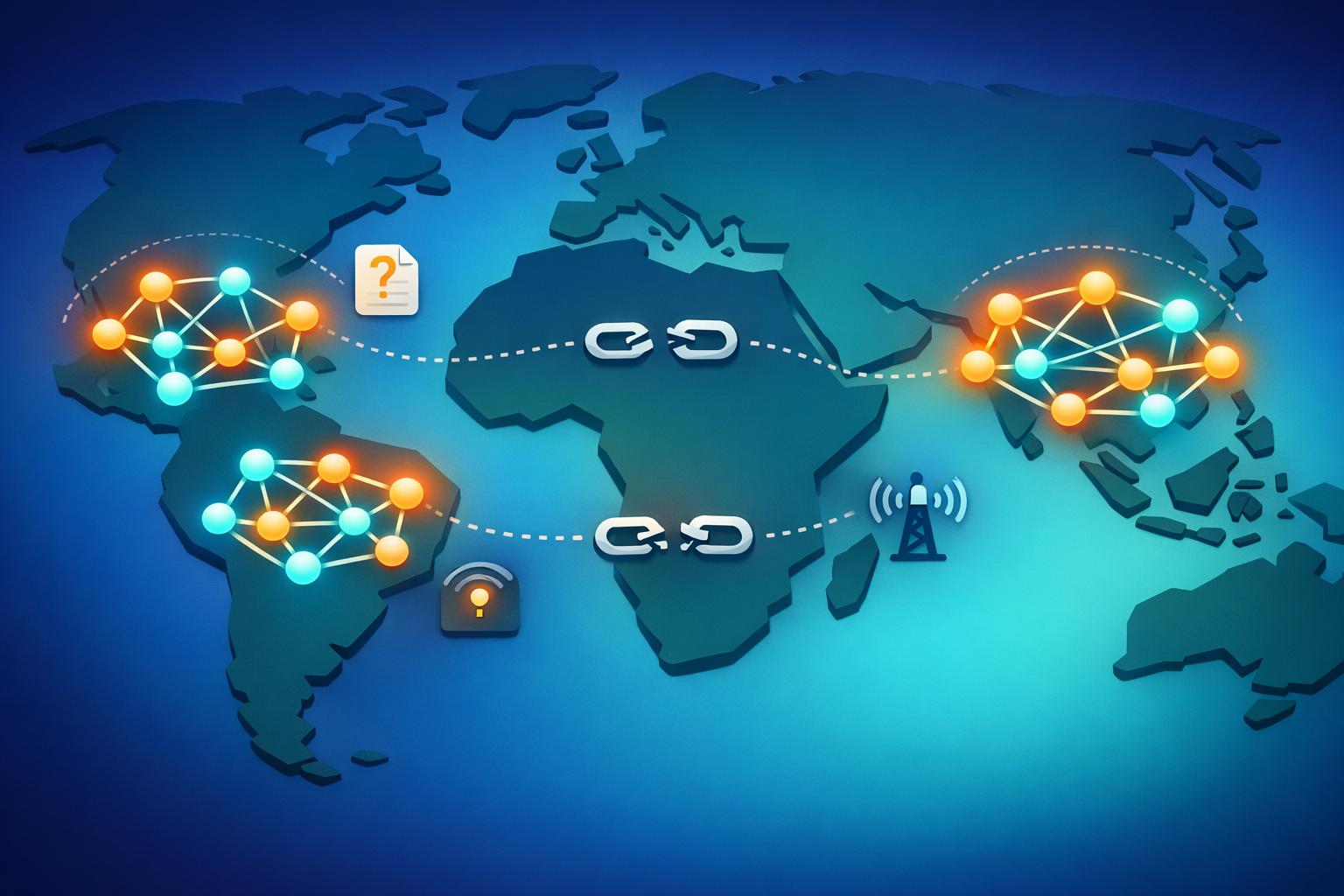
Emerging markets face several obstacles in adopting blockchain technology, despite its potential to improve financial inclusion and reduce costs. These challenges include unclear regulations, limited infrastructure, interoperability issues, skill shortages, and privacy concerns. Here's a quick breakdown:
- Regulation: Unclear rules make it hard for businesses to plan and invest confidently. Compliance costs are high, and inconsistent classifications create confusion.
- Infrastructure: Poor internet access, high energy demands, and a lack of skilled professionals hinder blockchain implementation.
- Interoperability: Blockchains often can't communicate with each other, causing inefficiencies and limiting cross-border trade.
- Skills and Resistance: A lack of expertise and hesitation to adopt new technology slow progress.
- Privacy and Costs: Transparency in blockchain can expose sensitive data, and high initial investments deter adoption.
To address these issues, solutions like regulatory sandboxes, Layer 2 scaling, standardized protocols, and education programs are essential. These steps can help emerging markets overcome barriers and access blockchain's benefits in areas like finance, supply chains, and digital payments.

5 Key Challenges of Blockchain Adoption in Emerging Markets
Regulatory Uncertainty and Legal Barriers
The absence of clear government guidelines has led to a patchwork approach to regulation, often driven by crises rather than proactive planning for growth. This lack of clarity makes it tough for businesses to plan long-term investments and erodes user confidence in the safety of their digital assets. Much of this uncertainty stems from regulators' limited understanding of blockchain technology, which complicates effective oversight.
Many regulatory bodies struggle to grasp the decentralized nature of blockchain. Without the necessary expertise, they risk creating overly restrictive rules that stifle progress or leaving gaps that expose users to fraud and scams. For example, in July 2025, Nigerian authorities tightened their framework to identify unlicensed crypto firms and prevent platforms from being used to bypass capital flow restrictions. According to the International Monetary Fund, this initiative aimed to align anti-money laundering (AML) supervision with the specific risks present in Nigeria's market.
Unclear regulations also come with significant financial costs. In 2024, crypto firms faced annual compliance costs averaging $500,000, with AML and Know Your Customer (KYC) protocols accounting for 30% of those expenses. These high costs often discourage local startups in emerging markets, leaving the field open to unregulated offshore entities, which further undermines public trust. Additionally, inconsistent digital asset classifications force businesses to navigate a maze of legal requirements - limiting their operations to single markets or exposing them to retroactive penalties for unintentional violations. Enforcement becomes even more challenging due to blockchain's decentralized structure, especially when local authorities fail to coordinate with international counterparts.
Solutions for Regulatory Challenges
Finding solutions to these legal barriers is critical for unlocking blockchain's potential in emerging markets. Addressing these challenges requires fresh approaches that balance effective oversight with industry growth.
One promising avenue is the use of regulatory sandboxes. These provide businesses with the opportunity to test blockchain applications under relaxed regulations while allowing regulators to learn alongside industry participants. Switzerland took this approach with the DLT Act, implemented in February 2021. By 2023, this law had integrated blockchain into existing legal frameworks and provided clear guidance for decentralized governance. Similarly, Liechtenstein introduced the Token and Trusted Technology Service Provider Act in January 2020. This law defined digital assets based on their function and extended property protections to blockchain through a "Token Container Model".
"Developing a proper governance and regulatory framework for blockchain-based applications will be essential to providing market participants the stability they need to fully engage with the technology and allowing innovation to flourish." – Marina Niforos, World Bank Group
Collaboration between public and private sectors also plays a key role. When regulators work closely with industry stakeholders, they can design frameworks that encourage innovation while safeguarding consumers. The IMF has emphasized the importance of building advanced analytical tools for market monitoring and fostering international cooperation to ensure AML measures address real risks effectively.
Standardizing regulatory frameworks across borders can further ease compliance challenges and build trust. While full harmonization may be difficult, emerging markets can adopt core principles for asset classification, taxation, and consumer protection that align with global standards. This approach not only simplifies cross-border operations but also signals regulatory stability, which can attract foreign investors.
sbb-itb-0796ce6
Infrastructure and Scalability Challenges
Emerging markets face tough hurdles when it comes to adopting blockchain technology. Issues like poor internet connectivity, underdeveloped digital infrastructure, and high energy needs make it difficult for blockchain networks to operate reliably or scale effectively in these regions.
One major challenge is the heavy reliance on mobile networks and cloud infrastructure, which are often insufficient in reaching underbanked populations. As Aarthi Krishnamurthy from Finacle points out, "Like any other technology, blockchain too has flip sides like high cost and infrastructure, energy consumption for processing". This energy demand becomes especially problematic in areas where electricity is already scarce, forcing blockchain activities to compete with vital services like hospitals and households for limited resources. For example, Bitcoin alone generates around 72 million tons of CO₂ annually, raising concerns in regions where electricity is both expensive and hard to come by.
Blockchain's decentralized nature also relies on strong connectivity and robust digital infrastructure - resources that many emerging markets simply don’t have. Adding to the difficulty is a shortage of skilled professionals, which weakens network stability. On top of that, limited user-friendly crypto platforms and a lack of technical support discourage adoption, particularly when ease of use is a deciding factor.
Another hurdle is blockchain's slower transaction speeds compared to conventional systems. The absence of standardized data protocols means organizations must rely on costly custom API integrations, which drain engineering resources. Frank van Zegveld, Head of EMEA Sales at Talos, explains: "Unlike traditional markets, where data communications are standardized by the FIX protocol, no such standardization exists in digital asset markets". These technical limitations highlight the need for practical solutions to improve blockchain's performance in resource-limited settings.
Addressing Infrastructure Gaps
Overcoming these barriers calls for targeted, cost-effective solutions. Collaborating with technology providers or outsourcing infrastructure needs can reduce the steep upfront costs of implementing blockchain systems from scratch. Before making large investments, organizations should carefully evaluate whether blockchain offers genuine value for their specific use case.
One promising approach is the adoption of Layer 2 scaling technologies, which boost transaction speeds and lower costs by handling processes off-chain and settling transactions in batches. Similarly, cloud-based Blockchain-as-a-Service (BaaS) models allow organizations to avoid the technical complexity of setting up and maintaining nodes, making blockchain more accessible.
The talent gap is another pressing issue. Between 2019 and 2020, demand for blockchain-related skills grew by 351%, followed by another 118% increase from 2020 to 2021. Instead of competing for limited external talent, businesses can focus on training their current workforce through collaborative programs.
In regions with energy constraints, careful planning is essential. Establishing clear milestones and running simulations can help ensure smooth deployment and reduce the risk of implementation failures. Combined with strategies to address regulatory and interoperability challenges, closing infrastructure gaps is a critical step in extending blockchain's reach. As the International Finance Corporation puts it, "Digital finance - mobile networks, the cloud, big data, and blockchain - is the key to bringing banking to the next billion people". However, this vision can only be realized if infrastructure challenges are tackled systematically, paving the way for broader blockchain adoption in emerging markets.
Interoperability Issues Across Blockchain Networks
Emerging markets face a significant challenge with interoperability across blockchain networks. Currently, most blockchains operate in isolation, unable to share data, assets, or transactions with one another. This lack of connectivity creates a fragmented system, cutting off users and assets from the broader global economy. For regions reliant on cross-border trade and remittances, this isolation slows down economic activity and highlights the need for unified standards to enable seamless integration across blockchain infrastructures.
One major technical hurdle is the variety of consensus mechanisms and data formats used by different blockchains. These differences make it difficult for networks to securely validate and process cross-chain transactions. Chainlink describes the issue clearly:
"The blockchain interoperability problem is the inability of blockchain networks to share data, transfer tokens (i.e., bridge), and perform transactions with one another".
Without a universal communication standard - akin to the internet's TCP/IP protocol - users often resort to risky alternatives, which can compromise security.
The financial consequences of this fragmentation are immense. Liquidity is trapped within individual networks, preventing the creation of unified markets and reducing overall capital efficiency [18, 19]. For example, in Latin America and the Caribbean, fragmented payment systems create barriers to trade. The International Monetary Fund (IMF) highlights the potential benefits of overcoming these challenges:
"Leveraging these technologies can help LAC countries reduce transaction costs and times, thus enhancing economic efficiency and fostering deeper regional and global trade relationships".
However, these benefits remain out of reach until interoperability issues are addressed. Current solutions, like cross-chain bridges, have proven risky, with over $2.8 billion lost to hacks targeting these infrastructures. For users in emerging markets, such financial losses can be devastating, further eroding trust in blockchain technologies.
Solutions for Interoperability
Efforts to solve these issues are gaining momentum. Standardized protocols and collaboration across the blockchain industry are key to bridging these divides. One promising example is Chainlink's Cross-Chain Interoperability Protocol (CCIP). This framework has enabled over $12 trillion in on-chain transaction value through its decentralized oracle networks. In July 2024, the Aave protocol adopted CCIP to facilitate the cross-chain transfer of its GHO stablecoin, improving liquidity while maintaining strong security measures.
Additionally, major institutions like DTCC, ANZ, and Swift tested Chainlink's interoperability solutions in 2024 to transfer tokenized assets between private and public blockchains. These initiatives represent steps toward what some call the "Internet of Contracts", where blockchains can communicate seamlessly.
For emerging markets, industry consortiums and self-regulatory organizations (SROs) offer a practical way to establish interoperability standards. By taking the lead in setting these standards, the blockchain industry can avoid restrictive government regulations while maintaining decentralized principles and minimizing antitrust risks.
Addressing interoperability requires focusing on three critical areas. First, introducing standardized APIs and protocols can allow platforms to communicate without relying on risky third-party bridges. Second, independent risk management networks can provide secondary validation and anomaly detection for cross-chain transactions, enhancing security. Third, programmable token transfers - where tokens can be moved and additional actions like staking or depositing are executed in a single transaction - can streamline processes and improve user experience.
A real-world example of interoperability's impact comes from India's Unified Payments Interface (UPI). In June 2025, the IMF reported that integrating UPI with a major fintech firm led to a 50% increase in digital payment usage within just one year. This demonstrates that prioritizing interoperability in fragmented regions can drive significant economic growth. As blockchain technology evolves, emerging markets that invest in secure, standardized solutions will be better equipped to thrive in the global digital economy.
Skills Shortages and Cultural Resistance
Emerging markets face a tough combination of challenges when it comes to blockchain adoption: a significant lack of expertise and a general resistance to unfamiliar technologies. Despite over $13.1 billion being invested in blockchain startups globally between 2009 and 2018, adoption levels in these regions remain far behind those in advanced economies. This lag isn't just about technical know-how - it’s also about cultural preferences for traditional, centralized systems.
One of the biggest hurdles is the perception that blockchain is overly complex. A study involving 347 professionals in an emerging market revealed that two key factors - personal openness to innovation and the perceived ease of use - play a crucial role in determining blockchain adoption. Many professionals view blockchain as a risky endeavor simply because they don’t fully understand it. In Kenya, for instance, this lack of understanding creates a vicious cycle: low adoption discourages skill development, which in turn keeps adoption low.
As Bernard Ofosu Boateng from the University of the West of Scotland explains:
"Attitude has a substantial impact on adoption, and that this impact is enhanced when one's attitude is also related to their perception of the technology's usability and their own propensity for innovation."
This knowledge gap is often compounded by organizational issues. A lack of support from top management can stall progress. Without leadership buy-in, companies fail to invest in the necessary hiring and training. In Southeast Asia, for example, fewer than 20% of small and medium-sized enterprises in logistics and manufacturing had adopted blockchain by 2020. The reasons? Complexity and unclear regulations. Meanwhile, the global shipping industry continues to rely on manual paperwork, which accounts for 15% to 50% of shipping costs - costs that blockchain could help reduce if the expertise to implement it were available.
Overcoming Skill Gaps and Resistance
Tackling these challenges requires addressing both the technical and human sides of the equation. Education, cultural adaptation, and practical demonstrations are critical. Research shows that educating people about blockchain can improve their attitudes and increase their willingness to adopt it. Companies should focus on targeted training programs to build local technical capacity. These programs should highlight blockchain's practical benefits, such as increased transparency, cost savings, and improved security.
Pilot projects can also play a big role in breaking down resistance. Small-scale trials allow organizations to demonstrate blockchain's effectiveness without requiring huge investments upfront. Engaging early adopters helps build momentum. When stakeholders see real-world benefits - like a 40% boost in operational efficiency or a 35% increase in competitiveness - their skepticism often fades.
For a long-term solution, academic partnerships are key. Collaborating with local universities to create specialized blockchain courses can help build a pipeline of skilled professionals. Simplifying blockchain systems with user-friendly interfaces and accessible support can also make the technology feel less intimidating.
Cultural adaptation is just as important as education. Blockchain platforms need to be more than just translated - they must feel natural and relatable to local users. Securing leadership buy-in early on is another major factor. As MDPI points out:
"Top management support is crucial for driving organizational change and securing the necessary resources for implementing blockchain solutions".
Finally, bridging the gap between IT experts, industry professionals, and regulators is essential. These groups need to work together to resolve what researchers describe as "the paradox of centrally legitimate, decentralized solutions". By aligning their perspectives and fostering a culture of innovation, emerging markets can gradually shift attitudes and encourage broader blockchain acceptance. Combined with efforts to refine technical and regulatory frameworks, this approach could pave the way for meaningful progress.
Economic and Privacy Concerns
Economic feasibility and user privacy are central challenges when it comes to implementing blockchain technology in emerging markets. High initial costs and uncertain returns often deter adoption. A review of 21 peer-reviewed studies identified financial and market limitations as one of the main barriers to widespread blockchain use in developing regions. Despite blockchain’s potential to lower transaction costs, many tech firms hesitate to invest due to unclear return on investment. This creates a need for strategies that can reduce costs while safeguarding user data.
Privacy is another significant issue. While blockchain’s transparency is often seen as a security advantage, it can also pose risks, especially in regions with sensitive political or economic conditions. On public blockchains, transaction histories, wallet balances, and asset flows are permanently visible. Researchers from MDPI highlight this tension:
"The transparency that enables public verification creates a fundamental tension: transaction histories, wallet balances, and asset flows remain permanently visible on public ledgers".
For users in emerging markets, this level of exposure can be risky. Adding to the complexity, blockchain exploits caused $2.36 billion in losses in 2024 and $2.47 billion in just the first half of 2025. Notably, over 80% of these losses were due to compromised private keys rather than flaws in blockchain protocols. This creates a paradox: blockchain’s transparency, while enhancing security, can also leave users vulnerable to surveillance and financial risks.
Addressing Economic and Privacy Challenges
To tackle these challenges, targeted solutions are necessary. On the economic front, organizations can use scenario simulations to evaluate the potential benefits of blockchain adoption before committing resources. As Aarthi Krishnamurthy explains:
"The initial analysis is worth the time which goes a long way in arriving at a consensus and clear decision to go for the technology or not".
Collaborative investment models can also help ease financial pressures. By sharing the costs of training and infrastructure, multiple organizations or financial institutions can save up to $20 billion annually.
For privacy concerns, technical measures are key. Tools like zero-knowledge proofs and ring signatures can provide both compliance and confidentiality. The IMF advises central banks in emerging markets adopting Central Bank Digital Currencies (CBDCs) to focus on privacy-by-design approaches:
"Central banks can facilitate better use of CBDC data through robust transparency and accountability arrangements, sound policies, and judicious adoption of privacy‐by‐design approaches".
Encouragingly, illicit blockchain activity dropped to 0.4% of total transaction volume in 2024, down from 0.9% in 2023, showing that privacy measures and regulatory compliance can coexist.
To improve economic viability, emerging markets should consider using high-throughput, low-cost networks. For instance, Solana-based transactions often cost less than $0.01. Platforms like Kryptonim (https://kryptonim.com) demonstrate how streamlined, EU-regulated services can reduce both technical and financial obstacles. By offering secure cryptocurrency access with competitive rates and an easy-to-use interface that eliminates account creation, such platforms pave the way for broader blockchain adoption.
Conclusion: Strategic Roadmap for Blockchain Adoption
Emerging markets face hurdles like regulatory uncertainty, infrastructure gaps, interoperability challenges, skills shortages, and economic constraints when it comes to adopting blockchain technology. A step-by-step approach that includes regulatory collaboration, targeted investments in infrastructure, and user-friendly tools can help unlock blockchain's potential in these regions. These challenges serve as the foundation for a strategic roadmap built around regulatory frameworks, infrastructure upgrades, and skills development - key themes discussed throughout this analysis.
This roadmap encourages collaboration between regulators and industry leaders. According to World Bank experts, clear governance and regulatory frameworks are crucial for fostering blockchain innovation. Regulatory sandboxes - controlled environments where blockchain applications can be tested under real-world conditions - offer a practical way to balance oversight with innovation.
The phased rollout of blockchain should focus on sectors where it directly addresses pressing challenges in emerging markets. Areas like financial de-risking, supply chain transparency, and clean energy access are strong starting points. However, the success of these efforts depends on making technical solutions accessible and impactful, rather than simply showcasing technical complexity.
As blockchain integrates with existing digital ecosystems, building local expertise becomes equally critical. Technologies like mobile networks, cloud services, big data, and blockchain are pivotal in expanding access to banking and other financial services. Rather than functioning in isolation, blockchain should complement existing digital platforms, leveraging widespread mobile usage. Platforms such as Kryptonim (https://kryptonim.com) highlight how secure, accessible services can bridge the gap between blockchain's theoretical potential and its practical application in resource-limited settings.
Fostering innovation within organizations, providing comprehensive technical training, and ensuring stable governance frameworks are essential steps. When combined with mobile-first solutions and tools that ensure interoperability, blockchain can transform from a concept into a reliable driver of trust and efficiency. By aligning regulatory initiatives with phased technology adoption and practical tools, emerging markets can achieve secure and cost-effective blockchain integration.
FAQs
How can startups stay compliant when crypto rules keep changing?
Startups can navigate compliance challenges by keeping up-to-date with changing regulations through trusted sources like FinCEN, SEC, and OFAC. Seeking advice from crypto law experts and establishing strong AML/KYC procedures in line with FATF standards is a smart move. Tools like Kryptonim can simplify compliance processes and support secure fiat-to-crypto transactions.
Additionally, staying proactive by regularly revising policies, keeping clear and transparent records, and conducting audits can help reduce risks and adjust smoothly to new regulatory requirements.
What’s the cheapest way to run blockchain with weak internet and power?
Operating a blockchain network in regions with unreliable internet and power can be challenging, but it's not impossible. The key is to use offline-enabled blockchain technologies. These systems allow transactions to be processed locally and then synchronize with the main network whenever connectivity becomes available.
One practical solution is edge computing. For example, low-power devices like Raspberry Pi nodes can handle transactions while keeping energy consumption and latency low. This makes them ideal for areas where resources are scarce.
Additionally, decentralized frameworks with local nodes play a crucial role. They ensure transactions remain secure and valid, even when power or network interruptions occur. This setup not only reduces operational costs but also preserves the integrity of the transaction process.
How can cross-chain transfers be made safer than bridges?
Cross-chain transfers can become more secure by integrating independent verification layers like ZK proof-based systems and trustless protocols such as Chainlink CCIP. These methods cut down dependence on centralized components by leveraging cryptographic proofs and multiple verification steps. This layered approach helps reduce potential vulnerabilities, ensuring a safer and more reliable process for transferring assets across blockchains.