
Top Stablecoins for Portfolio Diversification in 2026
Diversify stablecoin holdings across regulated fiat-backed and decentralized options to limit depeg risk and preserve liquidity.

Stablecoins are a vital tool in 2026 for managing crypto portfolio risk and maintaining liquidity. These digital assets, pegged to stable values like the U.S. dollar, now dominate 75% of crypto trading activity with a market cap of $321 billion and daily trading volumes of $100 billion. Here's a breakdown of the top stablecoins to consider:
- USDT (Tether): Market leader with a $185 billion supply. Widely used for trading but faces regulatory challenges and lacks full independent audits. Best for liquidity, not long-term storage.
- USDC (USD Coin): Highly transparent with $78.1 billion in circulation. Backed by U.S. Treasuries and cash, with SEC oversight. Strong regulatory compliance but limited in emerging markets.
- DAI: Largest decentralized stablecoin ($5 billion supply). Offers censorship resistance and full on-chain transparency but is exposed to crypto collateral risks.
- FDUSD (First Digital USD): Hong Kong-regulated with $402.87 million in circulation. High trading velocity but heavily reliant on Binance, posing concentration risks.
- TUSD (TrueUSD): Limited transparency and shrinking market cap ($494.5 million). Regulatory and governance issues make it a riskier option.
- Tokenized Dollar Stablecoins: Issued by financial institutions like Visa and Mastercard, these offer blockchain efficiency with regulated backing. Best for payments, not yield-focused investments.
Quick Comparison
| Stablecoin | Market Cap | Backing | Transparency | Strengths | Risks |
|---|---|---|---|---|---|
| USDT | $185B | U.S. Treasuries, BTC, gold | Quarterly attestations | Liquidity leader | Regulatory concerns |
| USDC | $78.1B | U.S. Treasuries, cash | Monthly attestations | High transparency | Limited P2P use |
| DAI | $5B | ETH, WBTC, U.S. Treasuries | Real-time on-chain | Decentralized | Collateral volatility |
| FDUSD | $402.87M | U.S. Treasuries, cash | Monthly attestations | High trading velocity | Binance reliance |
| TUSD | $494.5M | Disputed reserves | Limited | None notable | Regulatory issues |
Diversify holdings to reduce risks. A balanced approach with regulated options like USDC and decentralized choices like DAI can help protect against market volatility.

Top Stablecoins Compared: Market Cap, Backing & Risk (2026)
1. Tether USD (USDT)
USDT continues to lead the stablecoin market in 2026. By early 2026, its circulating supply surpassed $185 billion, giving it a 58.29% share of the entire stablecoin market. On a daily basis, USDT facilitates around 75% of all cryptocurrency trading volume, solidifying its role as a crucial liquidity layer across centralized exchanges and cross-chain protocols.
The $1.00 peg is maintained through a combination of institutional redemptions and market arbitrage. Verified institutional clients can redeem USDT directly with Tether at a 1:1 ratio, though the minimum redemption amount is $100,000. As of Q1 2026, Tether's reserves are composed of approximately 80% U.S. Treasury bills, with smaller allocations in gold (4–5%), Bitcoin (3–5%), and secured loans (~2%). Additionally, Tether holds an $8.23 billion excess buffer to cushion against market fluctuations. In March 2026, Tether took a major step by engaging KPMG for its first full Big Four financial audit, moving beyond the quarterly attestations previously conducted by BDO Italia. These measures reinforce Tether's focus on maintaining stability and transparency.
"Our responsibility is to make sure USD₮ works without compromise. That means building a system that behaves the same way in any market condition, not just when things are stable." - Paolo Ardoino, CEO of Tether
USDT operates across more than 15 blockchains. Tron, which hosts roughly 45–50% of USDT's supply, and Solana are favored for cost-effective transfers. Meanwhile, Ethereum remains the go-to choice for institutional and DeFi transactions, despite its higher fees.
However, Tether's centralized structure comes with risks. It has the ability to freeze addresses and has frozen over $3.3 billion across 7,268+ addresses between 2023 and 2025. Additionally, its lack of compliance with MiCA regulations has led to delistings in Europe. While holding Bitcoin and gold adds diversity to its reserves, it also introduces potential volatility due to market price fluctuations. For portfolio use, USDT is best suited as a liquidity tool rather than for long-term storage. Diversifying across multiple stablecoin issuers can also help mitigate risks tied to a single issuer.
2. USD Coin (USDC)
USDC holds the position of the second-largest stablecoin in 2026, with a circulating supply of $78.1 billion, accounting for about 24% of the market. Issued by Circle Internet Group (NYSE: CRCL), which went public in June 2025, USDC enjoys widespread adoption through integrations with major payment providers like Visa, Mastercard, BlackRock, and Stripe. Its strong regulatory framework sets it apart from competitors.
How USDC maintains its $1 peg: The stablecoin relies on arbitrage to keep its value steady. When USDC trades below $1, traders purchase and redeem tokens; when it trades above $1, new tokens are minted and sold. Its reserves are composed of 80% short-dated U.S. Treasuries and 20% cash, held in segregated accounts through the SEC-registered Circle Reserve Fund (USDXX). This fund is managed by BlackRock and custodied at BNY Mellon. Importantly, these reserves are separate from Circle's corporate assets and are not eligible for lending or rehypothecation. Circle also provides transparency through monthly attestation reports by Deloitte & Touche LLP and files quarterly 10-Q and annual 10-K reports with the SEC.
"USDC is among the safest large-cap stablecoins available in 2026, backed 1:1 by cash and short-dated US Treasuries held in segregated accounts." - Eco Research
USDC adheres to the US GENIUS Act and the EU's MiCA framework, which bolsters its appeal to institutional investors. Unlike USDT, which is excluded from MiCA-regulated venues in Europe, USDC's compliance enhances its credibility. Investors can independently verify USDC's reserves by reviewing the Circle Reserve Fund's daily holdings on BlackRock's website or through SEC EDGAR filings.
That said, USDC isn't without risks. In March 2023, it briefly depegged to $0.87 after $3.3 billion of its $40 billion reserves were tied up in Silicon Valley Bank. The peg was restored within 72 hours, thanks to an FDIC guarantee. Since then, Circle has shifted most of its cash into the BlackRock-managed fund to minimize exposure to any single bank. Additionally, Circle has the ability to freeze wallet addresses, as seen in August 2022 when it froze 44 wallets linked to Tornado Cash.
USDC operates on more than 20 blockchains, and while smart contract vulnerabilities are uncommon, using Circle's native Cross-Chain Transfer Protocol (CCTP) is considered the safest way to handle cross-chain transfers. For those looking to diversify their portfolio, USDC offers a combination of regulatory clarity and robust reserves, making it a dependable choice alongside other leading stablecoins.
3. Dai (DAI)
DAI, with a $5 billion circulating supply in 2026, stands as the largest decentralized stablecoin. It operates under the governance of the Sky Protocol, where MKR and SKY token holders ensure no single entity can freeze wallets or block transactions.
How DAI maintains its $1 peg: Users mint DAI by locking crypto assets like ETH and WBTC into Maker Vaults. The process requires over-collateralization, usually between 150–170% for ETH vaults. For instance, minting $100 in DAI would require locking at least $150 worth of ETH. If the collateral value drops below the required threshold, liquidation bots step in, triggering auctions to sell the collateral and maintain system stability. DAI's reserves consist of about 60% crypto assets, 30% tokenized U.S. Treasuries, and 10% USDC in its Peg Stability Module. Unlike fiat-backed stablecoins, DAI offers fully on-chain transparency, making it appealing to those prioritizing decentralization.
Real-time transparency is a standout feature of DAI. Anyone can check its collateralization ratios and reserve details at any time using platforms like makerburn.com or daistats.com.
"DAI is the go-to if decentralization is non-negotiable." - USDC.org
However, DAI isn't without risks. In March 2023, during the Silicon Valley Bank crisis, USDC dropped to $0.88, causing DAI to depeg to around $0.89–$0.90 since over 50% of its backing was in USDC. A similar event occurred in March 2020 on "Black Thursday", when ETH's value plunged ~50% within 24 hours. Network congestion disrupted liquidation bots, leaving the protocol with $8 million in bad debt, which was addressed through an emergency MKR token dilution auction. Most recently, DAI's supply decreased by 20% between January and February 2026, as users transitioned to Sky Protocol's new stablecoin, USDS. On the regulatory side, the EU's MiCA framework classifies DAI as an Asset-Referenced Token (ART), restricting its public offering in the region.
"DAI is rated higher risk than USDC and USDP due to crypto collateral volatility and regulatory classification gaps." - StableRegistry Research Report
For U.S. investors, DAI remains an attractive choice if censorship resistance and DeFi integration are priorities. It is widely used across lending platforms like Aave and Morpho, and its Dai Savings Rate (DSR) currently offers competitive returns of 5% to 8% APY. That said, minting DAI comes with liquidation risks. To mitigate this, maintaining a collateralization ratio above 200% is a practical approach during volatile market conditions. For those seeking a decentralized, transparent option to diversify their crypto portfolios, DAI continues to be a resilient choice in 2026.
4. First Digital USD (FDUSD)
FDUSD is a stablecoin regulated in Hong Kong and issued by FD121 Limited (First Digital Labs). It operates under a bankruptcy-remote reserve trust structure, which legally separates user funds from the issuer's operational capital. This setup ensures that reserves remain secure even if the issuer faces operational challenges.
As of April 30, 2026, FDUSD has a circulating supply of about $402.87 million, fully backed by $404.27 million in reserves. These reserves are distributed as follows: 74.5% in U.S. Treasury Bills, 17.5% in cash, 6% in bank deposits, and 2% in reverse repos. To maintain transparency, monthly independent attestation reports - audited by firms like Prescient Assurance - verify these reserves. FDUSD is available across multiple blockchains, including Ethereum, BNB Chain, Solana, Sui, Arbitrum, and TON, with its smart contracts independently audited by Quantstamp, PeckShield, and Ottersec. This robust backing supports FDUSD's active trading profile.
One standout feature of FDUSD is its trading velocity. In March 2026, its 24-hour trading volume reached $391.91 million, surpassing its market cap of $384.59 million. This resulted in a volume-to-market-cap ratio of over 100%. As Stablecoin Insider explained:
"FDUSD's ratio reflects its identity: it is not money people hold, it is money people trade, and every token in circulation is turning over more than once a day." - Stablecoin Insider
This high trading activity is largely fueled by FDUSD's use as a zero-fee trading pair on Binance. However, this reliance also introduces a structural risk. At its peak, 94% of FDUSD was held or traded on Binance. This concentration became evident during the April 2, 2025, depeg event. After Tron founder Justin Sun claimed that First Digital was insolvent, FDUSD's price dropped to $0.87–$0.91, and its market cap fell by roughly $130 million within hours. The peg was restored within 24 hours when First Digital confirmed its reserves were fully backed by U.S. Treasury Bills, but the incident led to a long-term contraction in supply - from a peak of $4.8 billion in March 2025 to about $403 million by April 2026.
For U.S. investors, FDUSD is best suited as a short-term trading tool for liquidity management rather than a long-term portfolio stabilizer. While its conservative reserve structure and transparent attestations are strengths, the heavy reliance on Binance and vulnerability to social media-driven events make it a riskier option. Additionally, direct fiat redemption is limited to institutional clients who meet AML/CTF requirements, leaving retail users dependent on secondary market liquidity.
5. TrueUSD (TUSD)
TrueUSD stands out with several transparency features, including daily reserve attestations by Moore Hong Kong, real-time on-chain verification through Chainlink's Proof of Reserve, and a VeriNumus™ dashboard that shows collateral balances. As of May 24, 2026, TUSD maintains a 101% collateral ratio and a circulating supply of approximately 494.5 million tokens.
But TUSD's history has been marked by controversy. In September 2024, the SEC discovered that over $500 million in TUSD reserves had been invested in a speculative offshore commodity fund rather than being held 1:1 in U.S. dollars. This led to a settlement where TrueCoin LLC paid $340,930 in disgorgement plus interest, and both TrueCoin LLC and TrustToken Inc. faced civil penalties totaling $163,766. Adding to its troubles, on February 6, 2026, Archblock LLC - the original creator of TUSD - filed for Chapter 11 bankruptcy in Delaware, citing liabilities estimated between $100 million and $500 million (Case No. 26-10152).
Governance issues further cloud TUSD's reputation. The stablecoin was sold to Techteryx, a Hong Kong-based company linked to Tron founder Justin Sun, in 2022. S&P Global rated TUSD with a stability score of 5, the lowest rating on their scale. Additionally, several European exchanges delisted TUSD under MiCA regulations after the issuer failed to adequately verify its reserve backing. These governance and regulatory challenges have also led to significant liquidity problems.
"With disputed reserves, low credit ratings, and regulatory rejection across multiple jurisdictions, there is no compelling reason to hold TUSD when alternatives with stronger backing exist." - Mark Snowden, Stablecoin Researcher
This expert insight highlights the risks tied to both governance and liquidity. TUSD's market cap has dropped sharply, falling from about $3 billion in 2023 to under $500 million by mid-2026. Its 24-hour trading volume is now around $6.7 million, a thin level of activity that increases slippage and makes large trades difficult. For U.S. investors looking to diversify, TUSD's regulatory setbacks, centralized control, and shrinking liquidity make it a high-risk option in 2026.
sbb-itb-0796ce6
6. Tokenized Dollar Stablecoins on Major Payment Networks
Tokenized digital dollars are bridging the gap between traditional finance and blockchain technology, offering a fresh layer of diversification. Unlike crypto-native stablecoins, these tokens are often issued by well-established financial institutions, combining the reliability of traditional finance with the efficiency of blockchain networks. Pegged 1:1 to the U.S. dollar and backed by high-quality liquid assets, these stablecoins provide an institutional-grade alternative, enhancing portfolio stability and integrating seamlessly with global payment systems.
In May 2026, Western Union introduced USDPT (U.S. Dollar Payment Token) on the Solana blockchain. Issued by the federally chartered Anchorage Digital Bank, USDPT replaced SWIFT-based interbank settlements in over 200 countries. This move enabled real-time, 24/7 payouts through Western Union's global agent network, including key remittance corridors such as the Philippines and Bolivia.
"By integrating a regulated digital dollar directly into our network, we're creating a more efficient settlement layer that supports partners, agents and future consumer use cases." - Western Union CEO Devin McGranahan
At the same time, Visa and Mastercard are incorporating stablecoins into their payment systems for both consumers and merchants. By Q4 2025, Visa reported $3.5 billion in annualized spending through stablecoin-linked cards - a massive 460% year-over-year jump. In March 2026, Visa, in collaboration with Stripe-owned Bridge, expanded its stablecoin-backed card program to 100 countries, enabling users to spend tokens from wallets like Phantom and MetaMask at more than 175 million merchant locations. Similarly, in August 2025, Mastercard deepened its partnership with Circle, allowing acquiring institutions in the EEMEA region to settle transactions in USDC or EURC, which helped reduce cross-border payment friction in emerging markets.
The regulatory framework surrounding these tokens has bolstered their credibility. Under the 2025 GENIUS Act, issuers are required to maintain 1:1 reserves in high-quality liquid assets and adhere to Bank Secrecy Act requirements, including "freeze and burn" mechanisms. By December 2025, the OCC granted conditional national trust bank charters to Circle and Paxos, officially recognizing them as federally qualified payment stablecoin issuers.
Despite their strengths, these tokens come with certain risks. For instance, reserves held at banks are insured by the FDIC only at the issuer level, leaving individual token holders without direct coverage. Additionally, technical issues on specific blockchains and the yield restrictions imposed by the GENIUS Act limit their attractiveness for investors seeking income-generating assets. For most, these stablecoins are best viewed as tools for stability and liquidity rather than yield-focused investments.
7. Kryptonim
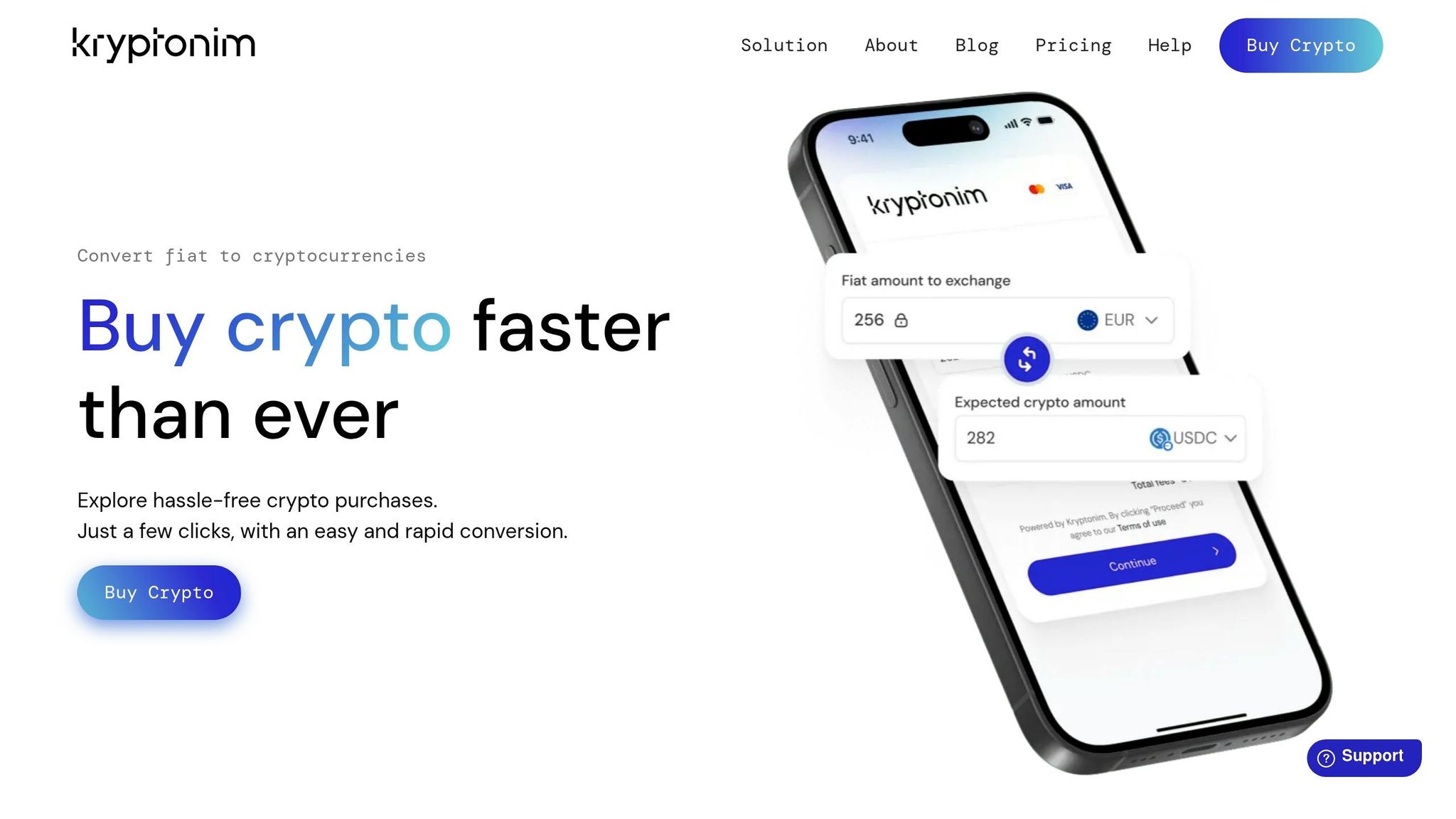
Once you've chosen your stablecoins, buying them quickly and securely is essential. Kryptonim offers an EU-regulated platform that adheres to MiCA (Markets in Crypto-Assets) regulations. These rules ensure strict asset segregation and platform transparency, making Kryptonim a reliable choice.
One standout feature of Kryptonim is its no-account-required process. There's no need to register or go through a lengthy KYC procedure to purchase stablecoins like USDC or USDT. Simply provide your wallet address, pick your payment method, and you can complete your transaction in as little as 3–5 minutes. Using Apple Pay or Google Pay can speed things up even more, sometimes taking just 3 minutes.
Your purchased stablecoins are sent directly to your self-custody wallet. Whether you use MetaMask, a hardware wallet, or the Kryptonim Wallet app, your assets remain under your control, with no third-party involvement.
"Kryptonim is fully non-custodial. No third party holds your assets. Your private keys stay with you - always." - Kryptonim Wallet App
The platform's fees are simple: 2% for EU-based transactions and 4% for non-EU transactions, with no hidden spreads. For larger amounts, SEPA bank transfers provide a convenient way to convert stablecoins back into Euros, all at the same flat fee. Kryptonim supports various payment methods, including Visa, Mastercard, Apple Pay, Google Pay, and SEPA transfers.
| Feature | Details |
|---|---|
| Account Requirement | No sign-up needed for card purchases |
| Custody Model | Non-custodial - funds go directly to your wallet |
| Transaction Speed | 3–5 minutes |
| EU Fee | 2% flat |
| Non-EU Fee | 4% flat |
| Payment Methods | Visa, Mastercard, Apple Pay, Google Pay, SEPA |
| Supported Stablecoins | USDT, USDC, EURC |
Kryptonim's straightforward approach and efficient features make it a strong contender for stablecoin transactions. These elements will be crucial for comparing other platforms in the following section.
Comparison Table
The table below outlines critical factors - such as collateral type, issuer, transparency, strengths, and risks - for several stablecoins.
| Stablecoin | Type | Issuer | Primary Backing | Transparency | Key Strength | Major Risk |
|---|---|---|---|---|---|---|
| USDT | Fiat-backed | Tether Ltd. | ~80% US Treasuries, cash, BTC, gold | Quarterly attestations by BDO | Global P2P liquidity leader | No full independent audit; regulatory challenges |
| USDC | Fiat-backed | Circle | US Treasuries (BlackRock fund, ~88.8%) and cash | Monthly attestations by Deloitte | High transparency; GENIUS Act–compliant | Limited P2P use in emerging markets |
| DAI | Crypto-backed | Sky (MakerDAO) | ETH, wBTC, RWA (Treasuries), USDC | Real-time on-chain | Censorship-resistant; strong DeFi presence | Smart contract risks; governance centralization |
| FDUSD | Fiat-backed | First Digital | US Treasuries, bank deposits, repos | Monthly attestations | Zero-fee trading on Binance | Reliance on a single exchange |
| TUSD | Fiat-backed | Techteryx | Disputed (Dubai entity) | Limited transparency | Few notable strengths | Regulatory and reserve uncertainties |
This table highlights the stark differences in collateral types and transparency levels among these stablecoins. For instance, USDC stands out with its monthly attestations and alignment with stricter reserve standards under the US GENIUS Act, contrasting with USDT's quarterly attestations and lack of a full independent audit. DAI, as the sole crypto-backed option, offers censorship resistance and seamless DeFi integration, but its reliance on smart contracts introduces unique risks.
TUSD's case is particularly striking. Its market cap plummeted from $3 billion to under $500 million after $456 million in reserves were moved to an unauthorized Dubai entity, leading to regulatory delistings under MiCA. This example underscores how reserve transparency - or the lack thereof - can directly impact the risks associated with a stablecoin.
Conclusion
Stablecoins have become a cornerstone of diversified crypto portfolios. With projections placing the total stablecoin market at approximately $300 billion in 2026 and daily trading volumes around $100 billion, these digital assets play a crucial role in navigating crypto market volatility. Their growing importance has made them a key tool for managing risk in the ever-evolving digital asset landscape.
However, it's essential to recognize that no stablecoin is without risk. For instance, USDT dominates in global liquidity, USDC is praised for its transparency, and DAI provides censorship resistance but comes with the added risk of smart contract vulnerabilities. Each option involves trade-offs, and maintaining a balanced approach is critical for portfolio stability.
A practical guideline to follow is the "30% rule": avoid allocating more than 30% of your stablecoin holdings to a single asset. Combining regulated fiat-backed stablecoins like USDC with decentralized options such as DAI can help achieve a balance between compliance and censorship resistance in your portfolio.
"No stablecoin is 100% safe. Spread your capital across USDC, USDT, DAI, and FRAX. This reduces the impact of any single de-peg event." - EarnifyHub Research Team
For those ready to implement this strategy, acquiring stablecoins is straightforward. Platforms like Kryptonim provide a secure, EU-regulated way to convert fiat into stablecoins like USDC and USDT in just 3–5 minutes. No account setup is required, and assets are sent directly to your self-custody wallet, giving you full control over your funds.
FAQs
How do I pick stablecoins for diversification without taking on hidden risks?
To diversify with stablecoins while steering clear of hidden risks, pay attention to a few critical factors:
- Collateral type: Look for fiat-backed options like USDC or EURC, which are tied to traditional currencies.
- Reserve audits: Choose stablecoins that undergo regular audits by well-known, trustworthy firms.
- Liquidity: High liquidity ensures you can easily redeem or trade your stablecoins when needed.
Make sure to select stablecoins that comply with local regulations and are issued by transparent, well-regarded organizations. Stay away from algorithmic or opaque models, as these can be riskier, especially during volatile market conditions.
What should I check to judge a stablecoin’s reserves and transparency?
To gauge a stablecoin's reserves and level of transparency, take a close look at several key factors:
- Reserve composition: What assets back the stablecoin? Are they cash, government bonds, or other financial instruments? This can reveal the stability of its backing.
- Audits or attestations: Check how often these are conducted and whether they’re performed by reputable third parties. Regular and thorough reviews are a good sign.
- Issuer’s disclosure history: Has the issuer been open and consistent with their financial disclosures? Transparency builds trust.
- Response to past de-pegging incidents: How has the issuer handled situations where the stablecoin temporarily lost its peg? Their actions can provide insight into their ability to manage risks effectively.
These elements together offer a clearer picture of the stablecoin’s reliability and the issuer's commitment to maintaining its value.
How can I reduce the impact of a stablecoin depeg in my portfolio?
To reduce the risk of losses from a stablecoin depeg, consider diversifying your investments across several stablecoins. Focus on those backed by reserves with transparent verification, such as USDC or USDT. Additionally, establish clear triggers to convert your holdings into fiat currency or other assets if the market shows signs of instability. These measures can help protect your portfolio during uncertain times.