
What Are Community Tokens?
Learn what community tokens are, how membership, reward, and governance tokens work, real use cases, and key risks like volatility and regulatory concerns.
Community tokens are blockchain-based digital assets that help online groups reward participation, share ownership, and make collective decisions. Unlike cryptocurrencies like Bitcoin, which focus on transactions or value storage, community tokens are designed to engage members and build collaborative ecosystems.
Key Highlights:
- Purpose: Tokens grant access to exclusive content, voting rights, or perks within a community.
- Examples: Friends With Benefits ($FWB) requires token ownership for membership; Uniswap’s $UNI allows holders to vote on protocol changes.
- Types:
- Membership Tokens: Provide access to private spaces or events.
- Reward Tokens: Incentivize contributions like creating content or engaging in activities.
- Governance Tokens: Enable voting on budgets, priorities, and rules.
- Applications:
- Challenges:
- Price volatility and scams (e.g., $10B lost to fraud in 2024).
- Regulatory hurdles, especially in the U.S.
- Security risks like smart contract vulnerabilities.
Community tokens are reshaping how groups operate and collaborate, offering new ways to engage, fundraise, and govern. However, users should navigate risks carefully, including market instability and regulatory uncertainty.
How Community Tokens Differ from Other Cryptocurrencies
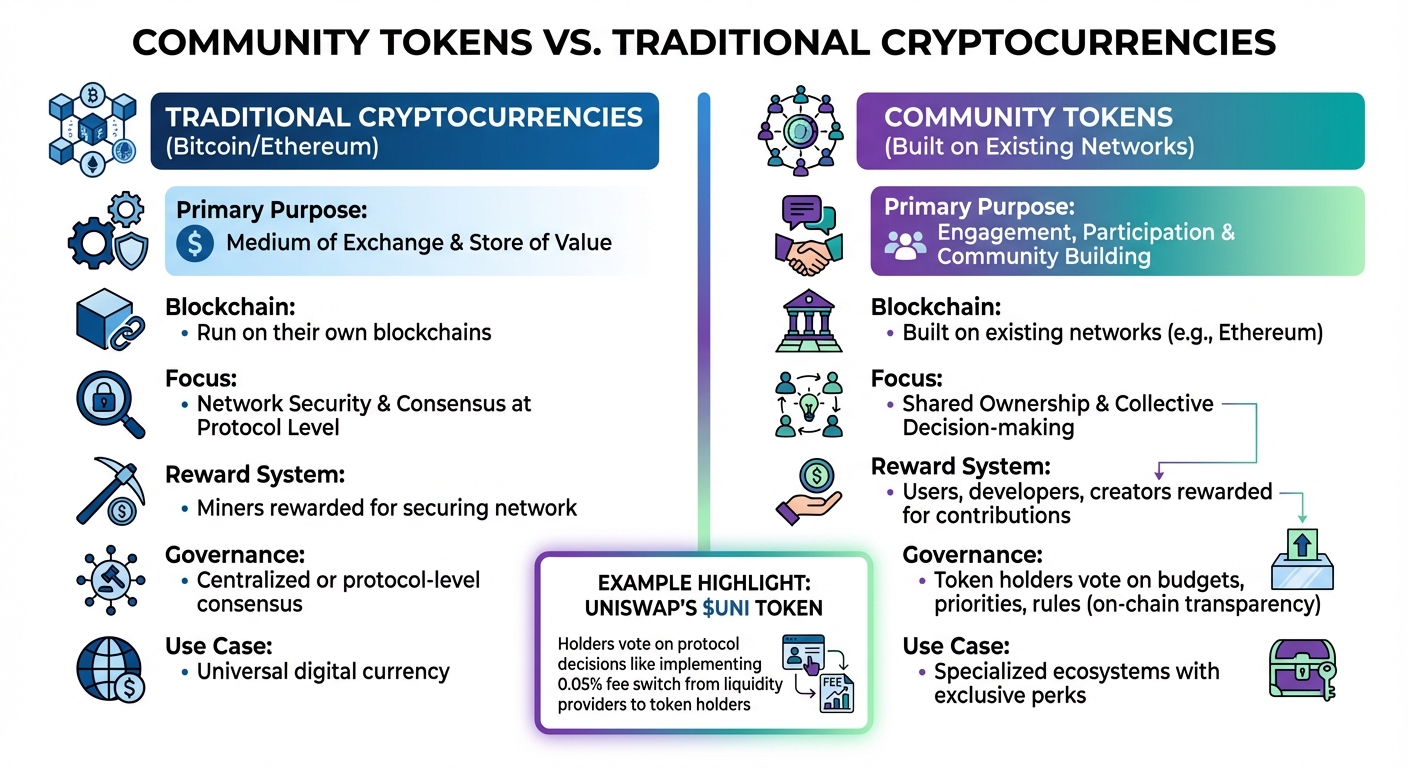
Community Tokens vs Traditional Cryptocurrencies: Key Differences
Bitcoin and Ethereum often grab the spotlight as general-purpose digital currencies, but community tokens operate on an entirely different plane. Their uniqueness isn't just about technology - it's rooted in their purpose. While cryptocurrencies like Bitcoin are designed primarily as a medium of exchange or a store of value, running on their own blockchains, community tokens take a different approach. These tokens are built on existing networks like Ethereum and provide access to exclusive community perks such as private chats, fee-sharing mechanisms, or governance rights. Essentially, community tokens go beyond simple transactions, focusing instead on fostering engagement and participation.
Purpose and Focus
Bitcoin aims to be a universal digital currency, but community tokens are more specialized. They are crafted for specific ecosystems, rewarding participants - users, developers, and creators - for their contributions to the network. These contributions might include resources like capital, content, or expertise. As Patrick Rivera from Mirror explains:
"Tokens are a breakthrough in open network design, because they are a mechanism for incentivizing open network participants, including users, developers, investors, and service providers".
A great example of this is Uniswap's $UNI token, launched in September 2020. Unlike Bitcoin, which rewards miners for securing the network, $UNI empowers its holders with governance rights. Token holders can vote on critical protocol decisions, such as implementing a "protocol fee switch" that redirects 0.05% of trading fees from liquidity providers to token holders. This innovation transformed Uniswap from a centralized project into a community-driven ecosystem.
Ownership and Governance
Traditional cryptocurrencies emphasize network security and consensus at the protocol level. Community tokens, however, focus on shared ownership and collective decision-making. Governance tokens grant voting rights, allowing members to influence key aspects like budgets, development priorities, and operational rules. This isn't about passive investment - it's about active participation.
Researchers Helena Rong and Zeslene Mao describe this governance model as a shift "from participants to contributors", where members take an active role in shaping the ecosystem. Unlike traditional equity structures that often operate behind closed doors, community tokens bring transparency to the table. Decisions are executed on-chain, making it possible for anyone to verify outcomes independently. This level of openness and involvement sets community tokens apart in the cryptocurrency landscape.
sbb-itb-0796ce6
Main Types of Community Tokens
Community tokens come in various forms, each designed to boost engagement, reward participation, and enable shared decision-making. Let’s dive into the main categories and see how they contribute to building stronger, more interactive communities.
Membership Tokens
Think of membership tokens as digital passes unlocking access to exclusive spaces like private Discord servers, Telegram groups, or niche platforms. Unlike traditional memberships tied to a company’s database, these tokens are tradeable assets that can gain value as the community grows.
Take the Friends With Benefits (FWB) community, for example. What started as a creator-led initiative has transformed into a DAO, where members actively curate content and manage the ecosystem. FWB members also enjoy perks like exclusive in-person events, including city meetups and afterparties.
Another standout example is the Whale token, created by collector WhaleShark. By August 2021, the project had grown to 3,750 holding addresses, with community members exchanging over 25,000 messages in a single month. On top of that, token holders gain fractional ownership of a high-value NFT collection, tying membership benefits to tangible assets.
Reward and Loyalty Tokens
Reward and loyalty tokens are all about turning participation into tangible incentives. They encourage members to contribute by creating content, sharing expertise, or staying engaged. As DocTom, a contributor at Gate Learn, puts it:
"Tokens appreciate in value only when the underlying community flywheel can provide and monetize value."
This approach transforms members into stakeholders who have a vested interest in the community's success. For instance, Reddit's r/ethtrader subreddit uses "Donut" tokens to reward members for their contributions. This gamified system has improved the quality of posts while keeping users active. The concept’s popularity is evident - social tokens saw a 400% growth in the first half of 2021 alone, highlighting the effectiveness of reward mechanisms in driving engagement.
Governance Tokens
Governance tokens go a step further by giving community members a direct say in decisions like budgets, development priorities, and operational rules. Voting happens on-chain, ensuring transparency and accountability.
MakerDAO is a great example here. Its DAI stablecoin is governed using MKR tokens, where holders can vote on key issues like stability fees, new rules, or team appointments. Each MKR token equals one vote, offering a decentralized alternative to traditional corporate governance, which typically relies on a small board of directors.
Another fascinating case is the $ALEX token, launched by entrepreneur Alex Masmej in April 2020. Masmej raised $20,000 from 30 backers in just four days. The token acted as a "human IPO", giving holders 15% of his income over three years (up to $100,000) and letting them vote on aspects of his daily life through a "Control My Life" system. By June 2021, the project had expanded to over 600 holders. Masmej explained:
"The common ethos behind social tokens is that they align participants behind a collective mission through participation or ownership."
Interestingly, many community tokens combine these functions. A single token might grant membership access while also offering governance rights, strengthening community ties and providing value beyond mere speculation.
Functions and Use Cases
Community tokens are no longer just experimental ideas - they’re actively transforming how groups collaborate, fund initiatives, and build decentralized ecosystems. Here's how they’re being applied in real-world scenarios.
Engaging and Rewarding Community Members
Tokens turn passive audiences into active contributors by incentivizing actions like creating content, engaging with others, or attending events. Take Reddit, for example: its "Community Points" system - Ethereum-based tokens like Moons and Bricks - rewards users on subreddits like r/CryptoCurrency and r/FortNiteBR for posting high-quality content. These tokens can be traded for perks like special badges or used to influence voting weight.
Nike’s .SWOOSH platform offers another example. In May 2023, Nike’s NFT sneaker drop generated over $1 million in revenue, even with technical glitches. Nearly 100,000 members participated by collecting and co-creating digital wearables, while creators earned royalties from sales. Unlike traditional loyalty points, these digital assets give users actual ownership - they can hold, trade, or use their tokens across different platforms.
Token-gating adds yet another layer of exclusivity. By holding a specific number of tokens, members can unlock private Discord channels, gain access to VIP webinars, or enjoy early product launches. Some communities even use staking mechanisms, where members lock up tokens for a period to unlock premium benefits like higher-tier status. As Jones from Blockchain App Factory puts it:
"Tokens are breathing new life into customer engagement - making loyalty feel personal, valuable, and future-ready".
This approach doesn’t just engage members - it also opens up new ways to raise funds.
Crowdfunding and Fundraising
Community tokens have revolutionized how projects raise money and democratized investment opportunities. Token sales allow projects to secure funding directly from a global audience, cutting out traditional middlemen like venture capitalists. One of the most famous examples is Ethereum’s 2014 ICO, which raised over $18 million by selling Ether (ETH) tokens. Filecoin followed suit, raising $250 million to develop its decentralized storage network.
But it doesn’t stop at startups. RealT has tokenized over 535 U.S. rental properties worth more than $101 million, enabling small-scale investors to buy fractional shares for as little as $50 and earn weekly rent payouts. Similarly, Hamilton Lane used blockchain tokenization to lower the minimum investment for one of its private equity funds from $5 million to $20,000, making it accessible to a broader range of investors.
Unlike traditional equity, which often ties up capital for years, tokens can be traded freely on decentralized exchanges. The tokenization market, valued at about $3.3 billion in 2024, is expected to grow to $4 billion by 2025. Deloitte even predicts tokenized assets could hit $16 trillion by 2030. On top of that, token holders often become advocates for the projects they’re invested in, promoting them because their financial success is directly tied to the project’s growth.
Building Decentralized Ecosystems
Tokens aren’t just financial tools - they’re the backbone of self-sustaining communities. They align incentives and distribute ownership, transforming members from mere participants into stakeholders. These stakeholders can vote on governance decisions, earn rewards for contributions, and participate in internal marketplaces.
The journey often starts with a single creator laying out a vision, which over time evolves into a decentralized autonomous organization (DAO). Authority gradually shifts to the community, turning access and participation into tradeable assets that can grow in value. This structure encourages long-term involvement and collective ownership.
Tokens can also drive tangible change. For example, Antwerp’s Ucoin project injected €12.4 million into the local economy by issuing digital credits to city employees, which they spent at 2,000 local businesses. Another notable initiative, Belgium’s "Unbox Litter" campaign, used digital tokens to reward participants for picking up litter. The result? Over 1.9 million litter pickups and 67.4 tons of waste collected by nearly 100,000 participants.
Tokens are proving to be more than just digital assets - they’re tools for innovation, engagement, and real-world impact.
Risks and Considerations
Community tokens come with a unique set of challenges that both creators and holders should carefully navigate.
Market Volatility
The value of community tokens can be highly unpredictable, with prices capable of dropping dramatically in a short period. Unlike traditional investments, which often offer a degree of predictability, tokens in the crypto space are inherently unstable. Compounding this risk is the irreversible nature of crypto transactions. If tokens are sent to the wrong address or lost to a scam, their recovery typically hinges on the goodwill of the recipient. This lack of safeguards can make the crypto space particularly unforgiving for mistakes.
Regulatory Challenges
The legal framework surrounding community tokens is still evolving, particularly in the United States. The Securities and Exchange Commission (SEC) often categorizes tokens as securities, requiring registration unless they meet specific exemptions. A key factor in this classification is "trust dependencies." If a token's value depends on a central entity, it is more likely to be classified as a security. Legal experts Nick White and Matthew Blakebrough from Charles Russell Speechlys caution:
"Token issuers should be cautious when attaching rights to a token that could be construed as being similar to the characteristics of a share, a debt instrument or other type of financial instrument".
Platforms that facilitate token trading face additional hurdles, including compliance with Know Your Customer (KYC) and Anti-Money Laundering (AML) regulations. They may also need to register as broker-dealers or alternative trading systems. A 2024 Financial Conduct Authority study revealed that 89% of crypto asset buyers acknowledged their investments lacked regulatory protection. For creators, consulting legal experts early in the process can help navigate these complex regulations and avoid potential violations. These legal challenges add another layer of difficulty to an already risky landscape.
Security and Trust
Security remains a pervasive issue in the token ecosystem. In 2024 alone, nearly $10 billion in crypto was lost to fraud and scams, with some estimates suggesting the figure could be as high as $12.4 billion. Alarmingly, about 3.59% of all tokens launched in 2024 showed signs of being "rug pulls", where creators abandon projects and abscond with investors' funds. Additionally, vulnerabilities in smart contracts and code exploits accounted for approximately 8.5% of stolen funds between January and November 2024.
Scammers frequently use fake social media accounts and spoofed websites to trick users into sharing private keys or sending tokens to fraudulent addresses. Even token-based governance systems can present risks, as they sometimes devolve into plutocracies where a small group of wealthy holders wields disproportionate power over community decisions.
For creators, conducting thorough third-party audits of smart contracts is essential to minimize vulnerabilities before launching a token. For users, engaging with projects that have transparent teams, verified credentials, and clear documentation can help mitigate risks. Additionally, enabling multi-factor authentication on all accounts is a simple yet effective measure, especially since human error is responsible for 90% of cyber breaches.
Being aware of these risks is essential for both creators and community members to protect their investments and maintain trust in decentralized ecosystems.
How Kryptonim Simplifies Crypto Acquisition
For those diving into community tokens, having a secure and efficient way to acquire them is just as critical as understanding their potential value. With the security risks and regulatory gray areas surrounding these tokens, a platform that prioritizes safety and clarity becomes a must-have. Enter Kryptonim, an EU-regulated platform designed to tackle these challenges head-on, whether you're a beginner or a seasoned investor.
A Platform Built on Regulation and Transparency
Kryptonim stands out by offering a regulated environment, addressing the concerns of the 89% of cryptoasset buyers who recognize the lack of regulatory safeguards in their investments. As an EU-regulated platform, it complies with anti-money laundering and counter-terrorist financing standards, ensuring a secure experience. Plus, its pricing is straightforward - no hidden fees, no surprises.
Simplified for Beginners
One of Kryptonim's standout features is its simplicity. The platform removes technical hurdles by allowing users to convert fiat to crypto in a single step, with no account setup required. This ease of use is especially appealing for those interested in community tokens, which often offer access to unique experiences. By streamlining the process, Kryptonim not only saves time but also keeps the focus on what matters most: the tokens themselves.
Competitive Rates and Quick Transactions
Community tokens live and breathe in a fast-moving market, where their value can shift based on popularity and demand. Kryptonim’s speedy processing ensures users lock in competitive rates, a crucial factor in such volatile conditions. With fees set at 2% for EU users and 4% for others, the platform keeps costs manageable. For those looking to trade or resell their tokens, these lower acquisition costs can make a big difference in potential returns.
Conclusion
Community tokens are reshaping how digital organizations operate, fund themselves, and govern their activities. By enabling internet-native economies where ownership, decision-making, and rewards are collectively shared, these tokens turn participants into stakeholders. For instance, customers tend to spend around 19% more after joining a branded community, and nearly 20% of companies report that their communities influence over 30% of their total revenue.
"Tokens are building blocks for the new era of the internet, the read-write-own era, defined by digital ownership." – Wilson Center
What makes community tokens so impactful is their ability to align incentives among users, developers, and investors. Whether it's governance tokens that offer voting rights, membership tokens that unlock exclusive perks, or reward tokens that recognize contributions, these digital assets inspire deeper engagement and long-term loyalty. They also tackle significant global challenges, such as providing financial tools to the 1.7 billion adults who remain unbanked due to barriers like high fees or limited access. Simplifying participation is key to unlocking these benefits.
However, technical hurdles remain. Complicated wallet setups and lengthy exchange processes can discourage newcomers. This gap between the tokens' potential and the difficulties of entry highlights the importance of regulated platforms. These platforms streamline the process, ensuring security and transparency. Beginner-friendly options, like Kryptonim’s competitive rates (2% for EU users and 4% for others), help users focus on building their communities rather than navigating technical complexities.
This evolution reflects the core promise of cryptocurrency. As Ethereum co-founder Vitalik Buterin once put it:
"The goal of crypto is to give people access to cryptographic and economic building blocks that give people more choice in whom to trust".
Community tokens are fulfilling that vision, transforming how we collaborate, create shared value, and achieve collective success.
FAQs
What makes community tokens different from other cryptocurrencies?
Community tokens are digital assets that offer holders special privileges, such as membership access, voting power, or exclusive perks within a specific group. Unlike cryptocurrencies like Bitcoin or Ethereum, which mainly serve as a store of value or a medium for transactions, community tokens are designed to encourage interaction and reward active participation within a particular ecosystem.
What sets these tokens apart is how they mirror the values and objectives of the community they belong to, making them more focused and purpose-built than general-use cryptocurrencies.
What are the risks of investing in community tokens?
Investing in community tokens carries a variety of risks that every potential investor should weigh carefully. One major concern is regulatory uncertainty. Many countries have yet to establish clear guidelines on how these tokens fit into laws governing securities, taxes, or anti-money-laundering measures. This lack of clarity can lead to compliance issues and even the possibility of legal challenges down the line.
Community tokens are also highly speculative and often illiquid, meaning their value can swing wildly due to limited trading activity. If the community’s interest wanes or the project doesn’t succeed, the token’s value can plummet. On top of this, governance for these tokens is frequently informal or poorly developed, leaving investors with little say in decision-making. In some cases, issuers may even change the rules or abandon the project entirely, leaving token holders with nothing.
Another critical risk is the potential for fraud or malicious actions, particularly since many of these tokens are launched by small teams or newly formed decentralized organizations. Scams like rug pulls - where developers suddenly withdraw funds and disappear - are a real threat. To protect yourself, it’s essential to thoroughly research any project, understand its risks, and ensure it aligns with your financial objectives before investing.
How can community tokens enhance engagement in a group?
Community tokens provide a creative way to reward and encourage participation within a group by turning member contributions into real benefits. These digital tokens can be earned through activities like sharing valuable insights, answering questions, or showing up for events. The process creates a fun, game-like environment where members feel appreciated and motivated to stay engaged.
But it’s not just about rewards - community tokens can unlock exclusive advantages. Think early access to new features, the ability to vote on group decisions, or invites to private, members-only events. They help build a stronger sense of connection and involvement, inspiring members to engage even more. Platforms like Kryptonim simplify the process of obtaining the cryptocurrency needed to create and share these tokens, making it easy for everyone to jump on board.