
Stablecoin Rules: US vs EU vs Asia
Stablecoin rules differ across the US, EU and Asia — from 1:1 reserve backing and issuer licensing to redemption timelines and cross-border limits affecting trading.
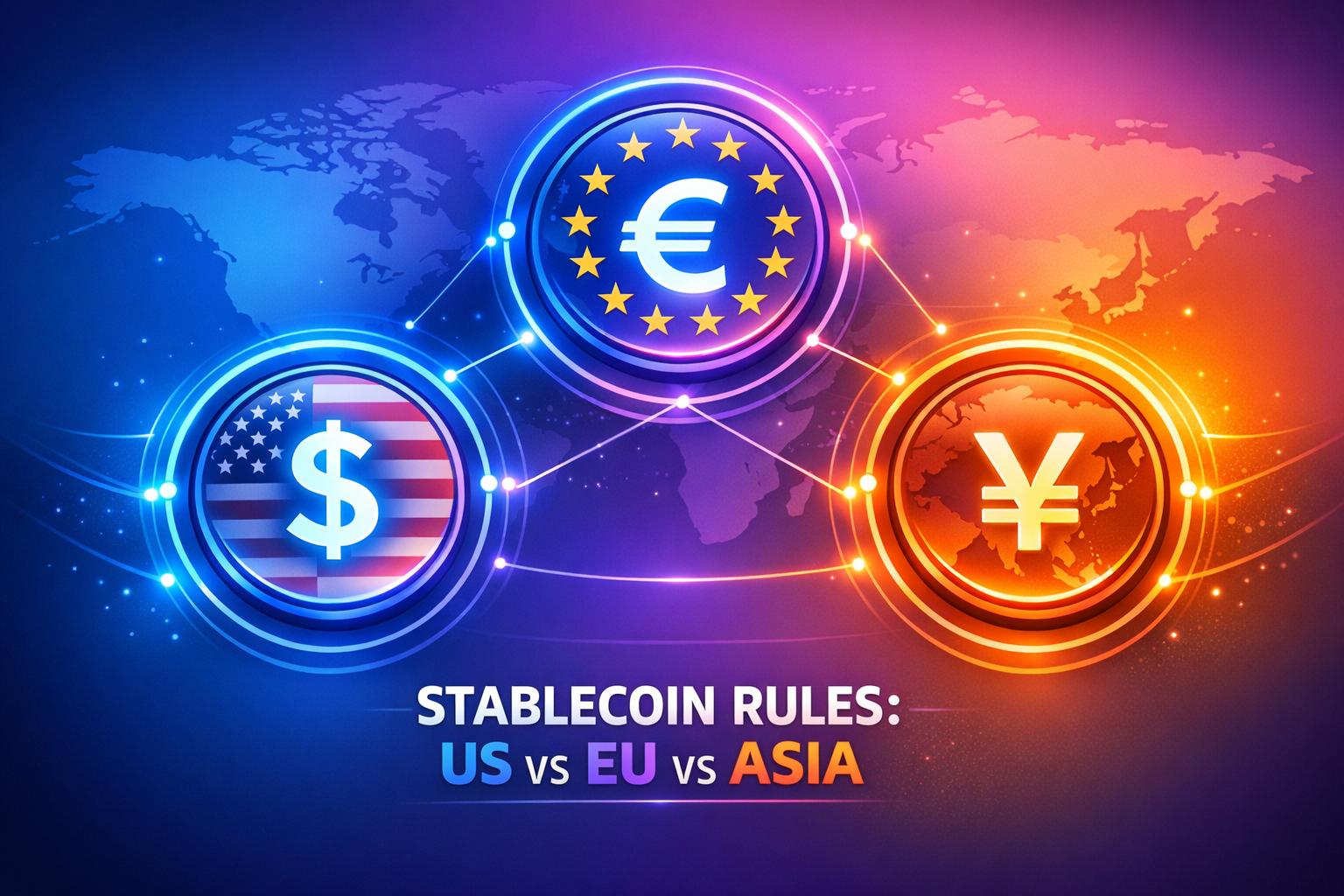
Stablecoins are reshaping digital finance, but global regulations vary widely. Here's a quick breakdown:
- United States (GENIUS Act): Requires 1:1 backing with liquid U.S. assets, bans interest payments, and prioritizes consumer protection in bankruptcy. Federal rules take full effect by 2027.
- European Union (MiCA): Divides stablecoins into E-Money Tokens and Asset-Referenced Tokens. Enforces strict issuance rules and caps transactions for non-euro tokens to promote euro adoption.
- Asia: Singapore, Hong Kong, and Japan focus on issuer licensing, reserve backing, and redemption rights. For example, Singapore mandates redemptions within five days.
Quick Comparison
| Feature | United States (GENIUS Act) | European Union (MiCA) | Asia (Singapore/Hong Kong) |
|---|---|---|---|
| Reserve Backing | 1:1 with U.S. assets | 1:1 with high-quality assets | 1:1 in pegged/G10 currency |
| Issuer Type | Federal/state-permitted | Credit/e-money institutions | Licensed by HKMA/MAS |
| Redemption | Par value, priority in bankruptcy | Par value | Par value (5-day max in SG) |
| Interest Payments | Prohibited | Prohibited | Prohibited |
| Cross-Border Rules | U.S.-focused | Extraterritorial | HKD/G10 pegged tokens |
Stablecoin regulations aim to ensure stability and transparency, but regional differences affect trading, compliance, and liquidity. Understanding these rules is key to navigating this evolving landscape.

Global Stablecoin Regulations Comparison: US vs EU vs Asia
US Stablecoin Regulations
On July 18, 2025, President Trump signed the GENIUS Act into law, creating a federal framework for stablecoins and positioning the U.S. as a leader in digital assets. The Act's provisions will take effect on January 18, 2027, or 120 days after federal regulators finalize their rules, whichever comes first. Below is an overview of the Act’s key requirements and the timelines for implementation.
GENIUS Act Requirements
Under the GENIUS Act, all payment stablecoin issuers must maintain a 1:1 reserve backed by highly liquid U.S. assets, such as U.S. currency, Federal Reserve deposits, Treasury bills maturing in 93 days or less, and specific repurchase agreements. Oversight varies based on the issuer's structure, with the OCC or other federal regulators (Federal Reserve, FDIC, or NCUA) taking the lead.
Issuers are required to meet strict compliance standards, including:
- Submitting monthly reserve reports reviewed by a registered public accounting firm.
- Providing certifications from top executives.
- Publishing annual audited financial statements for issuers with assets exceeding $50 billion.
The Act also prohibits paying interest to stablecoin holders and bans tying stablecoin services to the purchase of other products. Non-compliance carries steep penalties: fines of up to $1,000,000 per violation, up to five years in prison for individuals, and $100,000 in daily civil penalties for unlicensed operations.
In the event of bankruptcy, stablecoin holders receive priority over other creditors. Reserves are treated as customer property, not as part of the bankruptcy estate. Additionally, payment stablecoins are explicitly classified as neither "securities" nor "commodities", placing oversight responsibility with banking regulators instead of the SEC or CFTC.
Implementation Timeline and Foreign Issuers
The Act also establishes clear timelines and guidelines for both U.S.-based and foreign stablecoin issuers. Federal regulators must issue implementing regulations by July 2026, while the Act’s general provisions will take effect no later than January 18, 2027. Digital Asset Service Providers have until July 18, 2028, to comply fully, after which they must limit operations to approved stablecoins.
Foreign issuers face additional requirements. They must register with the OCC and be overseen by a foreign regulator with standards comparable to those in the U.S.. These issuers must also have the technical ability to comply with lawful orders, including freezing, seizing, or burning stablecoins when required. Issuers from countries under comprehensive U.S. sanctions or identified as significant money laundering risks are barred from operating in the U.S. market. For state-regulated issuers with less than $10 billion in outstanding stablecoins, state-level oversight is allowed. However, once this threshold is crossed, they must transition to federal supervision within 360 days.
EU Stablecoin Regulations
The European Union introduced its Markets in Crypto-Assets (MiCA) framework in stages throughout 2024, with the complete framework set to take effect on December 30, 2024. MiCA outlines a detailed regulatory structure for stablecoins, extending its reach beyond EU borders. This means any fiat-backed stablecoin offered to EU residents or traded on EU platforms must comply, no matter where the issuer is located.
The framework categorizes stablecoins into two types: E-Money Tokens (EMTs), which are tied to a single official currency like the euro, and Asset-Referenced Tokens (ARTs), which are backed by a mix of assets or multiple currencies. Each type comes with its own set of regulatory requirements.
MiCA Issuer Requirements
MiCA limits the issuance of stablecoins in the EU to regulated credit institutions or electronic money institutions. This contrasts with the U.S. GENIUS Act, which allows a more diverse range of entities to issue payment stablecoins. Under MiCA, issuers must:
- Maintain a 1:1 reserve of high-quality liquid assets, kept separate from operational funds.
- Allow token redemption at par value.
- Avoid offering interest on tokens to ensure they aren't treated as investment products .
Issuers are also required to publish a white paper covering key details, such as token characteristics, risks, reserve composition, and redemption processes.
MiCA's rules don't stop at EU-based issuers. They also extend to stablecoins issued outside the EU.
Non-EU Stablecoins and Transaction Caps
MiCA places restrictions on non-EU stablecoins as well. The European Securities and Markets Authority (ESMA) has instructed crypto service providers to either restrict or delist tokens that fail to meet compliance standards by January 31, 2025. By March 31, 2025, noncompliant tokens must transition to a "sell-only" model. Juan Ignacio Ibañez, a member of the MiCA Alliance's Technical Committee, emphasized:
"No trace of USDT should remain in the European Union after March 2025, even under the sale only mode".
For Asset-Referenced Tokens used as a medium of exchange, MiCA enforces strict limits. Transactions are capped at 1 million per day or $210 million per day within a single currency area, calculated as a quarterly average. These restrictions aim to reduce the circulation of non-euro stablecoins and promote the adoption of euro-compliant alternatives.
MiCA’s expansive scope compels even non-EU issuers to comply if they wish to serve EU users, encouraging global projects to seek EU authorization.
Asian Stablecoin Regulations
Stablecoin regulations across Asia vary widely, with each region focusing on specific principles like issuer jurisdiction, reserve backing, and redemption rights. Here's a closer look at how key Asian markets are shaping their frameworks.
Singapore's MAS Framework
In Singapore, the Monetary Authority of Singapore (MAS) oversees single-currency stablecoins pegged to either the Singapore Dollar or any G10 currency. Ho Hern Shin, Deputy Managing Director (Financial Supervision) at MAS, described the framework’s goal:
"MAS' stablecoin regulatory framework aims to facilitate the use of stablecoins as a credible digital medium of exchange, and as a bridge between the fiat and digital asset ecosystems".
Issuers in Singapore must adhere to strict rules, including maintaining reserve assets that meet rigorous standards for composition, valuation, custody, and audits. To protect consumers, issuers are required to honor redemption requests at par value within five business days. They must also maintain minimum capital and liquidity reserves to ensure they can manage an orderly wind-down if needed. Additionally, Singapore prohibits interest payments on stablecoins to prevent them from being classified as investment products.
Only issuers that meet these criteria can use the "MAS-regulated stablecoins" label, which helps users identify regulated assets. Misrepresentation of MAS regulation can result in financial penalties or imprisonment, with violators potentially being added to the MAS Investor Alert List.
Hong Kong and Japan Regulations
Hong Kong and Japan have also implemented unique regulatory measures. Starting August 1, 2025, Hong Kong will require issuers of HKD-pegged fiat-referenced stablecoins to obtain a license from the Hong Kong Monetary Authority (HKMA). Applicants must either be incorporated in Hong Kong or have a local branch if registered elsewhere, ensuring a physical presence in the region.
Japan, on the other hand, regulates stablecoins under its digital money framework. The country places a strong emphasis on audits and custody practices to protect user funds. Both Hong Kong and Japan enforce stringent requirements around reserves and redemption rights to ensure stability.
South Korea's Developing Framework
South Korea is in the process of finalizing its stablecoin regulations to align with broader regional standards. The country is moving toward adopting the Financial Stability Board’s recommendations, focusing on consistent rules for reserve backing and redemption rights. This shift aims to eliminate unlicensed issuers by introducing regulated labels similar to Singapore’s MAS model. These efforts are setting a benchmark across the region, requiring strict compliance from stablecoin issuers.
sbb-itb-0796ce6
Regional Regulatory Comparison
This section dives into how stablecoin regulations differ across the United States, European Union, and Asia, highlighting their shared goals but contrasting approaches.
While all three regions aim to ensure stability and transparency, their regulatory philosophies shape how they oversee stablecoins and authorize issuers. The table below and accompanying analysis break down these differences.
The European Union's Markets in Crypto-Assets Regulation (MiCA) stands out as a centralized framework. Fully applicable by December 2024, after taking effect on June 29, 2023, MiCA restricts stablecoin issuance to regulated financial institutions. Its extraterritorial scope means that any stablecoin offered to EU residents is subject to its rules, regardless of where the issuer is based.
Meanwhile, the US GENIUS Act of 2025 balances federal and state-level oversight. It requires stablecoins to be backed entirely by US dollars or short-term Treasury securities, with monthly public audits ensuring transparency.
In Asia, Hong Kong and Singapore have established themselves as regulatory leaders with strict licensing requirements. Hong Kong's Stablecoins Ordinance, effective August 1, 2025, mandates licensing by the Hong Kong Monetary Authority (HKMA) for fiat-referenced tokens, even if issued outside Hong Kong but pegged to the Hong Kong dollar. Singapore's Monetary Authority of Singapore (MAS) framework focuses on stablecoins tied to the Singapore Dollar or G10 currencies, with a requirement for redemption within five business days.
Framework Comparison Table
| Feature | United States (GENIUS Act) | European Union (MiCA) | Asia (Hong Kong/Singapore) |
|---|---|---|---|
| Primary Oversight | Federal and state agencies (SEC, CFTC, state regulators) | EBA and ESMA (unified EU-wide) | HKMA (Hong Kong), MAS (Singapore) |
| Issuer Types | Federal and state-permitted issuers | Credit or e-money institutions only | HKMA/MAS licensed issuers |
| Reserve Requirements | 100% liquid assets (USD or short-term Treasuries) | 1:1 backing with strict liquidity rules | 1:1 backing in pegged or G10 currency |
| Redemption Rights | Guaranteed at par value | Guaranteed at par value | Guaranteed at par value (5 days in Singapore) |
| Interest Payments | Prohibited (rewards allowed for active use) | Prohibited | Prohibited |
| Cross-border Impact | Focus on US-used stablecoins | Extraterritorial (any token offered to EU residents) | HK covers HKD-referenced tokens issued abroad |
| Disclosure Frequency | Monthly public disclosures and audits | Transaction caps for ARTs; ongoing CASP rules | Independent attestations; regular HKMA supervision |
These differences in regulatory frameworks shape how stablecoins are traded and how compliance strategies are developed in each region. The contrasting rules reflect varying priorities, from ensuring consumer protection to maintaining financial system integrity.
Trading Impact and Compliance
How Regulations Affect Trading
Regulatory frameworks are reshaping the trading landscape, setting distinct limits that vary across regions. For example, the EU’s MiCA regulation places a cap on Asset-Referenced Tokens used as a means of exchange, limiting them to 1 million transactions or $210 million daily. If these thresholds are breached, issuers may halt new issuances, potentially causing liquidity gaps that traders need to monitor closely. Beyond these caps, reserve requirements also play a key role in influencing market behavior.
In both the US (under the GENIUS Act) and the EU (through MiCA), stablecoins must have 1:1 reserve backing with high-quality liquid assets like US Treasuries or cash. While this stabilizes prices, it also eliminates the possibility of earning passive income from stablecoin holdings, as interest payments are prohibited.
The Travel Rule, expected to be implemented in 85 out of 117 surveyed jurisdictions by 2025, adds another layer of complexity. Enhanced data collection requirements under this rule have extended settlement times, occasionally leading to failed or delayed transactions when counterparties provide incomplete information.
Redemption timelines are another critical factor for liquidity planning. For instance, Singapore’s Monetary Authority of Singapore (MAS) framework mandates redemptions within five business days, while the US GENIUS Act prioritizes stablecoin holders’ claims during insolvency scenarios. Traders must carefully align their strategies with these redemption timelines to minimize risks during periods of market turbulence.
Compliance Tips for Traders
To navigate these regulatory challenges, traders need to focus on compliance strategies tailored to their operational regions. Start by ensuring you’re trading only with licensed issuers. For instance, in Hong Kong, only HKMA-licensed issuers will be authorized to operate starting August 1, 2025. In the EU, MiCA allows only regulated credit institutions to issue stablecoins, while in the US, the GENIUS Act governs permitted payment stablecoin issuers.
It’s also essential to establish region-specific policies, as the same stablecoin can face varying regulatory treatments depending on the jurisdiction. Set internal exposure limits based on the issuer’s licensing status and the applicable regulatory framework.
For fiat-to-crypto transactions, rely on regulated intermediaries. Platforms like Kryptonim, which operate under MiCA’s Crypto-Asset Service Provider framework, offer secure transactions with transparent pricing - charging a 2% transaction fee for EU users while maintaining competitive rates globally.
Another key step is ensuring that your service providers are equipped to handle the data collection requirements of the Travel Rule. By working with providers who can efficiently gather detailed originator and beneficiary information, you can reduce the risk of transaction delays or failures.
Lastly, confirm that issuers meet regulatory redemption timelines, such as Singapore’s five-day limit or MiCA’s par-value terms. Testing redemption processes with smaller amounts can help verify that issuers have the operational capacity to fulfill their commitments. These steps will help ensure your trading practices remain resilient across a variety of regulatory environments.
Conclusion
Stablecoin regulation has become more structured, introducing detailed licensing frameworks across different regions. With the US GENIUS Act set to take effect in Q1 2027, the EU's MiCA fully in force since December 2024, and Hong Kong's HKMA licensing rules active as of August 1, 2025, traders face intricate rules that directly impact counterparty risk, liquidity, and redemption processes.
Regional differences in regulation create unique challenges for compliance and capital protection. A stablecoin's regulatory treatment can vary significantly depending on the jurisdiction. For instance, MiCA imposes limits on non-Euro stablecoins - capping them at 1 million transactions or EUR 200 million daily - while Singapore requires redemptions to be processed within five business days. These differences influence everything from settlement timelines to liquidity availability during market volatility.
These regulatory variations bring tangible obstacles for traders. As one industry expert put it, "Teams that treat compliance as product infrastructure, rather than as legal paperwork, will be best positioned to scale across jurisdictions". The numbers speak for themselves - $23 trillion in trading volume in 2024 and a stablecoin market cap exceeding $250 billion by August 2025 highlight the importance of regulatory clarity and strict adherence to compliance measures like the Travel Rule.
To address these challenges, partnering with EU-regulated platforms like Kryptonim offers a streamlined approach to compliance. Under MiCA's Crypto-Asset Service Provider framework, Kryptonim manages issuer due diligence, Travel Rule requirements, and regional taxonomy oversight. With a 2% transaction fee for EU users, the platform ensures secure fiat-to-crypto transactions, allowing traders to focus on their strategies while staying aligned with evolving global standards.
FAQs
What are the main differences in stablecoin regulations between the US, EU, and Asia?
Stablecoin regulations differ widely across regions like the US, EU, and Asia, each reflecting distinct priorities and strategies.
In the United States, the regulatory landscape for stablecoins is still taking shape. Proposed laws, such as the GENIUS Act and STABLE Act, emphasize licensing for issuers, require a 1:1 reserve backing with approved assets, and enforce strict AML (Anti-Money Laundering) and KYC (Know Your Customer) rules. These efforts aim to refine oversight while ensuring the dollar remains a dominant global currency.
The European Union has taken a more unified approach with its MiCA regulation, which took effect in June 2023 and will be fully implemented by December 2024. MiCA creates a standardized framework across member states, requiring full reserve backing, consistent licensing, robust governance, and harmonized AML measures. This makes it one of the most coordinated regulatory systems for stablecoins anywhere.
In Asia, regulatory policies vary by country. For instance, Hong Kong's Stablecoins Ordinance, set to take effect in August 2025, introduces licensing requirements and aligns reserve and AML standards with international practices. However, unlike the EU, Asia lacks a single cohesive framework, resulting in a regulatory environment that is more fragmented but still proactive in addressing the challenges of stablecoins.
How do stablecoin redemption rights differ between the US, EU, and Asia?
Stablecoin redemption rights differ widely across regions, shaped by varying regulatory frameworks.
In the European Union, issuers must allow holders to redeem stablecoins at face value on demand. To support this, reserves are held in liquid assets, ensuring redemptions can typically happen within one day.
In the United States, proposed legislation requires stablecoins to be redeemable at a fixed value (like $1) and backed by a 1:1 reserve of approved assets. While redemption must be available upon request, the regulations focus more on licensing and liquidity requirements rather than imposing a specific redemption timeline.
In Asia, places like Hong Kong also mandate that stablecoins are redeemable at face value. However, they allow more flexibility in terms of reserve composition and redemption timing compared to the EU.
To sum up, the EU enforces the strictest rules around liquidity and timing, the US prioritizes reserve backing and licensing, and Asia adopts a more adaptable regulatory approach.
Why are stablecoins not allowed to pay interest globally?
Stablecoins are typically not allowed to provide interest payments. Why? Because offering interest could pull deposits away from traditional, regulated banks. This might limit the credit these institutions can extend, which could ripple through the economy and create instability. Regulators also aim to mitigate risks tied to unregulated financial activities that might pose threats to the larger financial system.