
Managing Emotions: Greed in Crypto Trading
Greed destroys crypto portfolios; learn to spot FOMO, use the Fear & Greed Index, set stop-losses and profit targets to protect gains.

Greed can ruin your crypto trading strategy. It clouds judgment, leads to impulsive decisions, and often results in losses. Here’s what you need to know:
- 84% of crypto traders act on FOMO, with 63% admitting greed has hurt their portfolios.
- Greed shows up as overtrading, ignoring stop-losses, and holding positions too long.
- Tools like the Crypto Fear & Greed Index can help identify when emotions are driving markets.
- Setting clear profit goals, using risk management tools, and sticking to a trading plan are key to staying disciplined.
The goal? Recognize greed, control it, and follow a structured approach to protect your portfolio.
What Is Greed in Crypto Trading
In the world of crypto trading, greed is the unchecked desire for quick profits that pushes traders to take reckless risks and overlook potential red flags.
While rational trading follows carefully thought-out plans, greed-driven trading abandons those plans in favor of chasing market trends impulsively. Often, this behavior ties closely to the Fear of Missing Out (FOMO), where decisions are influenced more by social media buzz than by sound research or fundamentals.
How Greed Affects Trading Decisions
Greed doesn’t just nudge trading decisions - it takes control of them. When a lucrative opportunity presents itself, the brain releases dopamine, a chemical linked to addictive behaviors like gambling. This rush can cloud judgment, making it harder to follow risk management strategies. The outcome? Overtrading - taking on too many positions without proper analysis.
Traders driven by greed may also overleverage or skip critical tools like stop-loss orders and diversification, convinced that prices will keep climbing. Holding onto positions too long in hopes of squeezing out extra gains often backfires when the market turns. This kind of impulsive behavior is particularly common among new traders who lack the experience to stick to disciplined strategies.
How Greed Shows Up in Beginner Traders
For beginners, greed tends to show itself in predictable ways. Many new traders see crypto as a shortcut to wealth. Without the necessary experience or discipline, they often chase trending coins based on hype rather than research. They also fail to set clear profit goals or establish risk limits.
A well-known example is Bitcoin’s dramatic rise to nearly $20,000 in December 2017. Many traders held their positions far too long, driven by greed and unrealistic expectations, only to suffer massive losses when the price crashed to $3,000. Greed, if unchecked, can wipe out entire portfolios.
How Greed Causes Losses in Crypto Trading
Greed has a way of draining portfolios by clouding judgment. When emotions take the wheel, traders often abandon strategies meant to safeguard their capital. As we’ve touched on earlier, greed warps decision-making, leading to poor timing and risky choices. Let’s break down how this happens.
Poor Timing and Overtrading
Greed often drives traders to jump into the market at the worst possible times. The fear of missing out (FOMO) pushes them to buy assets after prices have already skyrocketed - essentially chasing the hype. For example, in early 2021, Dogecoin saw an astonishing surge of around 10,000%. Many retail investors, swept up by FOMO, bought near the peak, only to face steep losses when the price corrected.
Overtrading is another trap fueled by greed. This happens when traders take on multiple positions without proper analysis, racking up fees with every trade. These costs add up quickly, even before factoring in poorly timed entries and exits. After experiencing losses, greed can lead to "revenge trading", where traders double down on bad bets in a desperate attempt to recover. Unfortunately, this often results in even greater losses.
Ignoring Stop-Losses and Risk Management
Greed doesn’t just affect timing - it also causes traders to ignore critical safety measures. One glaring example is the refusal to use stop-losses, which are designed to limit potential losses. Some traders skip these safeguards, convinced the market will turn in their favor soon enough. This behavior is often tied to loss aversion bias - the psychological discomfort of locking in a loss - which leads traders to hold onto losing positions far longer than they should.
Without clear exit strategies, greed also tempts traders to overleverage or pour too much capital into a single asset. This dramatically increases the risk of margin calls or even total account liquidation. To put this into perspective, 71% of retail client accounts lose money when trading CFDs, largely due to the dangers of leverage and poor risk management practices.
As one trading expert from IG wisely noted:
"Greed can very easily turn good trades into bad ones and bad trades into worse trades."
How to Spot Greed in Your Trading
Recognizing greed in your trading is a critical step toward managing it effectively. The tricky part? Greed doesn’t always make itself obvious. Instead, it often disguises itself as misplaced optimism. As Wijdan Khaliq from Coin Bureau aptly points out, "Greed in crypto often masquerades as optimism, but the two are very different beasts". Learning to tell the difference can save your portfolio from potentially severe losses. Spotting these signs allows you to adjust your trading strategies in real time.
Warning Signs of Greed
Greed often reveals itself through specific behaviors. For instance, impulsively increasing your position sizes without proper analysis is a common indicator. Another is buying assets based solely on social media hype instead of conducting thorough research. Studies consistently show that emotional decision-making, particularly driven by FOMO (fear of missing out), can wreak havoc on portfolios.
Physical reactions can also be telling. If you find yourself obsessively checking charts late at night or feeling your heart race during trades, it’s a signal that emotions may be taking the wheel.
Ignoring risk management tools, like stop-loss orders, is another major red flag. This is especially dangerous after a winning streak, as overconfidence can lead to reckless trading decisions.
Beyond these behavioral patterns, there are also objective tools that can help you gauge market sentiment and identify when greed is taking over.
Using the Crypto Fear & Greed Index
The Crypto Fear & Greed Index is a valuable tool for assessing market sentiment. It quantifies emotions on a scale from 0 to 100, with 0 reflecting "Extreme Fear" and 100 indicating "Extreme Greed". The index compiles data from market volatility, trading volume, social media trends, and Bitcoin dominance to provide a snapshot of the market’s emotional state.
This index is particularly useful as a contrarian indicator. For example, when the index enters the "Extreme Greed" zone (75–100), it often signals that the market is overbought, making a correction likely. Historical patterns show that greed levels around 60 often align with market peaks, which are typically followed by sharp reversals. A notable instance occurred in November 2025, when the index dropped to 21 ("Extreme Fear") on November 7 as Bitcoin fell by 17.7% to $103,650. Just three days later, the index rebounded to 29 as Bitcoin recovered to $106,333 - highlighting how quickly market sentiment can shift.
Although checking the index daily is useful, focusing on 7-day and 30-day trends can provide a clearer picture of momentum changes. When the index shows extreme greed, it’s wise to tighten your stop-losses or lock in profits instead of increasing your positions. These strategies help you stay disciplined and avoid falling into the greed trap, setting the stage for better trading habits.
sbb-itb-0796ce6
How to Control Greed When Trading
Crypto Fear & Greed Index Trading Strategy Guide
Recognizing greed is one thing - keeping it in check is a whole different challenge. The good news? You don’t need superhuman willpower to manage it. What you need is a structured approach that keeps emotions out of your decisions. By identifying the triggers we discussed earlier, you can apply these strategies to make logical, not impulsive, trading choices.
Set Clear Profit Goals and Exit Points
One of the smartest ways to avoid letting greed take over is to decide your exit plan before you even enter a trade. When your position starts climbing, the temptation to hold on for just a little more can be overwhelming. That’s why setting predefined profit targets is so important. For example, many traders stick to a 1:2 risk-reward ratio - if you’re risking $2,000, aim for a $4,000 profit.
Another tool to consider? Trailing stops. These automatically adjust as the price rises, securing your gains while protecting you from sudden reversals. Imagine Bitcoin jumps from $100,000 to $110,000. With a 5% trailing stop, your stop level adjusts upward, locking in profits even if the price dips later.
You can also use dollar-cost averaging (DCA) to gradually sell portions of your position at different price points. This method, used by 59% of crypto investors to handle market swings, reduces the stress of trying to time the market perfectly.
Technical indicators like the Relative Strength Index (RSI) can also guide you. For example, an RSI above 70 often signals that an asset might be overbought, making it a logical point to consider taking profits.
Use Risk Management Tools
Risk management tools act like guardrails, helping you stick to your plan when greed tempts you to go off course. Stop-loss orders, for instance, automatically sell your position if the price drops to a set level, limiting your losses without requiring constant monitoring. Position sizing is another key element - it ensures you’re not risking too much on a single trade. This is especially important when you consider that around 95% of crypto traders fail, often because they lack emotional discipline.
If you find yourself obsessively checking charts or losing sleep over a trade, it’s a sign your position might be too large. As DailyFX Currency Strategist James Stanley puts it:
"One of the easiest ways to decrease the emotional effect of your trades is to lower your trade size".
A good rule of thumb? Risk no more than 1% to 2% of your total trading account on any single trade. For example, if you have a $10,000 account, limit your risk to $100–$200 per trade.
Bracket orders can take things a step further by letting you set your entry, stop-loss, and take-profit points all at once. This "set-and-forget" strategy minimizes emotional interference and keeps you on track.
Here’s a quick look at some tools and their benefits:
| Tool | Primary Function | Emotional Benefit |
|---|---|---|
| Stop-Loss | Automatically exits at a loss | Reduces fear of losing everything |
| Take-Profit | Automatically exits at a gain | Prevents greed by locking in profits |
| Trailing Stop | Adjusts exit as price rises | Secures gains while allowing for growth |
| Position Sizing | Limits capital per trade | Lowers stress and emotional pressure |
Automated tools like recurring buys or AI-driven bots can also help you stick to data-driven decisions instead of emotional ones. When integrated into a solid trading plan, these tools can be game-changers for maintaining discipline.
Stick to a Trading Plan
A well-thought-out trading plan is your shield against impulsive, greed-driven decisions. It serves as your guide through the chaos of volatile markets. Without it, emotions like greed or overconfidence can lead to overtrading and rash moves.
Your trading plan should clearly outline your entry and exit criteria before you even place a trade. Ask yourself: What technical signals will trigger a buy? At what price will you take profits? How much are you willing to lose? Answering these questions transforms trading from guesswork into a structured process.
Take this example: Two traders face the same Bitcoin drop. Trader W, who trades impulsively, panics and sells at the lowest point, then tries to recover losses with emotional "revenge trades." On the other hand, Trader P follows a checklist, waits for clear technical signals, and exits at predefined levels. The difference? Discipline - not intelligence or experience.
Having a plan also helps combat decision fatigue. With an estimated 35,000 decisions made daily, setting clear rules in advance reduces the mental load when it matters most.
Separate Emotions from Trading Decisions
Trading should be treated as a calculated process, not an emotional rollercoaster. The market doesn’t care about your feelings, so it’s up to you to keep them in check. A simple yet effective technique is to step away after placing your orders. Once you’ve set stop-loss and take-profit levels, close your trading platform to avoid making impulsive changes.
Keeping a trading journal can also be incredibly helpful. Record prices, profits, and your emotional state during trades. Over time, you’ll start to see patterns - like moments when FOMO or anxiety led to poor decisions. These insights can refine your strategy.
Pay attention to physical signs of stress, like tension or nervousness. These can be red flags that you’re trading emotionally instead of logically. If this happens, consider setting daily loss limits that align with your risk tolerance. Once you hit your limit, stop trading for the day to avoid spiraling into revenge trades.
Mindfulness techniques, like deep breathing or taking short breaks between trades, can also reset your mental state. The goal? To ensure your decisions align with your plan, not fleeting emotions. By staying disciplined and focused, you can keep greed from derailing your trading success.
Building Better Trading Habits
Turning occasional practices into automatic habits is a game-changer for traders. Consistent routines take the guesswork out of decision-making and keep you disciplined, especially when emotions like greed threaten to take over. The secret lies in creating systems that hold steady, even during the most stressful moments.
Keep a Trading Journal
A trading journal is more than just a record of numbers - it's a tool for turning emotional reactions into objective insights. Instead of simply noting entry and exit prices, document the full picture: your actions, reasoning, and emotional state for each trade. This approach helps you identify patterns, like how often fear or FOMO leads you to break your own rules.
For instance, consider crypto specialist Neville Yardley’s experience during a sharp market downturn in November 2025. On November 7, when Bitcoin dropped to $103,650 and the Fear and Greed Index hit 21, Yardley recorded feeling "high anxiety" and an "urge to 'do something' to relieve psychological discomfort." However, his journal reminded him that institutional accumulation was still accelerating, and his conditions for exiting a position hadn’t been met. He held steady, and by November 10, Bitcoin rebounded to $106,333. Reflecting on the experience, Yardley said:
"The validation isn't that prices bounced. The validation is that I followed my framework regardless of emotion".
To make the most of your journal, include details like the date, time, asset, strategy, entry/exit points, risk-reward ratio, and your emotional state. Over time, you’ll start to see which emotional triggers lead to losses, helping you resist impulsive decisions.
Combine Technical Tools with Sentiment Indicators
Pairing technical analysis with sentiment tools can sharpen your trading strategy. For instance, the Fear & Greed Index, which is based on five weighted factors - Volatility (25%), Market Momentum/Volume (25%), Social Media (15%), Bitcoin Dominance (10%), and Google Search Trends (10%) - offers insights into market sentiment. Combine this data with technical indicators like the Relative Strength Index (RSI) for a more complete picture.
Look for moments when retail sentiment contradicts institutional behavior. For example, if the Fear & Greed Index shows "Extreme Fear" but institutional metrics like CME volume and ETF inflows remain strong, it could signal a buying opportunity. On the flip side, when the index hits "Extreme Greed" (above 75) and the RSI indicates overbought conditions (above 70), it’s often a good time to take profits.
To avoid reactive decisions, set aside a specific time each day - say, an hour - to review data and on-chain metrics without staring at live price charts. Before entering a trade, clearly define your stop-loss level (where your thesis is proven wrong) and your target profit level. This kind of pre-commitment helps you stick to your plan, even during high-volatility swings.
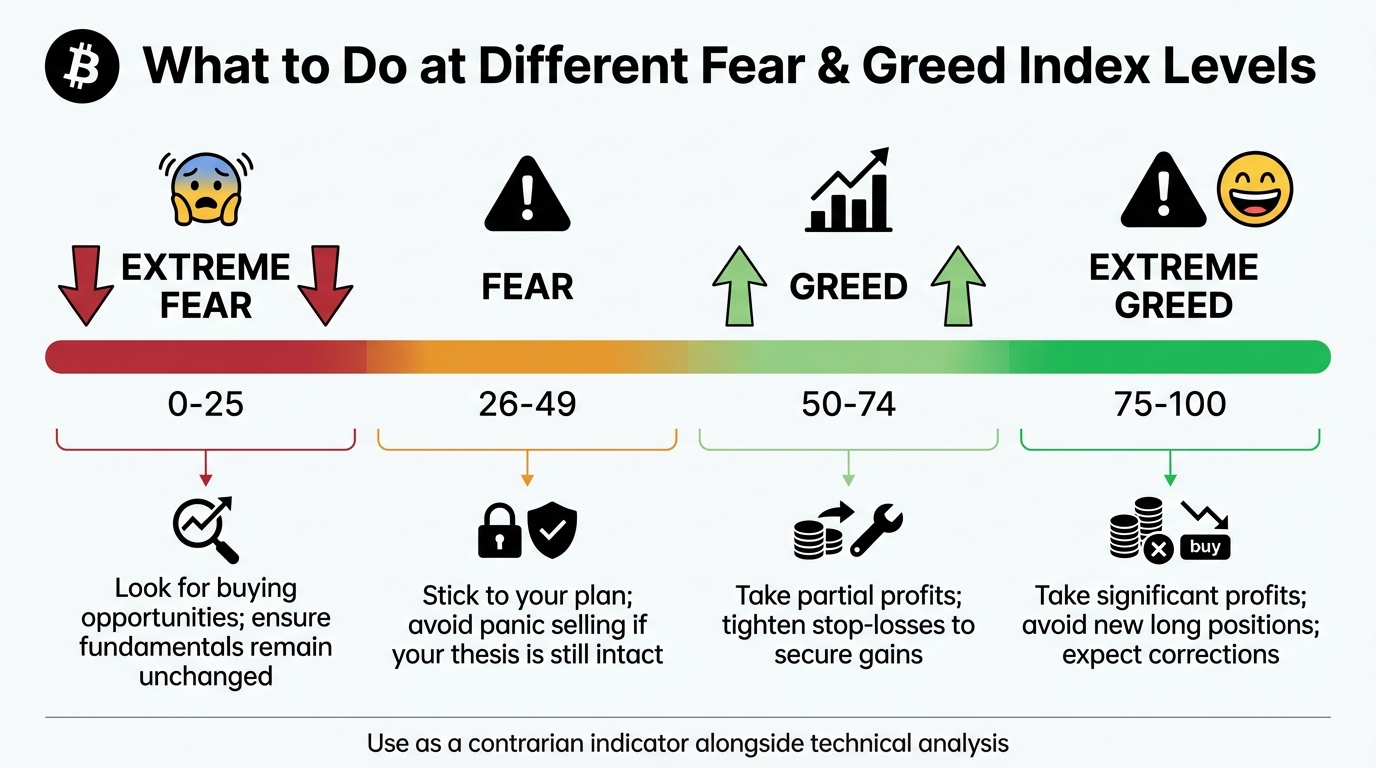
What to Do at Different Fear & Greed Index Levels
The Fear & Greed Index can guide your actions, depending on where it stands. Here's a quick reference:
| Index Range | Sentiment | Action |
|---|---|---|
| 0 - 25 | Extreme Fear | Look for buying opportunities; ensure fundamentals remain unchanged |
| 26 - 49 | Fear | Stick to your plan; avoid panic selling if your thesis is still intact |
| 50 - 74 | Greed | Take partial profits; tighten stop-losses to secure gains |
| 75 - 100 | Extreme Greed | Take significant profits; avoid new long positions; expect corrections |
When the index reaches extreme levels, take a step back and audit recent changes. Have there been any fundamental or technical shifts in the last 24 hours? If the only movement is in price and your thesis still holds, resist the urge to make rash decisions. This habit helps you separate genuine market signals from emotional noise, reinforcing the disciplined approach outlined in earlier risk management strategies.
Conclusion
Navigating greed in trading requires systems that can withstand the pull of emotions. Emotional decision-making has derailed many portfolios, but traders who stick to well-defined rules gain a clear advantage.
To make this work, focus on straightforward strategies: set clear exit points, maintain a trading journal, use tools like the Fear & Greed Index alongside technical indicators, and consider automation. These steps help take the guesswork out of trading when emotions run high. As crypto expert Neville Yardley wisely notes:
"The greatest challenge isn't analyzing the market. It's managing yourself while analyzing the market".
Consistency is your real edge - not chasing the latest hype. For example, 59% of investors who use dollar-cost averaging understand this principle. By removing the pressure to perfectly time the market, they build discipline into their approach. Each methodical trade reinforces this habit, helping to counter the impulsiveness we've discussed earlier.
Start small to put these ideas into action. Pick one habit - whether it's keeping a journal, setting stop-losses, or regularly reviewing the Fear & Greed Index - and focus on mastering it before layering on more. The aim isn’t to be flawless but to make steady progress toward a rules-based system that safeguards your capital when greed threatens to take over.
FAQs
How can I identify if greed is influencing my crypto trading decisions?
Recognizing greed in trading often starts with identifying behaviors that veer away from your original strategy. Some telltale signs include doubling down on losing trades, piling extra funds into a winning position in hopes of bigger gains, or overusing leverage, which can turn a calculated risk into a reckless gamble. You might also catch yourself holding onto profitable trades longer than planned, hoping for an extra surge, or jumping into rapid price spikes without doing proper analysis.
Another warning sign? Making decisions fueled by excitement instead of strategy. For instance, buying a cryptocurrency just because it’s trending or feels like a “can’t-miss” opportunity. If you’re thinking, “I can’t afford to miss this,” it’s a strong indication that emotions, not logic, are steering your actions.
To keep greed under control, stick to a clear trading plan and consider using straightforward platforms like Kryptonim. These platforms simplify transactions and remove the temptation of overly risky tools or features. Staying disciplined and committed to your strategy is key to avoiding the impulsive choices that greed often triggers.
How can I manage greed and stay disciplined while trading cryptocurrency?
Managing greed in crypto trading begins with crafting a solid trading plan. Define your entry and exit points clearly, establish stop-loss levels, and set realistic profit targets. Most importantly, commit to following this plan to avoid making impulsive decisions. Keep position sizes and leverage within limits that align with your risk tolerance to prevent overexposure.
To curb emotional trading, consider leveraging automation tools or strategies like dollar-cost averaging. These approaches can help you make consistent decisions without letting emotions take over. Maintaining a trading journal is another effective way to track your trades, analyze results, and pinpoint moments when emotions - like greed - might have influenced your choices. Regularly reviewing your performance not only sharpens your focus but also ensures you remain objective in your trading journey.
What is the Crypto Fear & Greed Index, and how can it help manage emotions in trading?
The Crypto Fear & Greed Index is a handy tool designed to gauge the market's overall mood, spanning from extreme fear to extreme greed. It offers valuable insights into how emotions might be influencing market trends, helping traders make smarter choices.
By paying attention to this index, you can spot potential buying opportunities during times of fear or steer clear of overcommitting when greed takes over. It promotes a more level-headed, emotion-conscious trading approach, keeping you aligned with long-term goals instead of falling into impulsive decision-making.