
KYC Verification Problems: Causes and Fixes
KYC verifications fail due to bad documents, tech glitches, and regulatory gaps — practical fixes include clear uploads, troubleshooting, and automated ID tools.

KYC verification failures are frustrating but fixable. Issues often arise from poor-quality documents, technical glitches, or compliance challenges. Here's a quick breakdown of the main causes and solutions:
Common Problems:
- Bad Document Quality: Blurry images, expired IDs, or mismatched names.
- Technical Errors: System bugs, poor biometric scans, or VPN conflicts.
- Regulatory Complexities: Varying global laws and privacy rules.
Fixes:
- Submit Clear Documents: Use proper lighting, avoid edits, and ensure details match exactly.
- Address Tech Issues: Update apps, clear cache, and avoid using VPNs.
- Leverage Advanced Tools: Use platforms with features like real-time feedback, OCR, and biometric checks.
KYC is critical for security and compliance, especially in crypto. Platforms like Kryptonim simplify the process with automated systems and clear guidelines, reducing delays and rejections. By tackling these issues, businesses can improve user experience and compliance while minimizing fraud risks.

KYC Verification Failure Statistics and Impact 2024
Main Causes of KYC Verification Failures
Following our discussion on the importance of KYC, let’s dive into the common reasons why verification processes fail. These roadblocks don’t just slow down account creation - they also erode the trust and security that crypto platforms rely on.
Incomplete or Incorrect Documents
One of the biggest culprits behind KYC failures is submitting poor-quality or invalid documents. Blurry or low-resolution photos, images with glare, or cropped documents are often rejected outright. Using the wrong type of document, like a student ID or travel visa instead of a government-issued passport or national ID, is another frequent mistake.
Errors in personal details, expired documents, or non-official proofs - such as screenshots or scanned copies - can also lead to rejection. Biometric verification often fails when faces are obscured by accessories, filters, or poor lighting. And while it might seem like a good idea to edit a document to make it clearer, tampering is easily detected and results in immediate rejection. Alarmingly, U.S. consumers lost over $12.5 billion to scams and fraud in 2024, marking a 25% increase from the previous year.
System and Technical Errors
Even the best systems can make mistakes. Algorithms sometimes flag legitimate users as fraudulent, creating false positives that contribute to about 19% of total fraud-related losses. As Henry Patishman from Regula points out, these errors can have a significant financial impact. Actual fraud losses, on the other hand, account for roughly 7%.
Automated processes, like optical character recognition (OCR), often struggle with poor-quality images. Similarly, face recognition systems may fail due to shaky cameras, dim lighting, or issues with biometric data processing. For platforms relying on manual KYC reviews, costs can range from $30 to $80 per application when factoring in staff time and error corrections.
User experience also plays a role. Broken mobile interfaces, confusing forms, and the lack of "save-and-resume" options lead nearly 75% of users to abandon the KYC process. Integration issues between onboarding systems and backend controls can cause duplicate checks, missing audit logs, and inconsistent decisions - adding to the frustration.
Privacy Laws and Regulatory Differences
Global inconsistencies in regulatory enforcement, often called the "Sunrise Issue", make cross-border transactions particularly tricky. For example, 75% of jurisdictions worldwide are still only partially compliant or non-compliant with FATF standards. This lack of uniformity forces platforms to constantly adapt their workflows to meet regional requirements.
The staggered implementation of the FATF Travel Rule and varying AML directives create additional hurdles. On top of that, rapid regulatory changes can leave internal processes outdated, leading to compliance headaches. In 2024 alone, global AML/KYC penalties amounted to about $4.5 billion.
Data privacy laws add another layer of complexity. Platforms must follow strict rules for collecting, storing, and eventually destroying personal data. Striking the right balance between meeting these requirements and providing a smooth user experience is one of the toughest challenges platforms face today. Addressing these issues is essential for improving KYC processes and ensuring a seamless experience for users.
sbb-itb-0796ce6
Practical Fixes for KYC Verification Problems
KYC verification issues usually stem from three main areas: poor document quality, technical hiccups, and the lack of effective verification tools.
Submitting Accurate and Clear Documents
Did you know that nearly 90% of KYC verification failures are due to poor image quality - not fraud?
"You are not trying to prove you are real to a human being... You are trying to impress a robot. And honestly? These robots are kind of stupid." - Fix Your KYC
To increase your chances of success:
- Lighting matters: Use natural light, avoid flash, and ensure your camera is stable. Position light-colored IDs on a dark background, leaving visible space around all edges.
- No edits allowed: Don’t modify your photos. Verification systems check metadata and flag edited files.
- Match your name perfectly: Your account name must match your ID exactly. For example, "William" on your ID won’t pass if you register as "Bill."
- Keep documents current: Proof-of-address documents, like utility bills, should be dated within the past three months.
Once your documents are in order, tackle any technical barriers that might disrupt the process.
Fixing Technical Problems
Technical issues are another common reason for KYC verification failures. Here’s how to troubleshoot:
- Turn off your VPN: A mismatched IP address and ID country can raise red flags.
- Clear your system: If you’re facing repeated rejections, try clearing your browser cache, updating your app, or switching to a device with a better camera.
- Be mindful of limits: Most platforms enforce a 24-hour cooldown after five failed attempts in a single day.
- Facial recognition tips: Remove glasses to avoid reflections, ensure you’re alone in the frame, and move your head slowly for better accuracy.
- Avoid screenshots: Photographing screens or using screenshots creates Moiré patterns that systems often interpret as fraudulent.
When manual fixes aren’t enough, modern technology can help simplify the process.
Using Modern Verification Tools
Advanced verification platforms use cutting-edge technology to make KYC verification faster and more efficient:
- OCR (Optical Character Recognition): Extracts data directly from your ID, reducing errors from manual entry.
- Liveness Detection: Tracks subtle movements like eye and head motions to confirm you’re a real person and not a deepfake.
- RFID Chip Verification: Double-checks embedded passport chips on secure servers to ensure they haven’t been tampered with.
- Real-time Database Syncing: Cross-references global sanctions lists and criminal records for up-to-date risk assessments.
Manual KYC processing can cost between $30 and $80 per application and take up to 8 hours. Automated systems, on the other hand, provide instant feedback - flagging issues like glare or blurriness on the spot. This significantly reduces the 73% abandonment rate caused by technical complications.
How Kryptonim Reduces KYC Problems
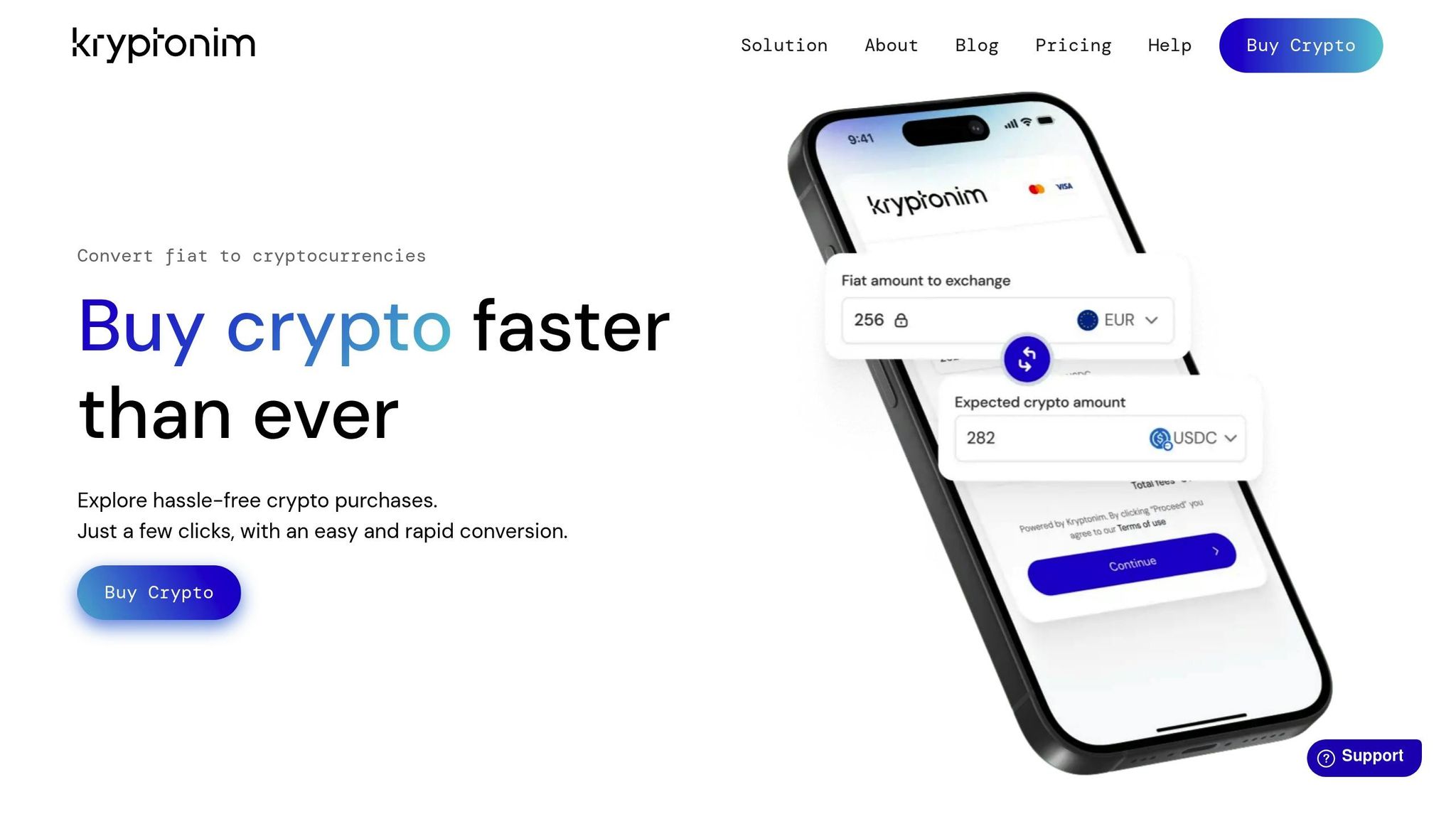
Kryptonim tackles the verification challenges head-on by combining automated systems with strict regulatory compliance. By leveraging third-party verification services, the platform extracts data directly from ID documents, minimizing manual errors and speeding up the process. It also automatically cross-checks your data and flags potential issues - like blurry photos or expired IDs - so they can be corrected immediately.
Simplified Verification Process
Kryptonim makes the verification process smoother by tailoring requirements based on risk. For low-risk users completing straightforward transactions, the process is quick and simple. Typically, you’ll only need to provide a government-issued ID (like a passport or driver’s license) and proof of address (such as a recent utility bill or bank statement). On the other hand, higher-risk users or those making larger transactions may go through Enhanced Due Diligence, which could involve additional questions about the source of funds or even a face-to-face interview. This tiered system ensures you only provide extra documentation when absolutely necessary.
To make things even easier, Kryptonim offers clear guidelines upfront on the documents required and how to submit them properly. This eliminates the confusion that often leads to rejections or delays. By addressing these pain points, Kryptonim significantly reduces the 73% abandonment rate caused by unclear instructions or complicated forms. The entire process is backed by strict regulatory oversight to maintain a secure and efficient experience.
EU-Regulated and Secure Platform
Operating under EU Directive 2015/849, Kryptonim complies with European financial security standards aimed at combating money laundering and terrorist financing. The platform is officially registered with the Polish Financial Supervision Authority (Komisja Nadzoru Finansowego) under entry number RDWW-649, ensuring all verification steps meet rigorous legal standards for data security.
"We are registered in the Register of activities in the field of virtual currencies, authorized by the relevant supervisory units acting on behalf of the Polish Financial Supervision Authority (Komisja Nadzoru Finansowego). Our entry number is RDWW-649." - Kryptonim AML/KYC Policy
This regulatory framework ensures a consistent and secure verification process. Your identity documents and transaction records are stored securely and only shared with authorities upon official request. Beyond the initial onboarding, Kryptonim continuously monitors transactions for unusual activity - like repeated transfers of similar amounts or links to high-risk regions. Importantly, you won’t have to re-verify for every transaction unless specific risks are identified. This approach strikes a balance between maintaining security and ensuring convenience, allowing you to complete transactions quickly while keeping the platform safe for all users.
Conclusion
KYC verification issues come with steep costs for both businesses and their users. On average, companies shell out $48 million annually on manual processing, while 73% of users give up on the process due to confusing forms or technical hiccups. These problems don’t just lead to frustration - they open the door to fraud. With document fraud skyrocketing by 244% year-over-year and U.S. consumers losing more than $12.5 billion to scams in 2024, addressing these challenges is no longer optional.
So, how can platforms tackle these hurdles? The answer lies in smarter, more efficient solutions. Automating data extraction with OCR, introducing biometric liveness checks to combat deepfakes, and offering real-time feedback to help users correct errors can make a world of difference. Risk-based onboarding allows low-risk users to breeze through the process while focusing security measures where they’re most needed. As Chris Hooper from Veriff explains, "Innovations in identity verification (IDV) have been shown to optimize KYC, helping to onboard more genuine customers faster, reduce the risk of fraud, and ensure legal compliance".
The benefits of improving KYC are undeniable. Streamlined processes can increase customer conversions by up to 30%, while platforms that fail to act risk losing 67% of potential customers to slow and clunky onboarding. By treating verification as an opportunity to build trust and stay ahead of fraud, businesses can turn a regulatory necessity into a strategic advantage.
FAQs
What are the main reasons KYC verification might fail?
One of the main reasons KYC verification fails is incomplete or incorrect documentation. For instance, the ID you upload might be missing key details such as your full name, date of birth, or signature. Another frequent issue is poor image quality - photos that are blurry, poorly lit, or affected by glare can make it difficult for the system to read the document.
To prevent these issues, double-check that your documents are complete, valid, and easy to read before submitting. Take photos in good lighting and avoid editing them, so the system can process everything without errors.
What can I do to make sure my documents are accepted for KYC verification?
To get through KYC verification smoothly, make sure you submit clear, accurate, and complete documents that align with the stated requirements. Double-check that your full name, date of birth, and other personal details are easy to read and match the information in your profile.
Here’s what you need to do:
- Use high-quality, color images of your documents - avoid anything blurry, cropped, or edited.
- Submit valid, unexpired identification, such as a passport or driver’s license, ensuring it includes both your photo and signature.
- Steer clear of damaged, altered, or unsupported documents. If you're providing proof of address, ensure it’s a recent document issued within the last three months.
By following these guidelines, you can reduce delays and improve the likelihood of a quick approval for your verification.
What technologies can help streamline the KYC verification process?
Several cutting-edge technologies are reshaping how KYC verification is handled, making it faster, more precise, and secure.
- AI-powered tools: These tools excel at automating data analysis, spotting fraudulent activities, and speeding up the onboarding process. By reducing manual intervention, they streamline workflows and enhance accuracy.
- Biometric verification: Methods like facial recognition and fingerprint scanning add a layer of security by ensuring the person’s identity matches their documentation, significantly lowering the chances of impersonation.
- API-based systems: These systems simplify data integration and automate processes, cutting down on manual errors and boosting operational efficiency.
Together, these technologies tackle common KYC hurdles, such as delays in processing and incomplete paperwork, all while improving the customer experience.