
How to Cash Out Stablecoins to EUR Without Losing Money on Fees
Use low-fee networks, SEPA transfers, and smart timing to keep nearly all your value when converting stablecoins to EUR.

Want to convert stablecoins like USDT or USDC to EUR without high fees? Here's the key: choose low-cost networks, time your transactions strategically, and use transparent platforms like Kryptonim. Traditional methods can cost up to 6.5% of your funds, but stablecoins offer a much cheaper alternative with fees often under 2%.
Key Points:
- Fees to Watch For: Network fees, exchange fees, and bank transfer fees.
- Low-Fee Networks: Use Solana (<$0.01), Tron ($0.01–$0.10), or Polygon ($0.01–$0.05) for transfers.
- Platform Choice: Kryptonim charges a flat 2% fee for EU users with no hidden costs.
- SEPA Transfers: Avoid extra bank fees by using SEPA for EUR withdrawals.
- Timing Matters: Fees drop during low-traffic hours (e.g., weekends or early mornings).
By combining these strategies, you can minimize costs and maximize your EUR payout.
Understanding Fees in Stablecoin to EUR Transactions

Stablecoin vs Traditional Banking Fees Comparison for EUR Withdrawals
When converting stablecoins to EUR, three main types of fees come into play: network fees, exchange fees, and bank transfer fees. These costs can significantly impact how much EUR you actually receive, making it important to understand and plan for them.
By knowing these fees, you can avoid unexpected charges. For instance, withdrawing $200 using traditional banking methods might cost around $12.13 in fees. In contrast, transferring the same amount via a low-cost stablecoin network could cost less than $0.01.
Types of Fees: Network, Exchange, and Bank Transfer
-
Network Fees (Gas Fees)
These fees are paid to validators for processing stablecoin transfers. The cost depends on the blockchain network. For example:- Ethereum: Fees can range from $2 to over $50 during peak congestion.
- Solana: Transactions generally cost less than $0.01.
- Polygon: Average transaction fees are around $0.02.
Notably, these fees are flat, meaning they don’t change based on the transfer amount.
-
Exchange Fees
These cover the cost of converting stablecoins like USDT or USDC into EUR. Most exchanges charge between 0.1% and 1%, while some payment processors might charge up to 2.5% [7,8]. For example, Kryptonim charges a transparent 2% fee, keeping costs predictable and avoiding hidden markups. -
Bank Transfer Fees
These fees apply when transferring EUR from the platform to your bank account. Costs vary depending on the method:- Traditional international wire transfers: Outgoing fees range from $15 to $50, while receiving fees add another $15 to $25. Additionally, banks may apply a foreign exchange (FX) markup of 2% to 4% above the market rate.
- SEPA transfers (within the EU): These generally avoid extra fees, making them a cost-effective option.
| Fee Type | Stablecoin Cost | Traditional Banking Cost |
|---|---|---|
| Network Fee | Less than $0.01 up to $50 (depends on network) | N/A |
| Conversion Fee | 0.1% – 2.5% | 2% – 4% (FX markup) |
| Transfer Fee | $0 (using SEPA) | $15–$50 (outgoing) + $15–$25 (receiving) |
| Settlement Time | Seconds to minutes | 1–5 business days |
How Fees Affect Small vs. Large Withdrawals
The way fees impact your transaction depends on the withdrawal amount.
- Flat Fees and Small Withdrawals
Flat fees can take a big chunk out of smaller transactions. For instance, a $25 flat fee on a $100 withdrawal would mean losing 25% of your funds. However, the same $25 fee on a $10,000 withdrawal would only amount to 0.25%.
A practical example: In 2025, a software company saved $37,800 annually by reducing per-payment fees from $65 to $2 for 50 international contractors. This shows how minimizing flat fees can have a big impact.
-
Percentage-Based Fees and Large Withdrawals
Percentage-based fees scale with the transaction size. A 2% exchange fee on a $1,000 withdrawal would cost $20, but for a $10,000 withdrawal, it jumps to $200. For larger transactions, choosing platforms with transparent percentage-based fees is crucial to avoid hidden FX markups. -
Network Choice
For withdrawals under $1,000, using low-fee networks like Solana or Polygon can help preserve your funds. High-fee networks like Ethereum, on the other hand, might eat into smaller transactions significantly, making them less efficient.
sbb-itb-0796ce6
Using Kryptonim for Low-Fee Stablecoin to EUR Conversions
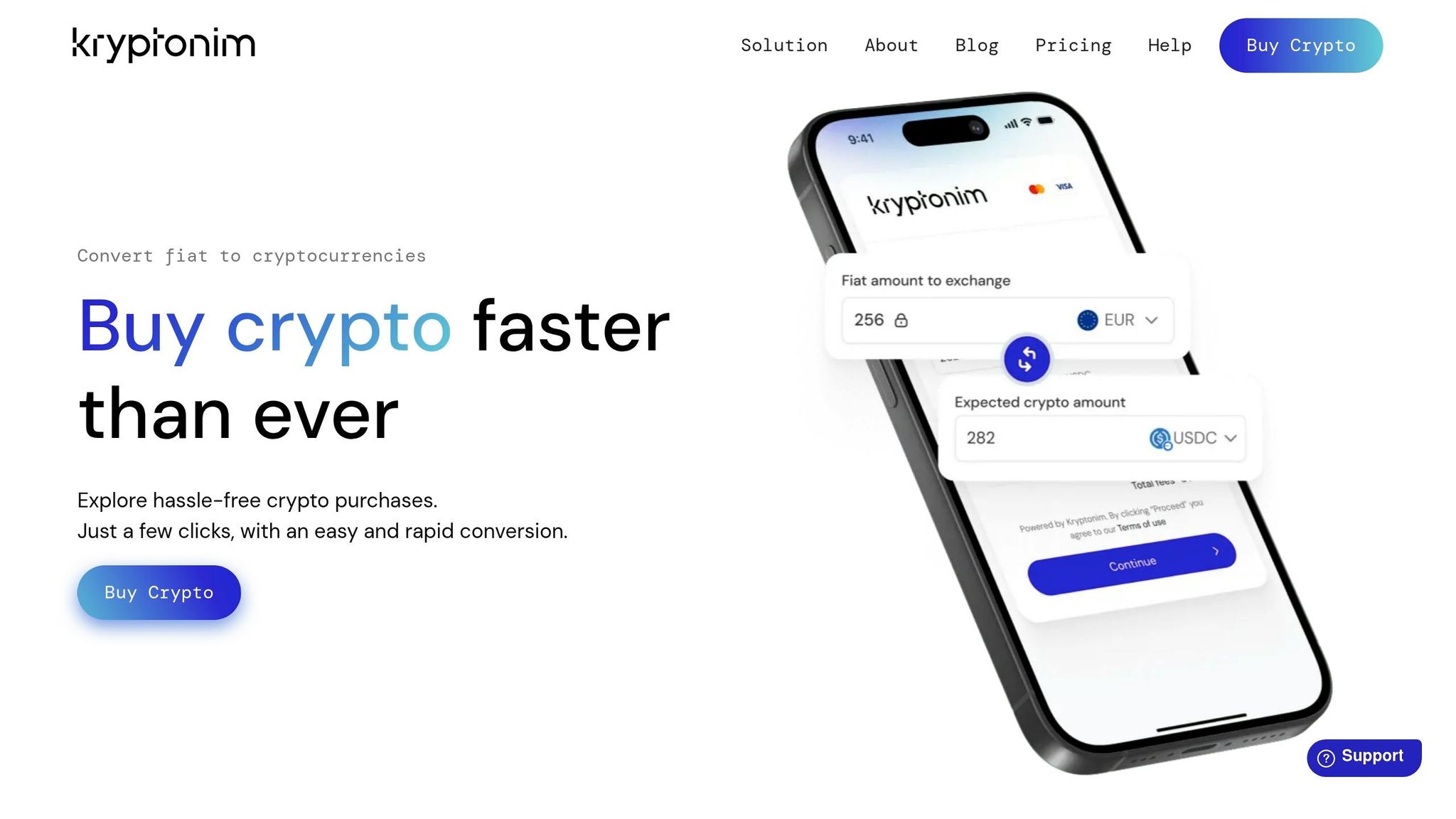
Kryptonim is an EU-regulated virtual assets service provider that specializes in converting USDT and USDC to EUR. With a fixed-fee model, the platform ensures users know exactly what they'll pay, avoiding any surprise costs. Its converter tool clearly displays the exchange rate upfront, making the process straightforward.
By utilizing automated identity verification, Kryptonim keeps costs low while offering direct wallet delivery. This means you can skip transferring funds between multiple custodial accounts, which often leads to extra network fees and delays. Instead, your stablecoins are converted to EUR and deposited into your account in just minutes - far quicker than traditional methods. Let’s take a closer look at the fee structure designed for EU users.
Kryptonim's 2% Fee Structure for EU Users
Kryptonim charges a 2% fee for EU-based users and 4% for users outside the region. This pricing strategy supports adoption within Europe while remaining competitive globally. For comparison, traditional methods can cost up to 2.5%, and remittance channels may charge as much as 6% of the transaction amount.
The 2% fee applies equally to USDT and USDC conversions to EUR, with no hidden markups. For instance, converting $5,000 in USDC would incur a $100 fee - this cost can be calculated in advance, thanks to Kryptonim's transparent pricing. To access the reduced 2% rate, you’ll need to complete identity verification using an EU-based payment method or ID.
Step-by-Step Guide: Converting USDT/USDC to EUR on Kryptonim
Here’s how to convert your stablecoins effortlessly:
- Step 1: Go to the Kryptonim website, select your stablecoin (USDT or USDC) and EUR as the target currency, and complete the automated KYC process. The tool will instantly display the exchange rate and fees. Having your ID ready can help you finish this step in under five minutes.
- Step 2: Once verified, transfer your USDT or USDC from your private wallet to the deposit address provided by Kryptonim. Make sure your wallet is compatible with the platform.
- Step 3: After Kryptonim receives your stablecoins, confirm the exchange at the displayed rate.
- Step 4: Choose where to send your EUR funds. You can direct them to your bank account via a supported payment method or opt for a SEPA transfer to avoid additional bank fees.
This process is designed to make stablecoin-to-EUR conversions as smooth and fast as possible.
Using SEPA Transfers to Avoid Additional Bank Fees

SEPA (Single Euro Payments Area) simplifies euro transfers across 36 countries, covering all EU nations and several others outside the EU. When cashing out stablecoins to EUR, SEPA helps dodge correspondent bank fees and foreign exchange markups that often come with traditional wire transfers. It treats euro transfers like domestic payments, keeping costs low and processing times fast - most transactions clear within 24 hours, and SEPA Instant can complete them in seconds.
Requirements for SEPA-Compatible Withdrawals
To withdraw EUR from Kryptonim via SEPA, you’ll need two key things: a bank account within the SEPA region and a valid International Bank Account Number (IBAN). Be sure your bank supports transactions involving cryptocurrency platforms since some banks might block or freeze such transfers.
SEPA transactions are strictly in euros, so make sure your stablecoins are converted to EUR within Kryptonim before initiating the withdrawal. Once these criteria are met, the process is straightforward.
How to Set Up a Bank Transfer from Kryptonim
After converting your stablecoins to EUR, withdrawing funds via SEPA is simple. Head to your EUR balance, select the withdrawal option, and choose SEPA transfer as your method. Input the amount you want to cash out and carefully enter your verified IBAN - mistakes here could lead to reversal fees.
Stick with the standard SEPA transfer option instead of selecting "urgent", as some banks might reject urgent requests. Once you confirm the transaction, your EUR should arrive within 1 to 3 business days, though many transfers are completed in under 24 hours. Processing is often quicker if you initiate the withdrawal during regular business hours.
How to Reduce Costs During Stablecoin Transactions
Saving money when converting stablecoins to EUR involves more than just selecting the right platform. It’s about being strategic from the start - choosing the right network and timing your withdrawals can make a big difference in how much you keep.
Choosing Low-Fee Networks for Stablecoin Deposits
Not all blockchains are created equal when it comes to transaction fees. Stablecoins like USDT and USDC operate on multiple networks, and each has its own fee structure. For instance, in 2026, sending USDT on Ethereum (ERC-20) can cost anywhere from $3.00 to $9.00 per transaction, while transferring the same amount on Solana (SPL) costs less than $0.01.
Networks like Tron (TRC-20) and Polygon (MATIC) offer a middle ground between affordability and reliability, with fees ranging from $0.01 to $0.10. Tron has become the go-to choice for moving USDT between exchanges because of its low fees. Polygon is another budget-friendly option, especially if you’re already using Ethereum-based decentralized finance tools.
Be sure to use the network specified by Kryptonim to avoid losing your funds. For example, sending USDT via TRC-20 when the platform expects ERC-20 can lead to permanent loss of funds. To avoid errors, test with a small $1 transaction before transferring larger amounts.
It’s also crucial to have the network’s native token (like MATIC for Polygon, TRX for Tron, or ETH for Ethereum) to pay gas fees. Without these, your transaction won’t go through.
Here’s a quick comparison of fees and speeds across popular networks:
| Network | Token Type | Average Transfer Fee | Confirmation Speed |
|---|---|---|---|
| Solana (SPL) | SPL Token | < $0.01 | Up to 5 seconds |
| Polygon (MATIC) | ERC-20 | $0.01 – $0.05 | 30 sec – 2 minutes |
| Tron (TRC-20) | TRC-20 | $0.01 – $0.10 | 5 – 15 seconds |
| Ethereum (ERC-20) | ERC-20 | $3.00 – $9.00 | 1 – 10 minutes |
By combining low-fee networks with smart timing, you can maximize your EUR payout when cashing out stablecoins.
Timing Your Withdrawals for Better Exchange Rates
Once you’ve chosen a cost-effective network, timing your withdrawal is the next step to saving more. Since stablecoins are tied to the US dollar, keeping an eye on the USD/EUR exchange rate can help you get the most value for your holdings. Unlike traditional banks that operate during fixed hours, stablecoin platforms let you convert 24/7, so you can act quickly when rates are in your favor.
Traditional banks often add a 2–4% markup to the mid-market exchange rate, while stablecoin platforms typically keep markups between 0–0.5%.
"Monitoring trends and timing conversions for favorable rates can help maximize return." - Mural Pay
Network congestion also impacts transaction fees. Fees tend to spike during high-traffic periods, as users compete for faster processing. To avoid this, plan your deposits during low-activity times. For example, transaction fees drop by 60–80% between 2:00 AM and 8:00 AM EST, when both U.S. and European markets are quiet. Additionally, weekend transactions often cost 40% less than weekday ones.
If you want to save even more, aim to process your transactions early in the morning or over the weekend when network activity is at its lowest.
Conclusion: Key Points for Low-Fee Stablecoin Withdrawals
Converting stablecoins to EUR doesn’t have to drain your funds with unnecessary fees. The secret lies in using the right platform and adopting smart transaction strategies. For instance, Kryptonim's 2% fee structure for EU users is a clear advantage over traditional banks, where combined fees and markups can reach a hefty 6.5%.
When it comes to deposits, opt for low-cost networks like Solana, Tron, or Polygon. These networks keep transaction fees minimal, unlike the Ethereum network, which tends to be much pricier. For withdrawals, SEPA transfers are your best bet - they typically cost just €0.90 to €1.00, far less than the €5.00 to €13.00 charged for SWIFT transfers.
To get the most out of every transaction, pay attention to network fees and aim to process transactions when costs are lower. Also, track exchange rates to convert your funds at the most favorable times. By carefully choosing networks and transfer methods, you can make the most of your stablecoin conversions.
FAQs
What’s the cheapest network to send USDT/USDC before converting to EUR?
The TRC20 (TRON) network stands out as one of the most affordable ways to send USDT or USDC, with transaction fees averaging around $1.60. For an even cheaper option, the Arbitrum network offers fees ranging from $0.003 to $0.05, delivering up to 99% savings compared to the Ethereum mainnet. These networks are excellent for cutting down transfer costs, especially when planning to convert funds to EUR.
How do I avoid sending my stablecoins on the wrong network?
To prevent sending stablecoins on the wrong network, always choose the correct blockchain network (like ERC20, TRC20, or Solana) that matches the recipient's wallet or platform. Carefully review the network details provided by the recipient or platform, and make sure your wallet supports the selected network. If you're uncertain, refer to the recipient's instructions to verify compatibility before proceeding with the transfer.
Why did I receive less EUR than expected after cashing out?
You might have ended up with fewer euros than anticipated because of transaction fees, spreads, or other costs that come into play during currency conversion. These could include hidden charges from service providers, delays you didn’t foresee, or extra steps tied to the method you chose - like exchanges, peer-to-peer platforms, or bank transfers. To avoid surprises, it’s a good idea to check fee structures and terms in advance.