
Case Studies: Dogecoin and Shiba Inu Communities
How community focus, memes and practical tools drove two meme-coin successes—one via tipping and charity, the other via DAO governance, burns and a DeFi ecosystem.
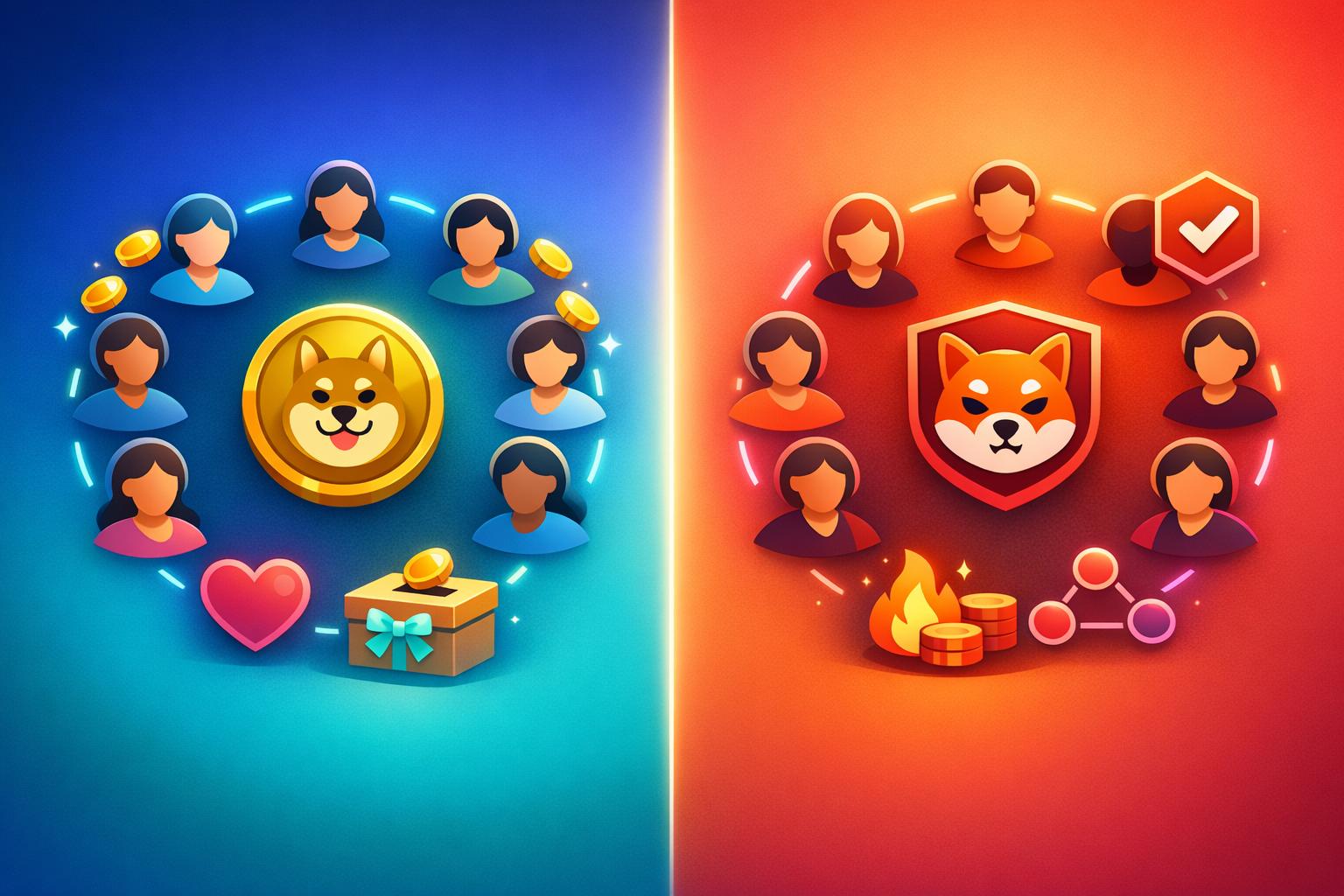
Dogecoin and Shiba Inu are two cryptocurrencies that succeeded by focusing on community-driven growth rather than complex technology or traditional funding. Both started as meme coins but evolved into billion-dollar projects thanks to their dedicated communities, humor, and unique approaches.
- Dogecoin: Launched in 2013, it gained popularity through humor, micro-tipping, and charitable campaigns. With a market cap of $53.44 billion in early 2025, its community ("Shibes") is known for generosity and simplicity. Elon Musk's tweets also boosted its visibility.
- Shiba Inu: Introduced in 2020 as the "Dogecoin Killer", it expanded beyond memes into a full ecosystem. By early 2025, it had 1.3 million holders and a market cap of $7.8 billion. Its "SHIB Army" focuses on decentralized governance, token burns, and tools like ShibaSwap and Shibarium.
Key Takeaways:
- Community Focus: Both coins thrived through grassroots efforts, humor, and collective action.
- Different Goals: Dogecoin emphasizes everyday transactions, while Shiba Inu builds a broader decentralized finance ecosystem.
- Engagement Strategies: Tools like tipping (Dogecoin) and governance (Shiba Inu) keep users involved.
These examples show that storytelling, shared ownership, and practical tools can drive long-term success in crypto projects.
Dogecoin: A Community Built on Humor and Generosity
Origins and Early Growth
Dogecoin made its debut on December 6, 2013, as a tongue-in-cheek response to the cryptocurrency market's often overly serious nature. Jackson Palmer, one of its co-founders, intentionally designed it to be "as ridiculous as possible". The project took inspiration from the Doge meme, featuring a Shiba Inu named Kabosu with Comic Sans captions, to create a mascot that was both funny and approachable. This lighthearted branding helped demystify cryptocurrency for those who found Bitcoin's technical aspects daunting.
The response was immediate and enthusiastic. Within just two weeks, the r/Dogecoin subreddit had gained over 19,000 members. In its first month, the official website attracted more than 1 million unique visitors. Even in its early days, Dogecoin achieved daily transaction volumes that surpassed Bitcoin's. Its playful nature encouraged users to explore digital tokens through micro-tipping on platforms like Reddit and Twitter, rather than viewing them as serious, high-stakes investments.
The humor at Dogecoin's core naturally gave rise to a spirit of generosity. When DogeWallet was hacked in December 2013, resulting in stolen funds, the community rallied together to raise 15 million DOGE (around $12,000 at the time) to compensate victims. This event, known as the "Dogecoin Christmas hack", reinforced generosity as a defining trait of the community. These early moments laid the groundwork for the collaborative campaigns that would shape Dogecoin's identity for years to come.
Strategies for Long-Term Engagement
Dogecoin's community maintained its momentum by organizing charitable initiatives that captured mainstream attention. For instance, after successfully fundraising for the Jamaican bobsled team, they turned their efforts to Charity: water, raising 40 million DOGE (approximately $50,000) to fund clean-water wells in Kenya. In March 2014, they stepped into the world of NASCAR, collecting 67 million DOGE (about $55,000) to sponsor driver Josh Wise. His #98 car, complete with the Shiba Inu meme, raced at the Talladega Superspeedway.
These campaigns not only showcased the community's generosity but also attracted new supporters through widespread media coverage. By August 2014, the DogeTipBot had gained over 70,000 users, becoming a popular tool for microtransactions on social media. This tipping culture made it easy for newcomers to get involved without significant financial risk, further boosting adoption.
Elon Musk played a pivotal role in amplifying Dogecoin's reach. When he tweeted statements like, "Doge might be my fav cryptocurrency. It's pretty cool" and "Dogs rock ... they have the best coin", his support sparked what became known as the "Elon Effect." These endorsements often led to dramatic surges in Dogecoin's price, bringing even more attention to the community and its quirky, generous spirit.
Shiba Inu: Using Memes and Ecosystem Development
Community Formation and Initial Growth
Shiba Inu made its debut in August 2020 with the bold tagline of being the "Dogecoin Killer". This clever branding tapped into the growing popularity of meme-based cryptocurrencies, quickly catching the attention of enthusiasts already familiar with the trend. The project’s anonymous founder, Ryoshi, deliberately chose to stay in the background, shifting the spotlight to the collective effort of its community rather than a single leader.
The reliance on memes and community-driven growth turned out to be a winning formula. By mid‑2025, the r/SHIBArmy subreddit had amassed over 500,000 members, while its X (formerly Twitter) following climbed to an impressive 3.94 million. This grassroots energy fueled SHIB’s meteoric rise, delivering jaw-dropping returns of over 45,000,000% in 2021. By June 2025, the project had attracted approximately 1.45 million on-chain holders.
"SHIB was pitched as just a grassroots experiment that anyone could contribute to for growth not marketed as a top‑down project."
– Jones, Author, Blockchain App Factory
One of the most memorable moments in Shiba Inu’s early history came in May 2021 when Ryoshi sent 50% of the total SHIB supply - 500 trillion tokens - to Ethereum co-founder Vitalik Buterin. In a dramatic move, Buterin burned 90% of these tokens, worth about $6.7 billion at the time, and donated the remaining 10% to the India COVID‑Crypto Relief Fund. This event not only showcased the project’s commitment to its community but also helped lay the groundwork for Shiba Inu’s transformation from a meme coin into a broader ecosystem.
Ecosystem Expansion and Utility
Shiba Inu didn’t stop at being just a meme coin. It took significant steps to create real-world utility and expand its ecosystem. At the heart of this expansion was a multi-token economy featuring four key tokens:
- SHIB: The base currency and primary payment method.
- BONE: Used for governance and staking within the Shibarium network.
- LEASH: A scarcity-focused token offering premium access within the ecosystem.
- TREAT: Designed to reward community participation and support DeFi incentives.
One of the project’s major milestones was the launch of Shibarium, a Layer‑2 network that processed over 1 million transactions in its first week and reached 1.54 billion by September 2025. The platform introduced an automated burn mechanism, converting 70% of transaction fees into SHIB and permanently removing them from circulation. This burn strategy aimed to add long-term value for token holders.
Another significant development came on September 12, 2025, with the release of ShibaSwap version 2. This upgrade brought native cross-chain trading across 19 blockchain networks, including BNB Chain and Polygon. Using smart routing algorithms, ShibaSwap 2 optimized both trading costs and execution speed. Beyond this, the ecosystem expanded into NFTs with the launch of Shiboshis and announced plans for "SHIB: The Metaverse".
In January 2025, the team introduced the TREAT token to incentivize community participation. A coordinated burn event in April 2025 further boosted the burn rate by 1,300%. The ecosystem also empowered its community by allowing holders to vote on future projects, such as "Shiba Pay", giving them a direct role in shaping the project’s direction.
| Token | Primary Function | Supply Detail |
|---|---|---|
| SHIB | Base currency and primary payment method | ~589.25 trillion in circulation |
| BONE | Governance and Shibarium staking/gas | Fixed 250 million supply |
| LEASH | Scarcity token and premium ecosystem access | 107,646 tokens in circulation |
| TREAT | DeFi rewards and governance incentives | 10 billion total supply |
Comparing Dogecoin and Shiba Inu Communities

Dogecoin vs Shiba Inu: Community-Driven Crypto Comparison
Differences and Similarities
When it comes to Dogecoin and Shiba Inu, their communities are as distinctive as their market strategies and technical frameworks. Both share a meme-inspired identity centered around the Shiba Inu mascot, but their paths to growth reveal contrasting philosophies. Dogecoin's community, affectionately known as the "Shibes", thrives on humor, simplicity, and a history of philanthropy. In contrast, Shiba Inu's "SHIB Army" is mission-driven, focusing on rapid ecosystem development and technological advancements rather than charitable initiatives.
This divide is also apparent in their governance structures. Dogecoin maintains a more informal, community-led development process. On the other hand, Shiba Inu has introduced a structured governance model through its Doggy DAO, allowing for more organized decision-making and strategic planning.
Market Performance and Social Reach
As of January 2025, Dogecoin holds the 7th spot in market rankings with a valuation of approximately $53.44 billion, while Shiba Inu ranks 18th with a market cap of around $11.92 billion. Dogecoin's five-year return stands at about 18,630%, whereas Shiba Inu has seen astonishing growth, delivering returns close to 5,605,252%. Social media engagement reflects this rivalry, with Dogecoin amassing around 4 million followers on X and 2.5 million on Reddit, while Shiba Inu boasts 3.9 million followers on X but only 546,000 on Reddit.
Technical Foundations and Ecosystem
The technical underpinnings of these cryptocurrencies highlight their different approaches. Dogecoin runs on its own Proof-of-Work blockchain, processing approximately 33 transactions per second. It follows an inflationary model, adding 5 billion new tokens annually to encourage spending and tipping. Shiba Inu, however, operates as an ERC-20 token on Ethereum's Proof-of-Stake network, which is more energy-efficient and supports up to 200 transactions per second. Shiba Inu also employs a deflationary strategy, reinforced by community token burns - most notably, Vitalik Buterin's burn of 410 trillion SHIB tokens in May 2021.
Adoption and Use Cases
Both communities benefit from low-cost tokens and the viral power of social media. Celebrity endorsements have played a significant role in their visibility. Dogecoin is accepted by over 2,500 merchants, including Tesla (for merchandise) and AMC Theatres, while Shiba Inu is supported by more than 1,000 retailers, such as Whole Foods and Petco.
Ultimately, their goals set them apart. Dogecoin aims to be a practical digital currency for everyday transactions, while Shiba Inu is building a decentralized finance ecosystem designed to expand its network utility. These differences in purpose and strategy underscore the unique appeal of each community.
sbb-itb-0796ce6
Lessons for Building Crypto Communities
Strategies for Engagement and Growth
Dogecoin and Shiba Inu highlight a key takeaway: storytelling often resonates more with retail investors than technical jargon. As Jones from Blockchain App Factory aptly puts it:
"Humor travels faster than whitepapers" – Jones, Blockchain App Factory
This lighthearted approach has been instrumental in making cryptocurrencies more accessible to newcomers, breaking down barriers of complexity.
Another critical factor is community ownership, which often fosters deeper loyalty than founder-led models. Shiba Inu's adoption of the ShibaDAO governance structure is a prime example. By allowing token holders to vote on ecosystem decisions through BONE tokens, the project empowered its community to take charge. The "Ryoshi Effect", named after Shiba Inu's anonymous founder, further emphasizes this idea. By stepping back, the founder encouraged grassroots leadership, reducing centralized blame and promoting shared responsibility.
Shared rituals also play a pivotal role in strengthening community bonds. Take the Shiba Inu decentralized burn event in April 2025, for instance. This community-organized effort increased the token’s burn rate by 1,300% in just one month, leading to noticeable price shifts. Such collective actions create a sense of camaraderie that extends beyond trading.
What truly sets sustainable projects apart, however, is utility integration. Shiba Inu evolved from a meme coin into a functional ecosystem by launching ShibaSwap, a decentralized exchange, and Shibarium, a Layer-2 network. These tools gave users practical reasons to stay engaged, even during market slumps. Projects that incorporate features like staking rewards, governance voting, or partnerships outside the crypto space tend to see higher engagement rates - around 35–40% - compared to just 18% for traditional crypto projects.
Finally, coordinated digital efforts amplify engagement. While Elon Musk’s tweets often caused short-term spikes in Dogecoin’s value, its long-term growth stemmed from community-driven campaigns like Twitter raids and the DogeTipBot reward system. Platforms like TikTok and X (Twitter) have shown that micro-influencers, with their relatable content, often drive more sustained interest than celebrity endorsements. Daily interactions - such as live AMAs, community challenges, or simple tasks like retweets - help establish a foundation for engagement before introducing more complex on-chain activities.
These strategies - combining humor, shared ownership, and meaningful utility - demonstrate the critical elements behind the enduring success of crypto communities.
Conclusion
Dogecoin and Shiba Inu prove that community is at the heart of value in meme-driven cryptocurrencies. Both projects thrived by building emotional connections through humor, shared identity, and collective action. The "SHIB Army" and "Shibes" became digital tribes with their own traditions, culture, and sense of ownership, fostering deep, lasting engagement.
Their success highlights the need to balance viral appeal with purposeful evolution. Dogecoin kept things simple, focusing on transactions, while Shiba Inu expanded into a broader ecosystem with features like ShibaSwap, Shibarium, and governance through ShibaDAO. This strategic shift helped SHIB maintain its $7.71 billion market cap and 1.45 million holders by June 2025, even as market conditions shifted.
Grassroots efforts like the April 2025 burn event, which boosted SHIB's burn rate by 1,300%, reflect how community-driven initiatives can create impact without relying entirely on developers. Similarly, Dogecoin's early charitable campaigns showed how decentralized efforts can build loyalty and credibility over time. These examples emphasize how community-led action can translate into enduring value.
For new crypto ventures, the takeaway is clear: storytelling grabs attention, but participation keeps it alive. Tools like governance voting and staking turn passive investors into active participants. When combined with practical use cases beyond speculation, blending humor, utility, and shared ownership lays the groundwork for long-term value that can weather market ups and downs.
FAQs
Why did Dogecoin grow so fast without major tech upgrades?
Dogecoin's rise to prominence wasn't due to groundbreaking tech changes but rather the incredible energy of its community. Through viral memes, celebrity shoutouts, charitable initiatives, and genuine engagement, they propelled the coin into the spotlight. This mix of grassroots enthusiasm and widespread appeal turned Dogecoin into a widely recognized name with a strong pop culture footprint, driving its success.
How do SHIB burns on Shibarium affect supply and price?
Shibarium's SHIB burns work by transferring tokens to unspendable wallets, effectively removing them from circulation forever. To date, over 410 trillion SHIB - equivalent to 41% of the original supply - has been burned. This process aims to create scarcity, which could lead to price increases if demand remains stable or rises. However, given the token's substantial circulating supply, any noticeable impact on price might take time to unfold.
What keeps meme-coin communities engaged during bear markets?
Meme-coin communities thrive even in bear markets by leaning heavily on a strong sense of togetherness and shared identity. Members stay active through activities like crafting memes, launching social media campaigns, and joining various community-driven initiatives. These efforts create a sense of belonging and give participants a purpose.
On top of that, collective actions such as token burns, staking opportunities, and governance participation strengthen the feeling of shared ownership. This keeps members engaged and motivated, helping them stay resilient during challenging market phases.