
Best Global Crypto Platforms for Oceania in 2026
Compare top global crypto platforms for Oceania—fees, AUD/NZD funding, compliance, and best use cases for traders and beginners.

If you’re in Oceania, the best platform depends on one thing: what you want to do. For low-fee spot trading, Binance leads. For tighter compliance and simpler AUD funding, Kraken and Coinbase make more sense. For direct fiat-to-wallet buys with no account setup, Kryptonim is the simplest path. And for traders who want more tools and more coins, Bybit and KuCoin fit better.
I’d sum the article up like this:
- Australia is the easiest market in the region for global crypto platforms.
- New Zealand has fewer direct fiat options on some platforms.
- Derivatives access is more limited than spot trading in parts of Oceania.
- Fees vary a lot: from about 0.10% spot trading fees on Binance, Bybit, and KuCoin to 4% per purchase on Kryptonim.
- Local funding matters just as much as headline fees. A low trading fee can still cost more if card spreads or conversion charges apply.
- Crypto ownership in Australia is high, with about 31%–32.5% of people having owned or currently owning crypto.
If I were picking fast:
- Choose Binance for lowest-cost active spot trading
- Choose Kraken for compliance plus AUD bank funding
- Choose Coinbase for easy exchange buying in Australia
- Choose Kryptonim for direct crypto delivery to your own wallet
- Choose Bybit or KuCoin for more trading tools and large coin lists

Best Crypto Platforms for Oceania 2026: Side-by-Side Comparison
Quick Comparison
| Platform | Best For | AUD/NZD Funding | Cost Level | Notes |
|---|---|---|---|---|
| Kryptonim | Direct fiat-to-wallet buys | Yes | High | No account setup, 4% transaction fee |
| Binance | Low-fee spot trading | AUD yes, NZ access varies by method | Very low | Spot available, derivatives limited in AU/NZ |
| Kraken | Compliance-focused users | AUD strong, NZ less direct | Low to mid | AUD via Osko/PayID, Pro fees lower than Instant Buy |
| Coinbase | Beginner-friendly exchange use | AUD strong, NZ less direct | Mid to high | Easy to use, but simple buys cost more |
| Bybit | Active traders | No direct AUD/NZD balance support | Very low | Better for crypto-first users |
| KuCoin | Low-fee trading and many assets | AUD yes, NZD supported | Very low | Spot and futures access depend on market rules |
So the short version is simple: pick based on funding, fees, and product access in your country - not just the brand name.
sbb-itb-0796ce6
1. Kryptonim
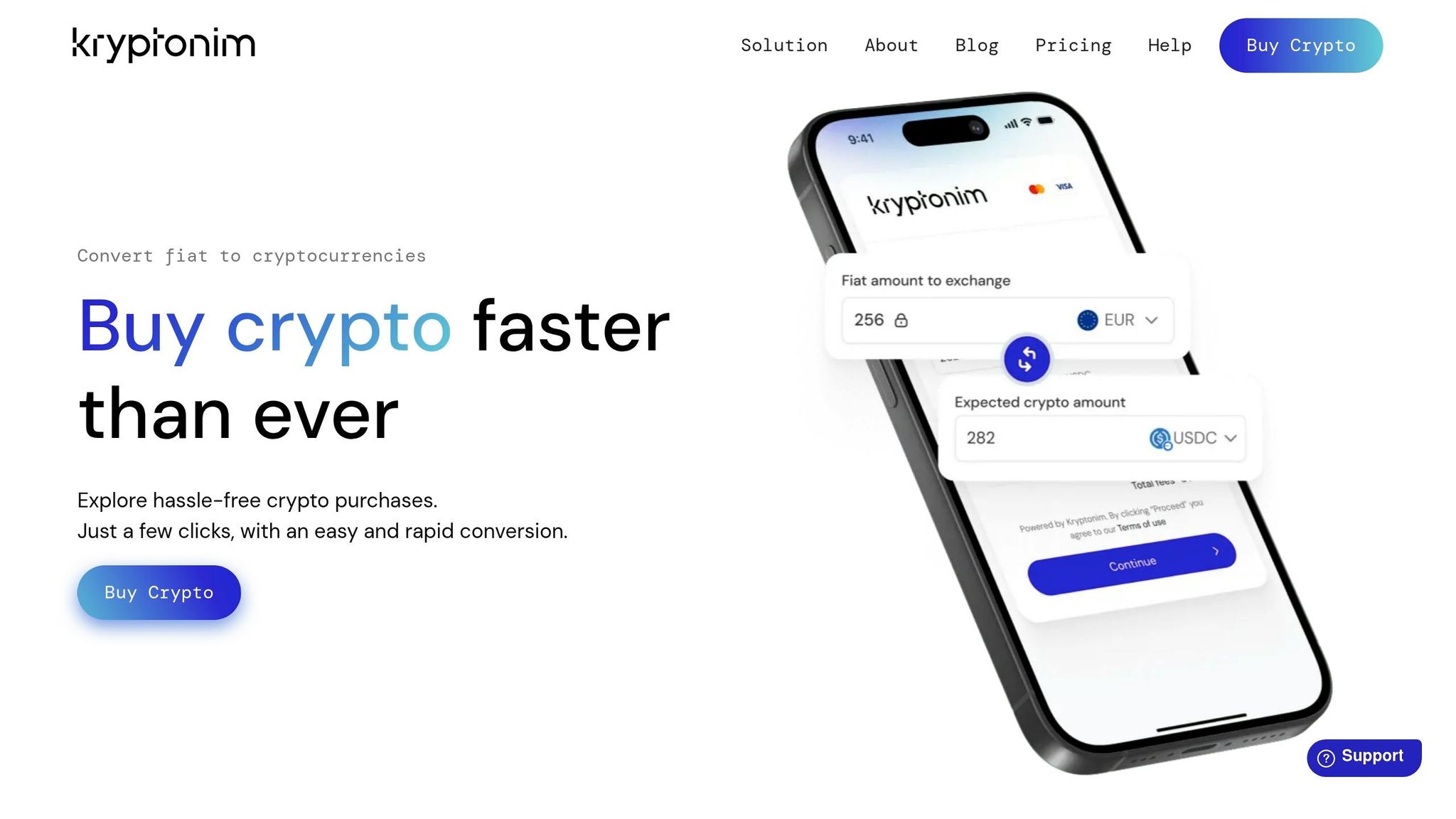
Kryptonim is a fiat-to-crypto purchase platform built for simple, direct crypto buys. For users in Oceania, the main draw is pretty clear: you pay with fiat, and the crypto goes straight to your own wallet.
Oceania Availability
Kryptonim is available to users in Oceania under its "Other Regions" tier. Because Kryptonim sends purchases straight to an external wallet, you need to have a wallet set up before you buy.
Fiat Support & Funding
For Oceania users, Kryptonim supports AUD and NZD with Visa, Mastercard, Maestro, Apple Pay, and Google Pay. You don't need to create an account, which keeps the process simple. That said, you still need to provide an email address and complete verification.
Trading & Purchase Costs
The fee structure is shown upfront, so you can see the cost before you complete the purchase.
| Detail | Oceania Users |
|---|---|
| Transaction Fee | 4% per transaction |
| Minimum Purchase | 10 EUR or local-currency equivalent |
| Network Fee | Variable, based on blockchain congestion |
| Typical Processing Time | 2–20 minutes |
For Oceania users, Kryptonim charges a 4% fee per transaction. Your final crypto amount is locked in when payment is received, not when you start the order, so small market moves can change what lands in your wallet. On top of that, network fees are charged separately and shift based on blockchain traffic.
That 4% fee is easy to understand, but it can add up if you buy often.
Regulation & Security
Kryptonim operates under EU oversight and uses verification and compliance controls. It also follows a non-custodial model, which means it doesn't hold your crypto for you.
For Oceania users who want a direct fiat-to-wallet purchase flow, Kryptonim sets a straightforward reference point.
2. Binance
For users in Oceania, Binance is mostly a low-fee spot trading platform. It supports Australia and New Zealand in 2026, but access depends on where you live, so you shouldn't assume you get the full global Binance lineup.
Oceania Availability
Spot trading is available in Australia and New Zealand. But Futures and other leveraged products are not available in those markets. So for most Oceania users, the key issue is simple: Can you access spot trading? The rest of the product catalog matters a lot less.
Fiat Support & Funding
Australian users got a big update in early 2026. Binance restored AUD deposits and withdrawals through a partnership with Bolt Financial Group, which brought back bank transfers and PayID. That means local users once again have a direct way to move money in and out through their bank.
For New Zealand users, crypto purchases are available through debit and credit cards, along with other supported payment methods. That said, card purchases often come with wider spreads than buying on the spot market. In plain English, the convenience can cost you. If you're buying in a liquid market, using limit orders on spot is usually the cheaper move.
Trading & Purchase Costs
Binance keeps its base spot trading fees low. The standard fee is 0.10% for both maker and taker orders. If you pay fees in BNB, that drops by about 25%, which puts the rate near 0.075%.
If you trade large volume, Binance's VIP tiers can push fees even lower, with rates falling below 0.02% at the top end. Binance also runs occasional zero-fee promos on major pairs like BTC and ETH, and during those periods, trading costs can drop to $0 for those pairs.
| Fee Type | Standard Rate | With BNB Discount |
|---|---|---|
| Spot Maker | 0.10% | ~0.075% |
| Spot Taker | 0.10% | ~0.075% |
Regulation & Security
In Australia, Binance operates through InvestbyBit Pty Ltd, which is registered with AUSTRAC. That puts it under Australian AML, CTF, client verification, and transaction monitoring rules. Full account verification is required if you want access to all features.
Binance also publishes Proof of Reserves and gives users a way to check balances inside the wallet interface. That's useful for transparency, but it doesn't change the basic rule of thumb: keep funds on an exchange for trading, not long-term storage.
3. Kraken
Kraken puts less weight on bargain-basement trading fees and more on regulated access plus simpler AUD funding for users in Australia. For people in Oceania, that mix can be a good fit: strong security, direct AUD deposits, and a setup that feels more straightforward than using an offshore-only option.
Oceania Availability
In Australia, Kraken operates through Bit Trade Pty Ltd, which is registered with AUSTRAC as a Digital Currency Exchange and Independent Remittance Dealer. It also holds an AFSL for derivatives offered to wholesale clients.
New Zealand users access Kraken through the global platform, and no separate local license is noted here. That said, access still depends on where you live. In Australia, some tokens and earn products are restricted, so the product lineup is not the same across all users.
Fiat Support & Funding
For Australian users, one of Kraken’s strongest points is AUD funding through Osko/PayID. Deposits are usually fast, and you skip the extra currency conversion step.
Outside Australia, the picture can be less convenient. Users often need international wire transfers, which can mean more fees and more waiting. That’s where Kraken starts to feel different depending on your location.
Trading & Purchase Costs
Instant Buy is the easy route, but that convenience comes at a price. The all-in cost is usually around 1.5%–2.5% per transaction.
Kraken Pro is where costs drop a lot. Maker/taker fees sit well below 0.5% for most retail tiers, and maker fees can fall to 0% at higher trading volumes. So if you trade often, or just don’t want to overpay for convenience, Kraken Pro is the part of the platform that keeps pricing in check.
Kraken’s edge isn’t that it has the absolute lowest advertised fee. It’s that it combines regulated access, local AUD funding, and lower-cost execution on Pro in one place.
Regulation & Security
Kraken holds licenses across major markets, runs semiannual Proof of Reserves audits, and holds ISO 27001 certification. For Oceania users who care a lot about compliance and security, that setup stands out.
4. Coinbase
Coinbase charges more than some rivals, but in return you get tight oversight and a smooth, easy-to-use platform.
Oceania Availability
Australia is where Coinbase has the strongest footing in Oceania. Access in New Zealand is more limited, and some advanced products aren't available there. Australian users can use spot trading, simple buys, and fiat funding. In some Pacific Island markets, users can get onchain trading through the app. So for people in Oceania, Coinbase is most usable in Australia and more limited outside it.
Fiat Support & Funding
Australia gets the best fiat setup. Coinbase supports AUD deposits and withdrawals through PayID with no deposit fee, and users can also make instant purchases with a linked debit card. New Zealand users often have to rely on international card or bank payments, which can add currency conversion costs. That makes funding ease a big part of Coinbase's appeal in the region.
Trading & Purchase Costs
Coinbase's simple buy option costs more: about a 0.5% spread plus extra fees. Coinbase Advanced Trade brings retail fees down to around 0.40%/0.60%. If you're using Coinbase in Oceania, it's smarter to fund with bank transfers instead of debit cards, and to use Advanced Trade for anything beyond a small one-time purchase. That's the main trade-off: a cleaner user experience, but higher costs if you use the basic flow.
Regulation & Security
Coinbase holds 45 state-level money transmitter licenses in the U.S. and received MiCA authorization in Luxembourg in 2025. It requires mandatory KYC for all users, keeps most customer funds in cold storage, and has insurance coverage for certain custodial holdings. For Oceania users who care a lot about compliance and custody safeguards, that's where Coinbase stands out.
5. Bybit

Bybit puts less emphasis on simple fiat purchases and more on active trading, especially derivatives. For users in Oceania, it works best as a crypto-first exchange: spot trading is available, but derivatives, including perpetual futures, are still the main reason many people use it where local rules allow.
Oceania Availability
Bybit is a better fit for Oceania users who already know their way around crypto and want a broad set of trading tools. If you just want to buy and hold, the platform can feel a bit busy at first.
Fiat Support & Funding
Bybit does not offer direct AUD or NZD balances or withdrawals. In most cases, funding goes through cards or payment gateways like One-Click Buy. That means it tends to work better for traders who move crypto in and out than for people who want direct local-currency banking.
If you want to cash out in AUD or NZD, the usual route is simple: send your crypto to a local exchange, then sell it there.
Trading & Purchase Costs
Bybit's base spot trading fees are 0.10% maker / 0.10% taker for standard non-VIP accounts. Derivatives fees follow a tiered schedule, with lower rates for users whose 30-day trading volume goes up.
A few other costs matter here too:
- Crypto deposits are free.
- Withdrawals come with fixed fees that depend on the asset.
- For Oceania users, the extra cost is often the fiat gateway spread or fee.
Regulation & Security
Bybit has been expanding its regulated footprint and requires KYC verification. It also supports two-factor authentication and withdrawal whitelisting. Before putting money into the platform, Oceania users should check what rules, user protections, and product access apply in their own country.
That leaves Bybit as a stronger match for active traders than for users who need direct AUD/NZD banking.
6. KuCoin

If you want more than a simple place to buy crypto, KuCoin leans into market access and trading options. It lists 1,000+ assets and includes spot, futures, margin, and Web3 wallet tools.
Oceania Availability
KuCoin is available across Oceania, though Australia is the clearest supported market. Access in other countries depends on local rules. Its Australian subsidiary is registered with AUSTRAC as a Digital Currency Exchange, and Australian users can complete KYC and use spot and futures markets.
That matters on paper, but for most people the next step is simple: can you fund the account without jumping through hoops?
Fiat Support & Funding
In Australia, KuCoin supports AUD through banking options like PayID. In New Zealand, users can fund with NZD through bank integrations, but the process takes more steps than it does in Australia.
Trading & Purchase Costs
KuCoin's standard spot trading fee is 0.10% maker / 0.10% taker. If you pay fees in KCS, that drops to about 0.08% / 0.08%. VIP tiers can lower costs even more.
Regulation & Security
Low fees are nice, but they only go so far if the platform controls aren't up to par. KuCoin's AUSTRAC registration covers AML/CTF duties, including KYC and suspicious transaction reporting.
On the account security side, KuCoin uses 2FA, withdrawal whitelists, and device controls. It also has SOC 2 Type II audits behind those systems. KYC is required, and unverified accounts have limited use.
Given KuCoin's 2020 hack, it's smart to turn on 2FA, set up withdrawal whitelists, and do a small test withdrawal before moving larger amounts.
Pros and Cons by Platform
Each platform comes with a trade-off between cost, access, and ease of use. The table below gives a quick side-by-side view of the six platforms.
| Platform | Fee Level | Coin Selection | Beginner Suitability | Regulatory Standing |
|---|---|---|---|---|
| Kryptonim | 4% per transaction | Limited | Very high - no account creation | EU-regulated on-ramp |
| Binance | Very Low | Massive | Moderate | Region-dependent |
| Kraken | Low–Mid | High | Moderate | Strong regulatory standing |
| Coinbase | High | Moderate | High | Strong regulatory standing |
| Bybit | Very Low | Massive | Low | Region-dependent |
| KuCoin | Very Low | Massive | Low | Region-dependent |
For users in Oceania, the split is pretty simple. Some platforms focus on local funding and easy access, while others lean toward more trading tools and lower fees.
In plain English: your pick depends on what matters most to you. If you want the simplest path, Kryptonim is the most direct on-ramp. If you want regulated access with AUD/NZD support, Kraken and Coinbase stand out. And if you're fine with a more complex interface in exchange for low fees and a large coin range, Binance, Bybit, and KuCoin fit that lane.
Final Verdict
There’s no one-size-fits-all pick for every Oceania user. The right platform depends on what matters most to you: cost, compliance, onboarding, or fast fiat access.
Using the same four filters - access, funding, cost, and compliance - here’s the fast way to narrow it down.
| User Need | Best Fit | Why |
|---|---|---|
| Lowest-cost active trading | Binance | Lowest standard spot fees, with AUD deposits restored via PayID |
| Regulation-focused users (AUD/NZD) | Kraken | Stronger compliance, AUD funding via Osko/PayID, and clearer pricing |
| Regulation-focused users (AUD) | Coinbase | Strong compliance standing and AUD support via PayID |
| Beginners buying on an exchange | Coinbase | Straightforward onboarding with AUD funding and no order book required |
| Fast fiat-to-wallet on-ramp | Kryptonim | No account creation, transparent 4% fee for Oceania users, and crypto delivered directly to your wallet |
| Advanced features + low fees | Bybit / KuCoin | Competitive spot fees with token-based discounts and broad coin selection |
If you trade often, Binance, Bybit, and KuCoin usually come out cheapest. That said, local funding methods can shift the actual cost, so the headline fee doesn’t always tell the whole story.
Kraken and Coinbase make more sense for users who care more about compliance than shaving every last bit off trading fees. And if you already have a wallet and just want to swap fiat for crypto without making an account, Kryptonim is the most direct option.
Pick based on your main priority: fees, compliance, access, or ease of use.
FAQs
How do I choose the right crypto platform in Oceania?
Define your priorities: speed, security, and simplicity. If you want a smooth experience without setting up and managing an account, Kryptonim lets you buy crypto straight to your own wallet.
It also helps to check a few basics before you choose a platform. Make sure it supports your local currency, spells out its fees in plain terms, and follows strict regulatory standards to help protect your data and assets.
What hidden costs should I watch for beyond trading fees?
Beyond trading fees, the final amount you get can end up a bit different from the estimate because of market volatility. In plain terms, crypto prices can move between the moment you place the order and the moment payment is received. Since the rate is usually locked only when payment comes in, not when you submit the order, price slippage can occur.
It’s also worth checking the full fee breakdown at checkout. Things like network congestion, payment method charges, and, for users outside the EU, Kryptonim’s flat 4% fee can all change the total value you receive.
Which platforms are easiest to fund in Australia and New Zealand?
Kryptonim makes it simple to buy crypto in both Australia and New Zealand. You can pay with local payment methods, including major credit and debit cards, and you don’t need to create an account to get started.
It also supports AUD and NZD, which can help you avoid extra currency conversion fees. In these markets, purchases are processed fast, with a clear 4% all-in-one transaction fee.